Mapa mental
Quadratics Concept Map
Conteúdo do mapa
Quadratics Concept Map
a curve used to represent a quadratic equation
- definition
- Parabola
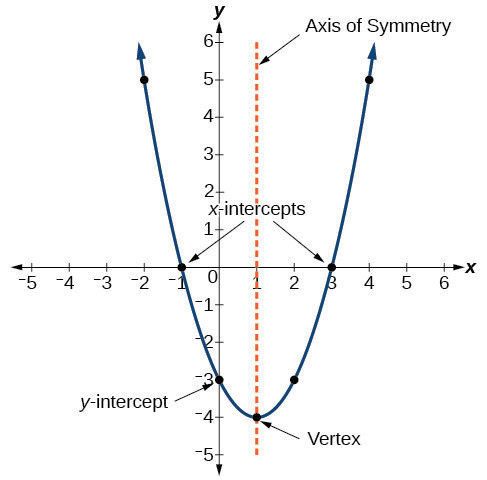
- vertex
- the point where the axis of symmetry and the parabola meet, also the point where the parabola is at its maximum or minimum
- axis of symmetry
- divides the parabola into 2 equal halves
- the 'x' value of the vertex
- the sum of the two roots divided by 2
- divides the parabola into 2 equal halves
- y- intercept
- where the parabola crosses the y-axis
- optimal value (maximum or minimum)
- 'y' value of the vertex
- direction of opening
- determines whether the parabola faces upward or downwards
- determined when 'a' value is either a negative or positive number
- determines whether the parabola faces upward or downwards
- x- intercepts
- points of the parabola that touch the x- axis
- also called zeroes or roots
- can be 1, 2 or no x-intercepts
- also called zeroes or roots
- points of the parabola that touch the x- axis
- vertex
- Parabola
- definition
Forms of Quadratic Equations
- Factored Form
- equation
- y= (x-r)(x-s)
- r &s re[resent x-intercepts
- a represents direction of opening & vertical stretch or compression factor
- example- y=2(x+5)(x-3)
- opening: up stretch: a factor of 2
- x-intercepts: x= -5 & x=1
- y= (x-r)(x-s)
- equation
- Standard Form
- equation
- y= ax²+bx+c
- formula for Axis of Symmetry
- x= -b/2a
- "c" value is the y-intercept
- formula for Axis of Symmetry
- y= ax²+bx+c
- equation
- Vertex Form
- equation
- y= a(x-h)²+k
- Vertex (h,k)
- h= x value of the vertex and axis of symmetry
- h value is always the oppoiste
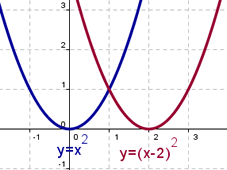
- "h" represents a horizontal shift
- k= y value of the vertex
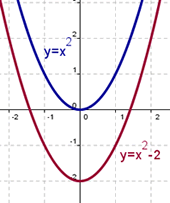
- "k" represents a vertical shift
- h= x value of the vertex and axis of symmetry
- example- y=2 (x+3)²-8
- opening: up stretch: factor of 2
- vertex: (-3,8)
- Vertex (h,k)
- y= a(x-h)²+k
- equation
- Transformations
- Vertex Form
- → If 'k' is positive a number, the graph shifts upwards → If 'k' is a negative number, the graph shifts downwards → If 'h' is a positive number, the graph shifts left → If 'h' is a negative number, the graph shifts right
- Standard Form
- → If a>0 it is a vertical stretch → If 0<a>1 it is a vertical compression
- Vertex Form
- Factored Form
Finite Differences
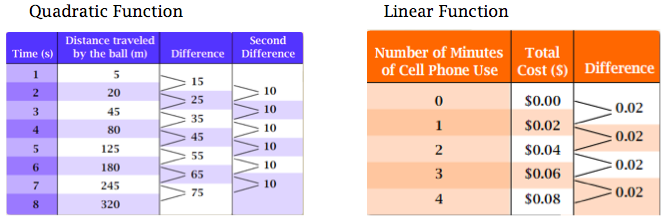
- table of values
- First Differences
- If First Differences are constant, there is a linear relation
- Second Differences
- If Second Differences are constant, there is a queadratic relation
- First Differences
- table of values
Expanding
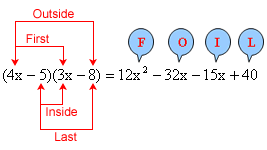
- FOIL method
- First Outside Inside Last
- (x+3)(x+2) =x²+2x+3x+6 =x²+5x+6
- Expanding Binomials
- (a+b)(c+d) =ac+ad+bc+bd ex.(x+4)(x-3) =x²-3x+4x-12 =x²+x-12
- Distributive Property
- a(b+c) =ab+ac ex.2(x+4) =2x+8
- Perfect Square Trinomials
- ( x+ a)²= (x+a)(x+a) (x-a)²= (x-a)(x-a) When the Binomial is square, to expand you must multiply the binomial by iself
- (x+5)² =(x+5) (x+5) =x² +10x+25
- ( x+ a)²= (x+a)(x+a) (x-a)²= (x-a)(x-a) When the Binomial is square, to expand you must multiply the binomial by iself
- Difference of Squares
- (x+a)(x-a) =x²-a²
- (x+5)(x-5)
- (x+a)(x-a) =x²-a²
- First Outside Inside Last
- FOIL method
Solving Quadratic Equations
- Method 1: Factoring
- Simple Factoring
- finding two numbers that add up to your 'b' value & multiply to give your 'c' value
- x²+5x+6 = (x+3)(x+2) 3+2=5 3x2= 6
- finding two numbers that add up to your 'b' value & multiply to give your 'c' value
- Common Factoring
- Factor out GCF
- 6m+15 → Find numbers that multiply into both 6 and 15 →1 and 3 →Find the greatest common factor; which is 3 →Write factored form so that when you expand you get the original expression =3(2m+5) →3x2m= 6m and 3x5= 15
- Factor out GCF
- Complex Factoring
- finding 2 numbers that add up to the 'b' value and multiple to (a)(c) →2x²+9x+4 (4x2=8) →Find two numbers that add up to 9, and when multiplied give 8 →1x8=8 1+8=9 →rewrite expression, but replace 9x with the two numbers →2x²+8x+1x+4 →factor by grouping
- Factor by Grouping
- 2x²+8x+1x+4 →put brackets around two terms and factor =(2x²+8x)(+1x+4) =2x(x+4)+1(x+4)
- Factor by Grouping
- finding 2 numbers that add up to the 'b' value and multiple to (a)(c) →2x²+9x+4 (4x2=8) →Find two numbers that add up to 9, and when multiplied give 8 →1x8=8 1+8=9 →rewrite expression, but replace 9x with the two numbers →2x²+8x+1x+4 →factor by grouping
- Simple Factoring
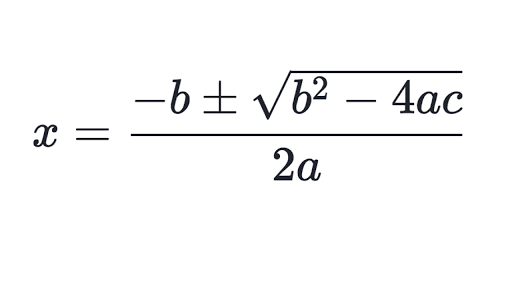
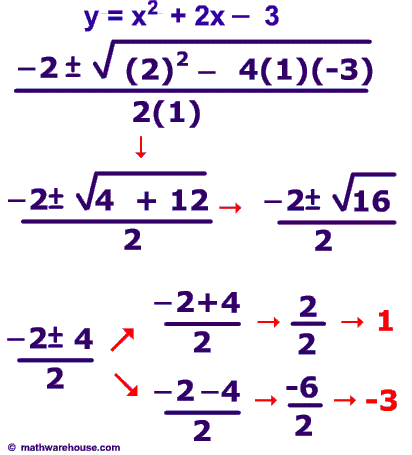
- Method 2: Quadratic Formula
- Use this method when the equation is not factorbale
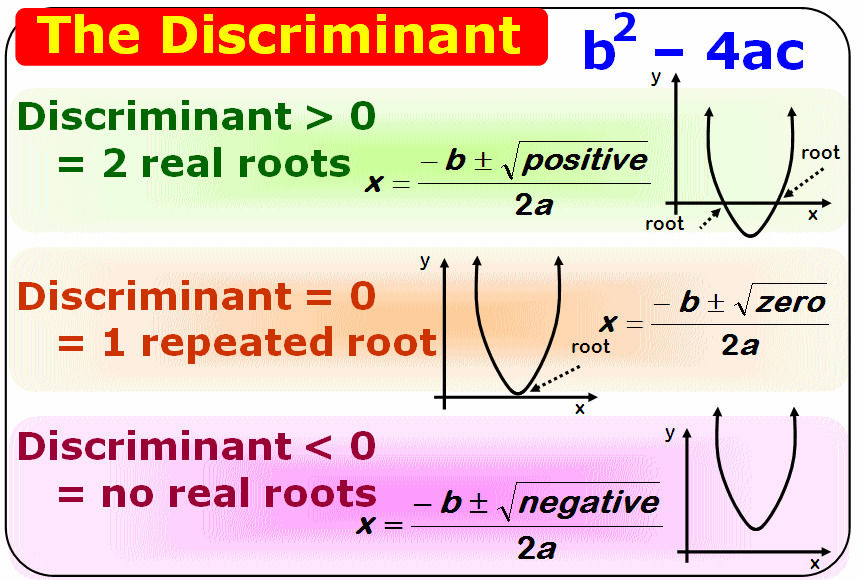
- discriminant
- x=b²-4ac
- →when d=0, there will be 1 solution →when d>0, there will be 2 solutions →when d<0, there are 0 solutions
- x=b²-4ac
- Method 3: Completing the Square
- used when converting from standard form to vertex form
- y=2x²+8x+6 y=(2x²+8x)+6 y=2(x²+4x)+6 y=2[x²+(4/2)²x]+6 y=2(x²+4x+4-4)6 y=2(x²+4x+4)-8+6 y=2(√ x²+4x+√ 4)-8+6 y=2(x+2)²-2
- used when converting from standard form to vertex form
- Method 1: Factoring