
Mapa mental
P1
Conteúdo do mapa
P1
Heating Houses
- Measuring
- Heat
- Measure of the total internal energy of an object
- On an absolute scale
- Measure of the total internal energy of an object
- Temperature
- A measure of hotness
- On an arbituary or chosen scale
- A measure of the of the average kinetic energy of the particles
- Substance heated
- Temp increases
- Particles vibrate faster
- Average kinetic energy increases
- A measure of hotness
- Heat
- Specific Heat Capacity
- Unit = J/kg0C
- Energy transferred = mass x specific heat capacity x temperature change
- The amount of energy needed to raise the temperature of one kilogram of a substance by one degree Celcius
- Specific Latent Heat
- The amount of energy needed to change the state of one kilogram of a substance without a change in temperature
- Unit = J/kg
- energy transferred = mass x specific latent heat
- Measuring
Keeping Homes Warm
- Conduction
- Metals are best conductors
- 1) Atoms lose their electrons and move about as free electrons
- 2) The atoms become charged ions
- 3) These ions are close together and are continually vibrating
- 4) When the solid metal is heated, the kinetic energy of the vibrations increase
- 5) Energy is transferred from hot areas ---> cooler areas by free electrons
- 6) The electrons move through the material, colliding with the ions
- Foam in a cavity reduces energy loss by conduction
- Convection
- 1) When a gas is heated it expands
- 2) The same mass of gas occupies a greater volume
- 3) As the volume increases, the density increases
- 4) This is why hot air rises
- As air in a cavity it warmed it rises through the cavity
- Colder air falls and a convection current is formed and this is hat transfers energy
- The air trapped in the foam stops convection from taking place
- If a loft is insulated, the air in the insulation cannot move around the loft by convection
- Radiation
- Infrared radiation is an electromagnetic wave
- Energy transferred by infrared radiation does not need a material
- Energy can be transferred through a vacuum as in space
- Blocks that are used when building new homes have shiny foil on both sides
- This means that energy transfer by radiation is reduced
- Energy transfer process
- 1) Energy from a coal fire warms up the room by radiation
- 2) The hot air rises up the chimney by convection
- 3) Energy is transferred through the surrounding bricks by conduction
- Energy efficiency = useful energy output / total energy input x 100
- Sankey diagrams show energy transformation
- Payback time (years) = cost of insulation / annual saving
- Conduction
A Spectrum of Waves
- Key Words
- Amplitude = maximum displacement of a particle from its rest position
- Wavelength = the distance between to successive points on the wave having the same displacement and moving in the same direction (m)
- Frequency = number of complete waves passing a point in 1 second (Hz)
- Crest = Maximum displacement above the rest position
- Trough = maximum displacement below the rest position
- Wave speed = frequency x wavelength
- Electromagnetic Spectrum
- Gamma Ray
- Highest frequency
- X-Ray
- Ultraviolet
- Visible Light
- Infrared
- Microwave
- Radio
- Largest Wavelength
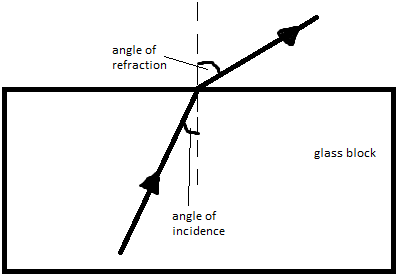
- Electromagnetic waves slow down in a denser medium
- Which causes the wave direction to change - refraction
- Gamma Ray
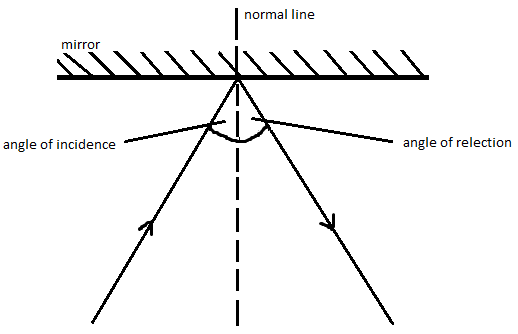
- Angle of incidence and angle of reflection
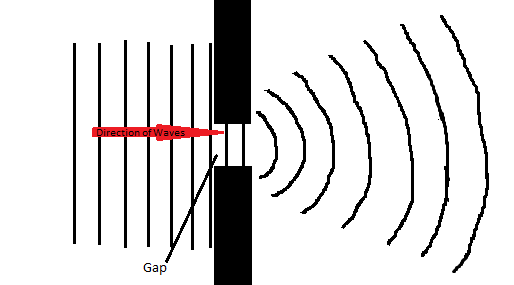
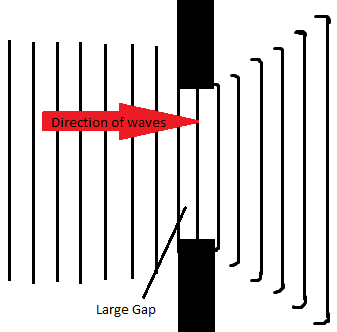
- Diffraction
- For diffraction to occur the wavelength has to be similar to the size of the gap
- When waves pass through an opening, they spread out
- If the gap is much larger than the wavelength of the waves, the diffraction effect is not so notieable
- Occcurs
- In astronomical telescopes
- The secondary mirror diffracts light around it, which reduces quality of the image but aims the light towards the human eye
- At the edge of a lens telescope or microscope
- Gives rise to spikes or rings around the object being viewed
- In astronomical telescopes
- Key Words
Lights and Lasers
- Sending Signals
- Can be sent by light, electricity, radio waves or microwaves
- They are instantaneous
- Light signals can be easily sent with nothing more sophisticated than a torch
- But the signal needs to be coded
- The signal is not secure, anyone can see it
- Electrical Signals need equipment and wires linking the sender and receiver
- Wires can be cut and damaged
- Signal also needs to be amplified at regular intervals because of energy loss in the form of heat due to the electrical current
- Radio Waves and microwaves can travel long distances and through the atmosphere
- Laser Light
- Light Amplification by Stimulated Emission of Radiation
- The light from a laser is at one frequency and in phase
- The beam is a monochromatic (single colour from one frequency) coherent (in phase) beam
- The beam does not diverge very much
- Can be sent by light, electricity, radio waves or microwaves
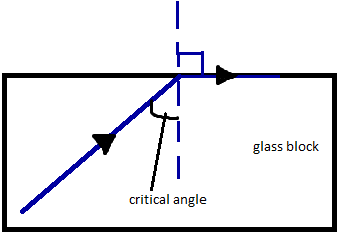
- Critical Angle
- When light passes from a more dense object (glass) into a less dense material (air), the angle of refraction is greater than the angle of incidence
- When the angle of incidence is increased, it is possible for the angle of refraction to be a right angle. When this happens the angle of incidence is called the critical angle
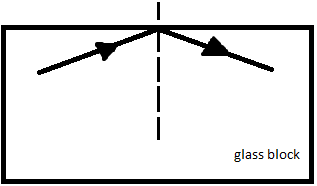
- If the angle of incidence is increased even more, the light is reflected back inside the more dense material, this is total internal reflection
- Endoscopy
- Uses optical fibers and allows doctors to see inside the body without surgery
- Light passes along the outer fibers and lights up the inside of the patient. The light is then reflected back along the inner fibers and the image is viewed through an eyepiece
- Uses optical fibers and allows doctors to see inside the body without surgery
- Optical fibers are used to transit data at 200 000 km/s which is the speed of light in glass. Telephone conversations and computer data can be transmitted very long distances with little energy loss, and some optical fibers have a coating round them to improve reflection
- Sending Signals
Cooking and Communicating Using Waves
- Cooking
- Infrared radiation does not penetrate very far into food and it only heats the surface of the food
- Microwaves penetrate about 1cm into the outer layers of food
- They can pass through glass and plastic but, like infrared radiation, cannot pass throught shiny metal surfaces
- That is why a microwave oven door is made from special glass that reflects microwave radiation
- They can pass through glass and plastic but, like infrared radiation, cannot pass throught shiny metal surfaces
- Electromagnetic Spectrum
- Energy is transferred by waves and the amount of energy depends on the wavelength or frequency of the wave. The shorter the wavelength (or higher the frequency), the more energy that is associated with the radiation
- Microwaves have a longer wavelength than infrared radiation and have less energy associated with them
- Normal ovens cook by infrared radiation where the energy is absorbed by particles on the surface of the food, which increases the kinetic energy of the particles
- The water or fat molecules in the outer layers vibrate more which increases the kinetic energy
- The rest of the food is heated when the energy is transferred to the center of the food by conduction or convection, depending on the food
- Cooking
Data Transmission
Wireless Signals
Imagens e arquivos do mapa
Informações
- Descrição
- GCSE Physics Mapa Mental sobre P1, criado por karla_b101 em 21-12-2014.
- Criado por
- karla_b101 · dez 2014
- Atualizado
- 19 fev 2016
- Visualizações
- 0
- Avaliação