
Mapa mental
Classifying objects
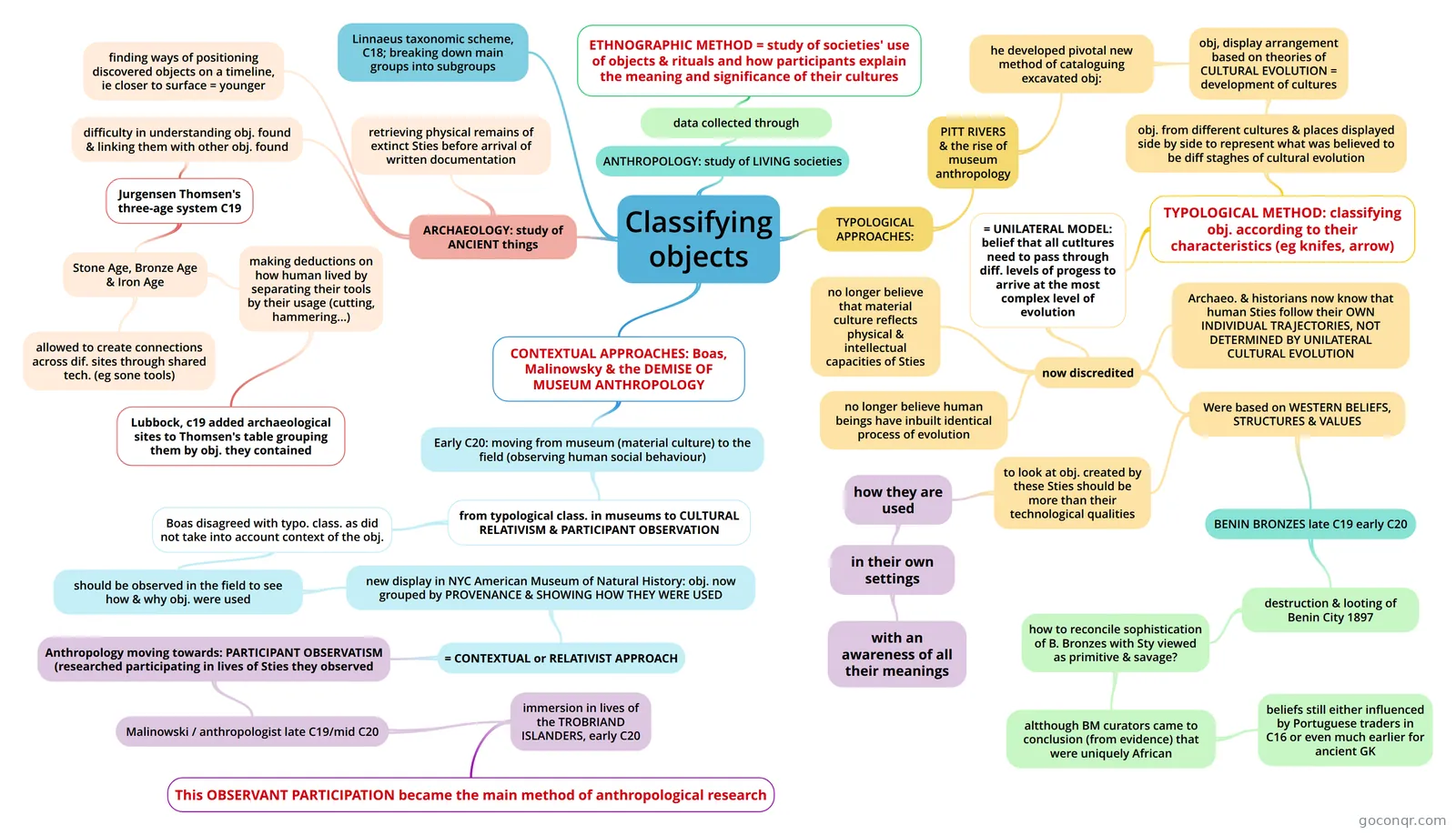
Mind map: classifying objects
Conteúdo do mapa
Classifying objects
ANTHROPOLOGY: study of LIVING societies
- data collected through
- ETHNOGRAPHIC METHOD = study of societies' use of objects & rituals and how participants explain the meaning and significance of their cultures
- data collected through
Linnaeus taxonomic scheme, C18; breaking down main groups into subgroups
ARCHAEOLOGY: study of ANCIENT things
- retrieving physical remains of extinct Sties before arrival of written documentation
- finding ways of positioning discovered objects on a timeline, ie closer to surface = younger
- difficulty in understanding obj. found & linking them with other obj. found
- Jurgensen Thomsen's three-age system C19
- Stone Age, Bronze Age & Iron Age
- allowed to create connections across dif. sites through shared tech. (eg sone tools)
- making deductions on how human lived by separating their tools by their usage (cutting, hammering...)
- Lubbock, c19 added archaeological sites to Thomsen's table grouping them by obj. they contained
- Stone Age, Bronze Age & Iron Age
- Jurgensen Thomsen's three-age system C19
TYPOLOGICAL APPROACHES:
- PITT RIVERS & the rise of museum anthropology
- he developed pivotal new method of cataloguing excavated obj:
- obj, display arrangement based on theories of CULTURAL EVOLUTION = development of cultures
- obj. from different cultures & places displayed side by side to represent what was believed to be diff staghes of cultural evolution
- TYPOLOGICAL METHOD: classifying obj. according to their characteristics (eg knifes, arrow)
- = UNILATERAL MODEL: belief that all cutltures need to pass through diff. levels of progess to arrive at the most complex level of evolution
- now discredited
- no longer believe that material culture reflects physical & intellectual capacities of Sties
- no longer believe human beings have inbuilt identical process of evolution
- Archaeo. & historians now know that human Sties follow their OWN INDIVIDUAL TRAJECTORIES, NOT DETERMINED BY UNILATERAL CULTURAL EVOLUTION
- Were based on WESTERN BELIEFS, STRUCTURES & VALUES
- to look at obj. created by these Sties should be more than their technological qualities
- how they are used
- in their own settings
- with an awareness of all their meanings
- in their own settings
- how they are used
- BENIN BRONZES late C19 early C20
- destruction & looting of Benin City 1897
- how to reconcile sophistication of B. Bronzes with Sty viewed as primitive & savage?
- altthough BM curators came to conclusion (from evidence) that were uniquely African
- beliefs still either influenced by Portuguese traders in C16 or even much earlier for ancient GK
- altthough BM curators came to conclusion (from evidence) that were uniquely African
- how to reconcile sophistication of B. Bronzes with Sty viewed as primitive & savage?
- destruction & looting of Benin City 1897
- to look at obj. created by these Sties should be more than their technological qualities
- now discredited
- = UNILATERAL MODEL: belief that all cutltures need to pass through diff. levels of progess to arrive at the most complex level of evolution
- TYPOLOGICAL METHOD: classifying obj. according to their characteristics (eg knifes, arrow)
- obj. from different cultures & places displayed side by side to represent what was believed to be diff staghes of cultural evolution
- obj, display arrangement based on theories of CULTURAL EVOLUTION = development of cultures
- he developed pivotal new method of cataloguing excavated obj:
- PITT RIVERS & the rise of museum anthropology
CONTEXTUAL APPROACHES: Boas, Malinowsky & the DEMISE OF MUSEUM ANTHROPOLOGY
- Early C20: moving from museum (material culture) to the field (observing human social behaviour)
- from typological class. in museums to CULTURAL RELATIVISM & PARTICIPANT OBSERVATION
- Boas disagreed with typo. class. as did not take into account context of the obj.
- should be observed in the field to see how & why obj. were used
- new display in NYC American Museum of Natural History: obj. now grouped by PROVENANCE & SHOWING HOW THEY WERE USED
- = CONTEXTUAL or RELATIVIST APPROACH
- Anthropology moving towards: PARTICIPANT OBSERVATISM (researched participating in lives of Sties they observed
- Malinowski / anthropologist late C19/mid C20
- immersion in lives of the TROBRIAND ISLANDERS, early C20
- This OBSERVANT PARTICIPATION became the main method of anthropological research
- immersion in lives of the TROBRIAND ISLANDERS, early C20
- Malinowski / anthropologist late C19/mid C20
- Anthropology moving towards: PARTICIPANT OBSERVATISM (researched participating in lives of Sties they observed
- = CONTEXTUAL or RELATIVIST APPROACH
- new display in NYC American Museum of Natural History: obj. now grouped by PROVENANCE & SHOWING HOW THEY WERE USED
- should be observed in the field to see how & why obj. were used
- Boas disagreed with typo. class. as did not take into account context of the obj.
- from typological class. in museums to CULTURAL RELATIVISM & PARTICIPANT OBSERVATION
- Early C20: moving from museum (material culture) to the field (observing human social behaviour)
Informações
- Descrição
- Material culture: life of objects, classifying & describing objects Mapa Mental sobre Classifying objects, criado por Chantal Walker em 30-05-2019.
- Criado por
- Chantal Walker
- Visualizações
- 4
- Avaliação