
Material Culture and Semiotics
95 resources created by 50 users
This Material Culture and Semiotics page on GoConqr gathers community-made mind maps, flashcards and notes on how objects carry meaning, from Saussure on signs to economic and cultural theory. It's built for university students working through the readings and teachers after ready-made material. There are over 90 resources here, including more than 80 mind maps, nearly all at university level. Pick a chapter map, read it alongside your own notes, then build your own maps and flashcards.
Top Material Culture and Semiotics resources
-
Mind map Wilhite: What Objects Mean: Chapter Three: Semiotic Approach to Material Culture Pretty snazzy map of Chapter Three: What Objects Mean I discovered color in this one!
-
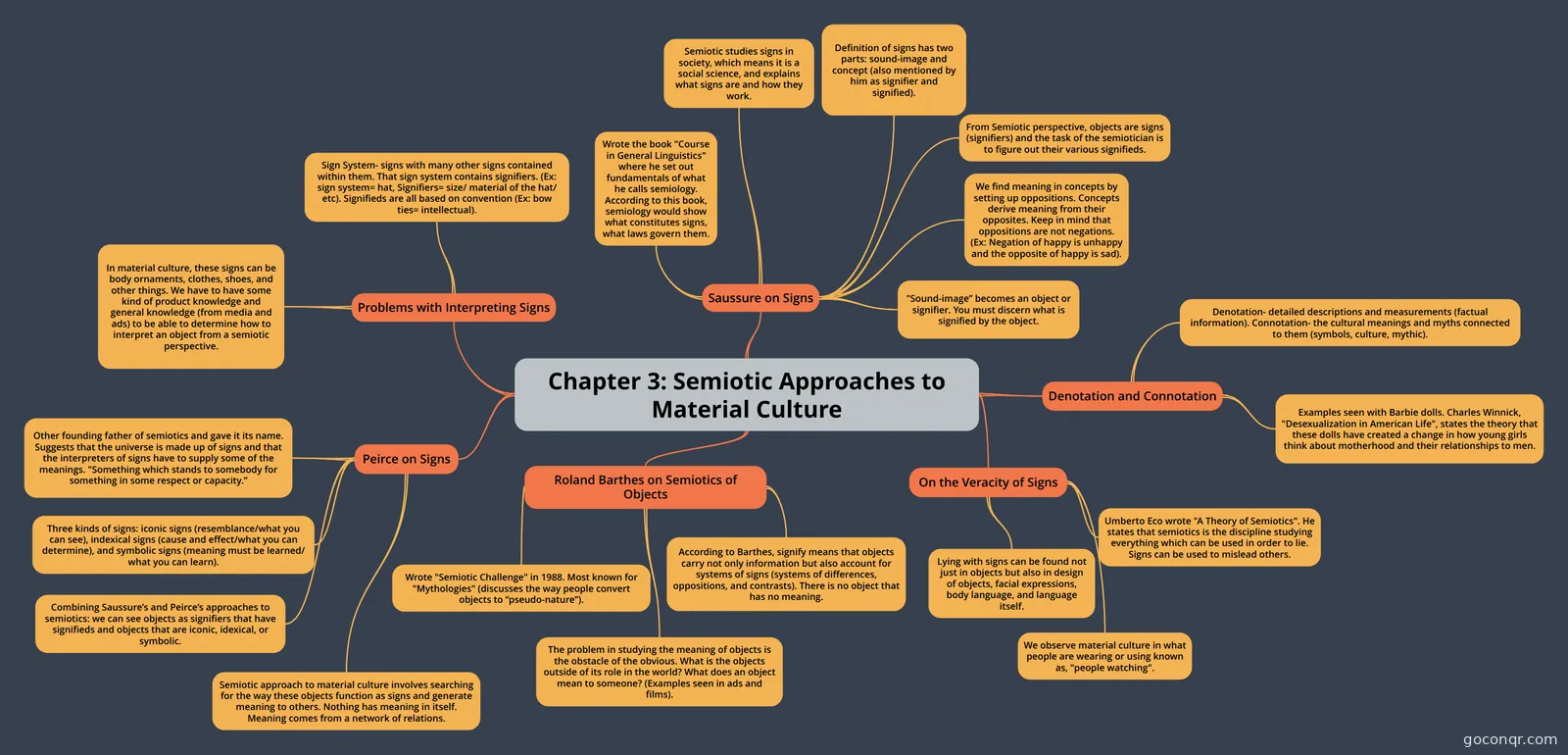 Mind map Chapter 3: Semiotic Approaches to Material Culture By Silvana Rodarte
-
 Mind map Chapter 1: Making Sense of Material Culture By Silvana Rodarte
-
Mind map cultural theory and material culture-chapter 6
-
Mind map Chapter 5: Economic Theory, Marxism, and Material Culture Chapter 5
-
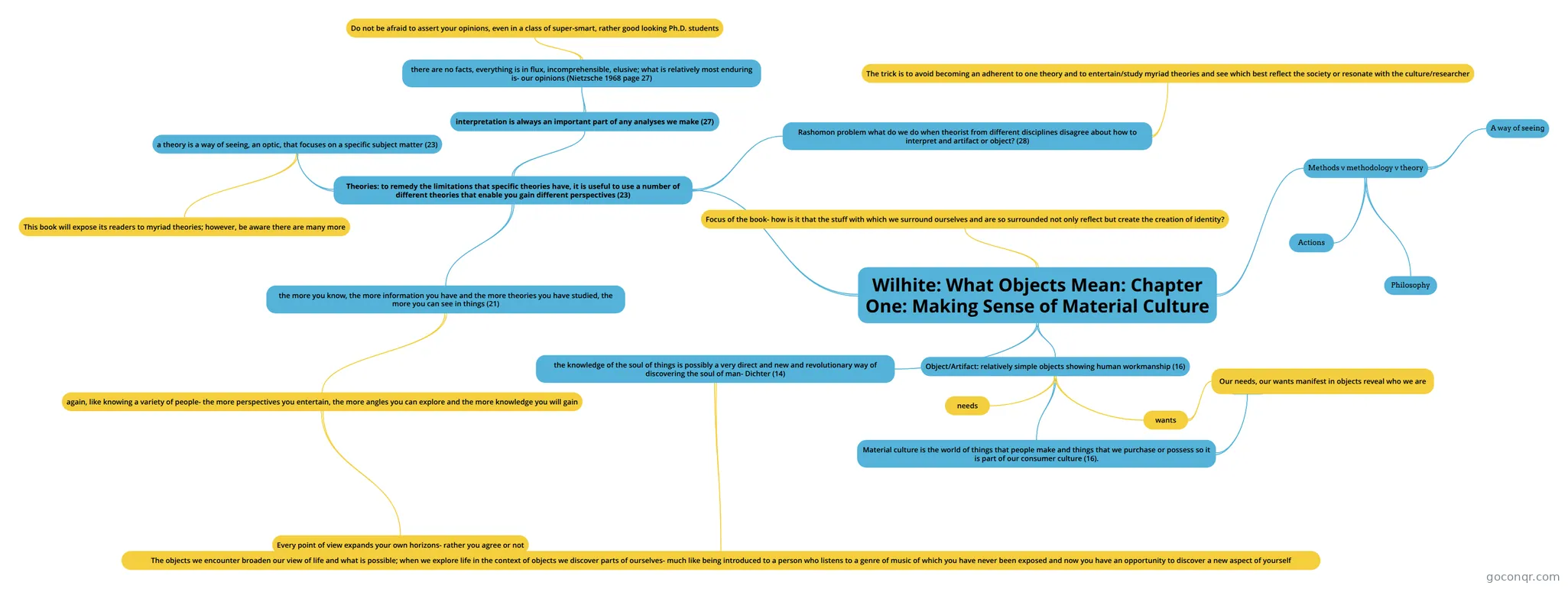 Mind map Wilhite: What Objects Mean: Chapter One: Making Sense of Material Culture What Objects Mean: Chapter One Main points and quotes (blue) My erudite commentary (yellow)
-
 Mind map Cultural Theory and Material Culture
-
Mind map What Objects Mean: Part I: Theoretical Approaches to Material Culture Overview of chapter 1, 2, 3
Mind maps
See all 91 mind maps-
Wilhite: What Objects Mean: Chapter Three: Semiotic Approach to Material Culture Pretty snazzy map of Chapter Three: What Objects Mean I discovered color in this one!
-
Chapter 3: Semiotic Approaches to Material Culture By Silvana Rodarte
-
Chapter 1: Making Sense of Material Culture By Silvana Rodarte
-
cultural theory and material culture-chapter 6
-
Chapter 5: Economic Theory, Marxism, and Material Culture Chapter 5
-
Wilhite: What Objects Mean: Chapter One: Making Sense of Material Culture What Objects Mean: Chapter One Main points and quotes (blue) My erudite commentary (yellow)
-
Cultural Theory and Material Culture
-
What Objects Mean: Part I: Theoretical Approaches to Material Culture Overview of chapter 1, 2, 3
Topics in Material Culture and Semiotics
More Anthropology topics
About Material Culture and Semiotics
GoConqr OriginalWhat this unit covers
This unit sits in the Culture, Language and Meaning strand of Anthropology. Most of what it lists is mind maps built around chapters of one book on material culture, What Objects Mean. Several maps cover the same chapter, so you can compare how different students have organised it.
Start with the basics
Begin with the maps on Chapter 1, Making Sense of Material Culture. They define material culture as things people make, buy or possess, which show what we are like and how we live. One excerpt describes it as the behaviour patterns acquired and passed on through symbols, along with material items. Another separates an object from an artifact, which is a relatively simple object showing human workmanship.
- Making Sense of Material Culture
- Chapter 1: Making Sense of Material Culture Edited
- Wilhite: What Objects Mean: Chapter One: Making Sense of Material Culture
Move on to semiotics
The largest group of maps covers Chapter 3, Semiotic Approaches to Material Culture. The first one in the list starts with Saussure on signs and his book Course in General Linguistics, where he set out what he called semiology. Another describes semiotics as the science of signs, treating artifacts as signs whose meaning must be worked out. A further map notes that signs combine a sound image and a concept, and that meaning comes from oppositions and relationships.
- Open Chapter 3: Semiotic Approaches to Material Culture first.
- Read a second version of the same chapter and note what differs.
- Write the key terms on your own flashcards.
Widen out to theory
Once the signs are clear, try the maps on economic theory and Marxism in Chapter 5 and on cultural theory in Chapter 6. The Ceramics map shows theory applied: technologies can be analysed as cultural choices, and material culture helps shape social relations and values. Three flashcard decks, including one on art and aesthetics, add vocabulary practice.
Using maps and notes together
Read a map to see the structure, then close it and try to rebuild it from memory. There are no quizzes on this page, so flashcards and your own notes are the way to check yourself. Choose a chapter and start making your own study set.
Frequently asked questions
Where should I start on this page?
Start with the Chapter 1 maps on making sense of material culture, such as Making Sense of Material Culture. They define objects, artifacts and material culture. Then move to the Chapter 3 maps on semiotic approaches, which build on those definitions with signs and meaning.
What do the semiotics mind maps cover?
They cover the science of signs applied to artifacts. The excerpts mention Saussure, his book Course in General Linguistics, signs made of a sound image and a concept, and how meaning comes from oppositions. Several students have mapped the same chapter, so you can compare versions.
Are there quizzes here?
No, this page has no quizzes. It offers mind maps, a few flashcard decks and a note made from a mind map. To test yourself, use the flashcards, or make your own questions from a map once you have read it.
Are the resources free to use?
Yes. Every resource listed here is free to open and study, with no account needed. They were made by GoConqr users, not by GoConqr, so it helps to read a few versions of a chapter side by side.
Which levels is this page for?
Almost all of it is university level, so it suits university students reading about material culture. A very small share is secondary. Teachers can use the maps as ready-made material to share or adapt for a class.
What if the topic I need is missing?
The page leans on chapters about making sense of material culture, semiotics, economic theory and cultural theory. If your topic is not here, a free account lets you make your own mind maps, flashcards and notes, and keep them with the rest.