
Mapa mental
CRANIAL NERVES
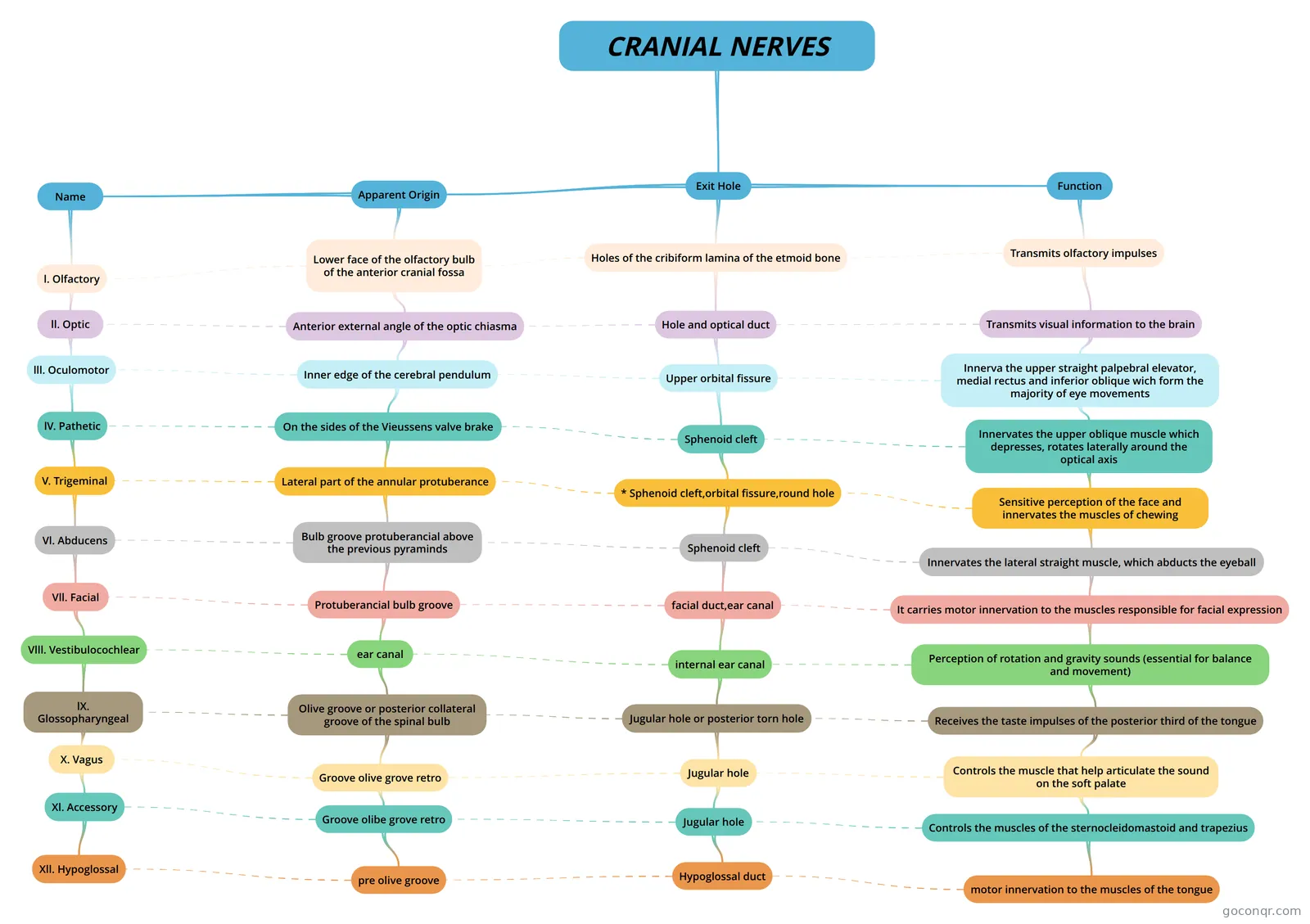
Mind map: Cranial nerves
Conteúdo do mapa
CRANIAL NERVES
Exit Hole
- Apparent Origin
- Name
- l. Olfactory
- ll. Optic
- lll. Oculomotor
- lV. Pathetic
- V. Trigeminal
- Vl. Abducens
- Vll. Facial
- Vlll. Vestibulocochlear
- lX. Glossopharyngeal
- X. Vagus
- Xl. Accessory
- Xll. Hypoglossal
- Xl. Accessory
- X. Vagus
- lX. Glossopharyngeal
- Vlll. Vestibulocochlear
- Vll. Facial
- Vl. Abducens
- V. Trigeminal
- lV. Pathetic
- lll. Oculomotor
- ll. Optic
- l. Olfactory
- Lower face of the olfactory bulb of the anterior cranial fossa
- Anterior external angle of the optic chiasma
- Inner edge of the cerebral pendulum
- On the sides of the Vieussens valve brake
- Lateral part of the annular protuberance
- Bulb groove protuberancial above the previous pyraminds
- Protuberancial bulb groove
- ear canal
- Olive groove or posterior collateral groove of the spinal bulb
- Groove olive grove retro
- Groove olibe grove retro
- pre olive groove
- Groove olibe grove retro
- Groove olive grove retro
- Olive groove or posterior collateral groove of the spinal bulb
- ear canal
- Protuberancial bulb groove
- Bulb groove protuberancial above the previous pyraminds
- Lateral part of the annular protuberance
- On the sides of the Vieussens valve brake
- Inner edge of the cerebral pendulum
- Anterior external angle of the optic chiasma
- Name
- Function
- Transmits olfactory impulses
- Transmits visual information to the brain
- Innerva the upper straight palpebral elevator, medial rectus and inferior oblique wich form the majority of eye movements
- Innervates the upper oblique muscle which depresses, rotates laterally around the optical axis
- Sensitive perception of the face and innervates the muscles of chewing
- Innervates the lateral straight muscle, which abducts the eyeball
- It carries motor innervation to the muscles responsible for facial expression
- Perception of rotation and gravity sounds (essential for balance and movement)
- Receives the taste impulses of the posterior third of the tongue
- Controls the muscle that help articulate the sound on the soft palate
- Controls the muscles of the sternocleidomastoid and trapezius
- motor innervation to the muscles of the tongue
- Controls the muscles of the sternocleidomastoid and trapezius
- Controls the muscle that help articulate the sound on the soft palate
- Receives the taste impulses of the posterior third of the tongue
- Perception of rotation and gravity sounds (essential for balance and movement)
- It carries motor innervation to the muscles responsible for facial expression
- Innervates the lateral straight muscle, which abducts the eyeball
- Sensitive perception of the face and innervates the muscles of chewing
- Innervates the upper oblique muscle which depresses, rotates laterally around the optical axis
- Innerva the upper straight palpebral elevator, medial rectus and inferior oblique wich form the majority of eye movements
- Transmits visual information to the brain
- Transmits olfactory impulses
- Holes of the cribiform lamina of the etmoid bone
- Hole and optical duct
- Upper orbital fissure
- Sphenoid cleft
- * Sphenoid cleft,orbital fissure,round hole
- Sphenoid cleft
- facial duct,ear canal
- internal ear canal
- Jugular hole or posterior torn hole
- Jugular hole
- Jugular hole
- Hypoglossal duct
- Jugular hole
- Jugular hole
- Jugular hole or posterior torn hole
- internal ear canal
- facial duct,ear canal
- Sphenoid cleft
- * Sphenoid cleft,orbital fissure,round hole
- Sphenoid cleft
- Upper orbital fissure
- Hole and optical duct
- Apparent Origin
Informações
- Descrição
- Mapa Mental sobre CRANIAL NERVES, criado por Maria Camila Bastidas Jimenez em 28-07-2019.
- Criado por
- Maria Camila Bastidas Jimenez
- Visualizações
- 1
- Avaliação