
Mapa mental
Algebraic Techniques
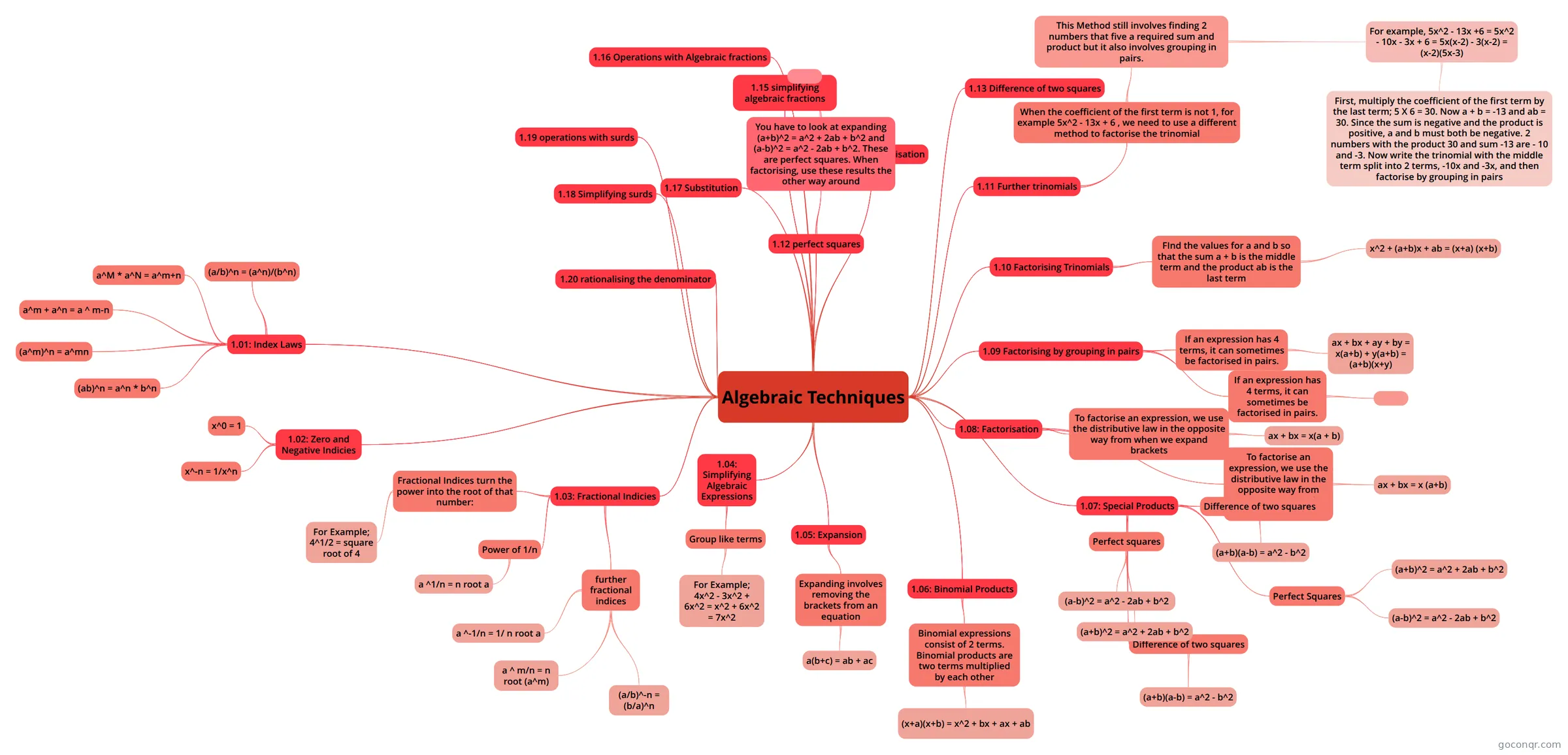
Mind map: algebraic techniques
Conteúdo do mapa
Algebraic Techniques
1.01: Index Laws
- a^M * a^N = a^m+n
- a^m + a^n = a ^ m-n
- (a^m)^n = a^mn
- (ab)^n = a^n * b^n
- (a/b)^n = (a^n)/(b^n)
1.02: Zero and Negative Indicies
- x^0 = 1
- x^-n = 1/x^n
1.03: Fractional Indicies
- Fractional Indices turn the power into the root of that number:
- For Example; 4^1/2 = square root of 4
- Power of 1/n
- a ^1/n = n root a
- further fractional indices
- a ^-1/n = 1/ n root a
- a ^ m/n = n root (a^m)
- (a/b)^-n = (b/a)^n
- Fractional Indices turn the power into the root of that number:
1.04: Simplifying Algebraic Expressions
- Group like terms
- For Example; 4x^2 - 3x^2 + 6x^2 = x^2 + 6x^2 = 7x^2
- Group like terms
1.05: Expansion
- Expanding involves removing the brackets from an equation
- a(b+c) = ab + ac
- Expanding involves removing the brackets from an equation
1.06: Binomial Products
- Binomial expressions consist of 2 terms. Binomial products are two terms multiplied by each other
- (x+a)(x+b) = x^2 + bx + ax + ab
- Binomial expressions consist of 2 terms. Binomial products are two terms multiplied by each other
1.07: Special Products
- Difference of two squares
- (a+b)(a-b) = a^2 - b^2
- Perfect Squares
- (a+b)^2 = a^2 + 2ab + b^2
- (a-b)^2 = a^2 - 2ab + b^2
- Difference of two squares
- (a+b)(a-b) = a^2 - b^2
- Perfect squares
- (a+b)^2 = a^2 + 2ab + b^2
- (a-b)^2 = a^2 - 2ab + b^2
- Difference of two squares
1.08: Factorisation
- To factorise an expression, we use the distributive law in the opposite way from when we expand brackets
- ax + bx = x (a+b)
- To factorise an expression, we use the distributive law in the opposite way from when we expand brackets
- ax + bx = x(a + b)
- To factorise an expression, we use the distributive law in the opposite way from when we expand brackets
1.09 Factorising by grouping in pairs
- If an expression has 4 terms, it can sometimes be factorised in pairs.
- If an expression has 4 terms, it can sometimes be factorised in pairs.
- ax + bx + ay + by = x(a+b) + y(a+b) = (a+b)(x+y)
- If an expression has 4 terms, it can sometimes be factorised in pairs.
1.10 Factorising Trinomials
- FInd the values for a and b so that the sum a + b is the middle term and the product ab is the last term
- x^2 + (a+b)x + ab = (x+a) (x+b)
- FInd the values for a and b so that the sum a + b is the middle term and the product ab is the last term
1.11 Further trinomials
- When the coefficient of the first term is not 1, for example 5x^2 - 13x + 6 , we need to use a different method to factorise the trinomial
- This Method still involves finding 2 numbers that five a required sum and product but it also involves grouping in pairs.
- For example, 5x^2 - 13x +6 = 5x^2 - 10x - 3x + 6 = 5x(x-2) - 3(x-2) = (x-2)(5x-3)
- First, multiply the coefficient of the first term by the last term; 5 X 6 = 30. Now a + b = -13 and ab = 30. Since the sum is negative and the product is positive, a and b must both be negative. 2 numbers with the product 30 and sum -13 are - 10 and -3. Now write the trinomial with the middle term split into 2 terms, -10x and -3x, and then factorise by grouping in pairs
- For example, 5x^2 - 13x +6 = 5x^2 - 10x - 3x + 6 = 5x(x-2) - 3(x-2) = (x-2)(5x-3)
- This Method still involves finding 2 numbers that five a required sum and product but it also involves grouping in pairs.
- When the coefficient of the first term is not 1, for example 5x^2 - 13x + 6 , we need to use a different method to factorise the trinomial
1.12 perfect squares
- You have to look at expanding (a+b)^2 = a^2 + 2ab + b^2 and (a-b)^2 = a^2 - 2ab + b^2. These are perfect squares. When factorising, use these results the other way around
- You have to look at expanding (a+b)^2 = a^2 + 2ab + b^2 and (a-b)^2 = a^2 - 2ab + b^2. These are perfect squares. When factorising, use these results the other way around
1.13 Difference of two squares
1.14 Mixed factorisation
1.15 simplifying algebraic fractions
1.16 Operations with Algebraic fractions
1.17 Substitution
1.18 Simplifying surds
1.19 operations with surds
1.20 rationalising the denominator
Informações
- Descrição
- Year 11 Advanced Maths: Algebraic Techniques
- Criado por
- Charlotte Saul
- Visualizações
- 26
- Tags
- Avaliação