
Mapa mental
4th Grade First Trimester 1920
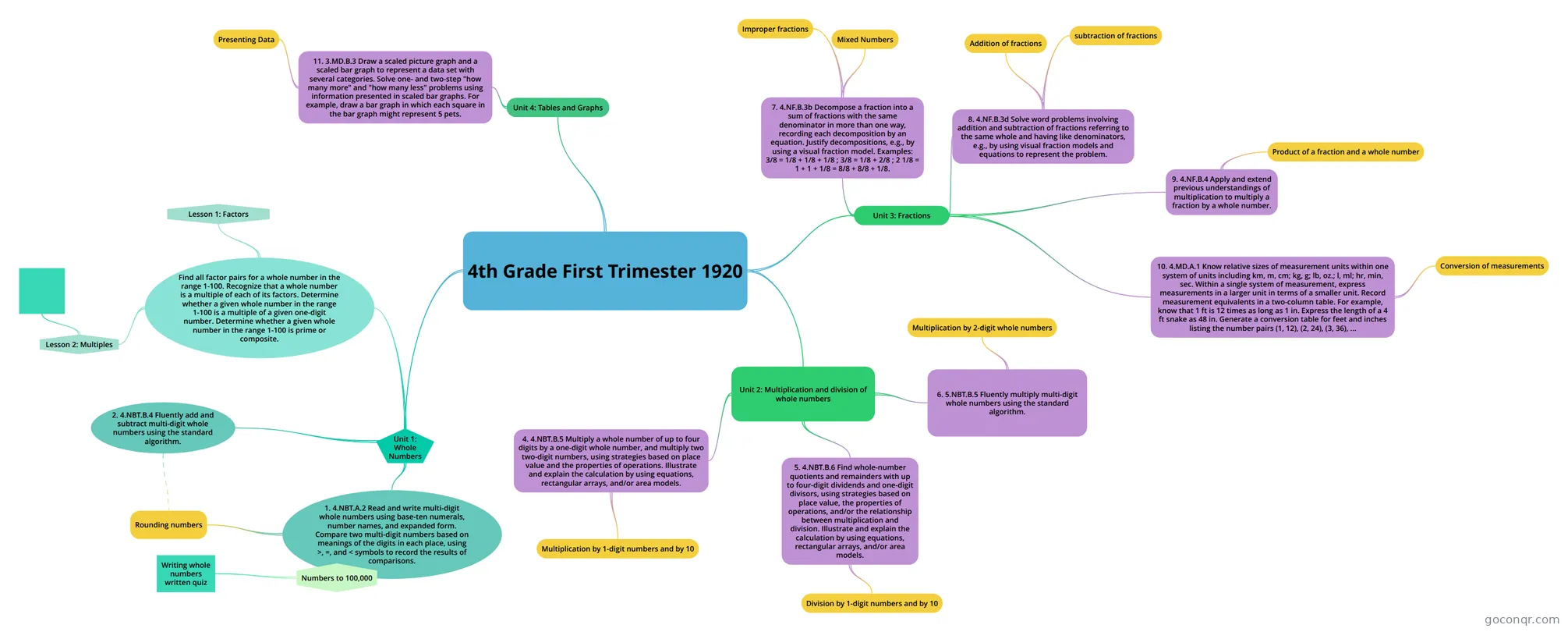
Mind map: 4th grade math first trimester
Conteúdo do mapa
4th Grade First Trimester 1920
Unit 1: Whole Numbers
- 1. 4.NBT.A.2 Read and write multi-digit whole numbers using base-ten numerals, number names, and expanded form. Compare two multi-digit numbers based on meanings of the digits in each place, using >, =, and < symbols to record the results of comparisons.
- Numbers to 100,000
- Writing whole numbers written quiz
- Rounding numbers
- Numbers to 100,000
- 2. 4.NBT.B.4 Fluently add and subtract multi-digit whole numbers using the standard algorithm.
- Find all factor pairs for a whole number in the range 1-100. Recognize that a whole number is a multiple of each of its factors. Determine whether a given whole number in the range 1-100 is a multiple of a given one-digit number. Determine whether a given whole number in the range 1-100 is prime or composite.
- Lesson 1: Factors
- Lesson 2: Multiples
- 1. 4.NBT.A.2 Read and write multi-digit whole numbers using base-ten numerals, number names, and expanded form. Compare two multi-digit numbers based on meanings of the digits in each place, using >, =, and < symbols to record the results of comparisons.
Unit 2: Multiplication and division of whole numbers
- 4. 4.NBT.B.5 Multiply a whole number of up to four digits by a one-digit whole number, and multiply two two-digit numbers, using strategies based on place value and the properties of operations. Illustrate and explain the calculation by using equations, rectangular arrays, and/or area models.
- Multiplication by 1-digit numbers and by 10
- 5. 4.NBT.B.6 Find whole-number quotients and remainders with up to four-digit dividends and one-digit divisors, using strategies based on place value, the properties of operations, and/or the relationship between multiplication and division. Illustrate and explain the calculation by using equations, rectangular arrays, and/or area models.
- Division by 1-digit numbers and by 10
- 6. 5.NBT.B.5 Fluently multiply multi-digit whole numbers using the standard algorithm.
- Multiplication by 2-digit whole numbers
- 4. 4.NBT.B.5 Multiply a whole number of up to four digits by a one-digit whole number, and multiply two two-digit numbers, using strategies based on place value and the properties of operations. Illustrate and explain the calculation by using equations, rectangular arrays, and/or area models.
Unit 3: Fractions
- 7. 4.NF.B.3b Decompose a fraction into a sum of fractions with the same denominator in more than one way, recording each decomposition by an equation. Justify decompositions, e.g., by using a visual fraction model. Examples: 3/8 = 1/8 + 1/8 + 1/8 ; 3/8 = 1/8 + 2/8 ; 2 1/8 = 1 + 1 + 1/8 = 8/8 + 8/8 + 1/8.
- Mixed Numbers
- Improper fractions
- 8. 4.NF.B.3d Solve word problems involving addition and subtraction of fractions referring to the same whole and having like denominators, e.g., by using visual fraction models and equations to represent the problem.
- Addition of fractions
- subtraction of fractions
- 9. 4.NF.B.4 Apply and extend previous understandings of multiplication to multiply a fraction by a whole number.
- Product of a fraction and a whole number
- 10. 4.MD.A.1 Know relative sizes of measurement units within one system of units including km, m, cm; kg, g; lb, oz.; l, ml; hr, min, sec. Within a single system of measurement, express measurements in a larger unit in terms of a smaller unit. Record measurement equivalents in a two-column table. For example, know that 1 ft is 12 times as long as 1 in. Express the length of a 4 ft snake as 48 in. Generate a conversion table for feet and inches listing the number pairs (1, 12), (2, 24), (3, 36), ...
- Conversion of measurements
- 7. 4.NF.B.3b Decompose a fraction into a sum of fractions with the same denominator in more than one way, recording each decomposition by an equation. Justify decompositions, e.g., by using a visual fraction model. Examples: 3/8 = 1/8 + 1/8 + 1/8 ; 3/8 = 1/8 + 2/8 ; 2 1/8 = 1 + 1 + 1/8 = 8/8 + 8/8 + 1/8.
Unit 4: Tables and Graphs
- 11. 3.MD.B.3 Draw a scaled picture graph and a scaled bar graph to represent a data set with several categories. Solve one- and two-step "how many more" and "how many less" problems using information presented in scaled bar graphs. For example, draw a bar graph in which each square in the bar graph might represent 5 pets.
- Presenting Data
- 11. 3.MD.B.3 Draw a scaled picture graph and a scaled bar graph to represent a data set with several categories. Solve one- and two-step "how many more" and "how many less" problems using information presented in scaled bar graphs. For example, draw a bar graph in which each square in the bar graph might represent 5 pets.
Informações
- Descrição
- Math Mind map for the first trimester at Rochester 1920
- Criado por
- Francy Julieth Sepulveda Vargas
- Visualizações
- 73
- Tags
- Avaliação