
Mapa mental
Memory: Chapter 1
Conteúdo do mapa
Memory: Chapter 1
History of Memory
- Willis
- Described the anatomy of the brain
- Galvani
- Electricity and nerve conduction
- Ramon y Cajal
- Discrete nerve cells in brain
- Golgi Stain to identify elements of neurons
- Four things he noted: 1) No continuation of nerve cells 2) Functionally polarized 3) Summation of signals
- Axonal Arborization and dendrites
- higher order vertebrates had higher neuron connectivity = basis of intellect = plasticity and learning
- Sherrington
- Neurons must be indpendent: 1) lesions showed restricted defecits 2) time lag in reflexes
- Synapses
- Sensory Stimulation generates muscle movement
- Sherrington & Cajal Agreement
- Golgi organ stretch receptors to monitor muscle length and tension
- Dermatones - sensory input from skin
- Mutiple inputs to motor neurons from spinal cord
- Summation for excitatory and inhibitory inputs
- Reciprocal Innervation (excitatory and inhibitory coordinate muscle movement
- Pavlov, Cajal and Sherrington
- Independent neurons
- Communicate via synapses
- to form a circuit or simple reflex
- to form a complex or learned reflex
- which can be modified during learning
- to form a complex or learned reflex
- to form a circuit or simple reflex
- Communicate via synapses
- Independent neurons
- Neurons must be indpendent: 1) lesions showed restricted defecits 2) time lag in reflexes
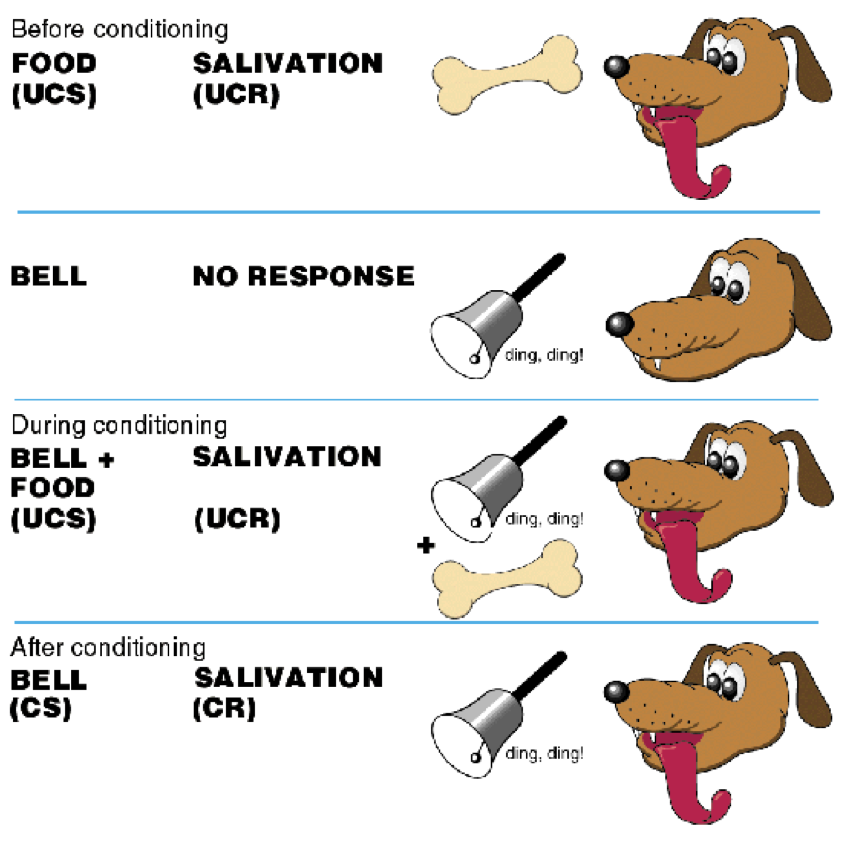
- Pavlov
- Gastric Secretion Reflex
- Digestion reflex arc: gustatory circuits in mouth - brain stem - vagus nerve - gastric secretions
- AKA "Psychic Secretions" from only the sight of food
- Becomes unreliable as there is excition without reinforcement
- Conditioned Reflex UCR/UCS
- Need close temporal continuity and CS must be consistent in predicting US for maintaning CR
- Gastric Secretion Reflex
- Gall & Phrenology
- Individual differences in behaviour in extremem cases and measured skulls to assume correlation between shame and brain anatomy
- Broca
- Inability to speak, but can hear and understand speech
- 3rd convolution, left frontal lobe
- Inability to speak, but can hear and understand speech
- Wernicke
- normal speech production and inability to understand speech
- left temporal lobe
- normal speech production and inability to understand speech
- Fritsch and Hitzig
- Motor cortex and electrical stimulation to specific muscle movement
- Ferrier
- Initial evidence of distinct sensory and motor
- specific lesions had specific effects i.e. temporal deaf and left frontal paralysis
- Initial evidence of distinct sensory and motor
- Willis
4 Cs
Random Points
- Complex Reflex: Decerebrate animals
- Walking, flying, jumping
- Inhibition via higher controls
- Walking, flying, jumping
- Complex Reflex: Decerebrate animals
Behaviourism
- Watson
- Trained rats to learn mazes
- Removed sensory ability
- Only need Kinesthetic movements
- Conclusion: Learning mediated by reflex chains and conscious thought is irrelevant
- Only need Kinesthetic movements
- Removed sensory ability
- Trained rats to learn mazes
- Ebbinghaus
- Created a control learned material of nonsense syllables all the same length and attempted to quantify memory
- Used math and stats to depict the forgetting curve a savings list was the amount remembered correctly from the first trial that would not have to be restudied. i.e. amount of memory saved
- Created a control learned material of nonsense syllables all the same length and attempted to quantify memory
- Small
- Mazes for lab animals and identified how rats learned
- rats preferred shortcuts over reinforced turns
- Learning may actually include cognition, insight and motive
- Cognitivism
- Learned behaviours are more complex than just reflexes
- William James
- Reflexes are the building blocks of memory - habits
- However, memories are different from reflexes
- Primary Memory
- STM/WM Consciousness
- Secondary Memory
- LTM content of information and experience
- Elaborate associations among habits and remembered items/experiences
- What makes good memory?
- Strength and number of pathways present diversify associations combine information and experience and don't just repeat/habit
- What makes good memory?
- Primary Memory
- However, memories are different from reflexes
- Reflexes are the building blocks of memory - habits
- Cognitivism
- Learning may actually include cognition, insight and motive
- rats preferred shortcuts over reinforced turns
- Mazes for lab animals and identified how rats learned
- Thorndike
- Puzzle box and law of effect
- Reinforcing behaviours are more likely to be repeated
- Puzzle box and law of effect
- Watson
Imagens e arquivos do mapa
Informações
- Descrição
- Mapa Mental sobre Memory: Chapter 1, criado por leela1 em 19-01-2015.
- Criado por
- leela1
- Visualizações
- 0
- Avaliação