
Mapa mental
NATURAL SELECTION 6
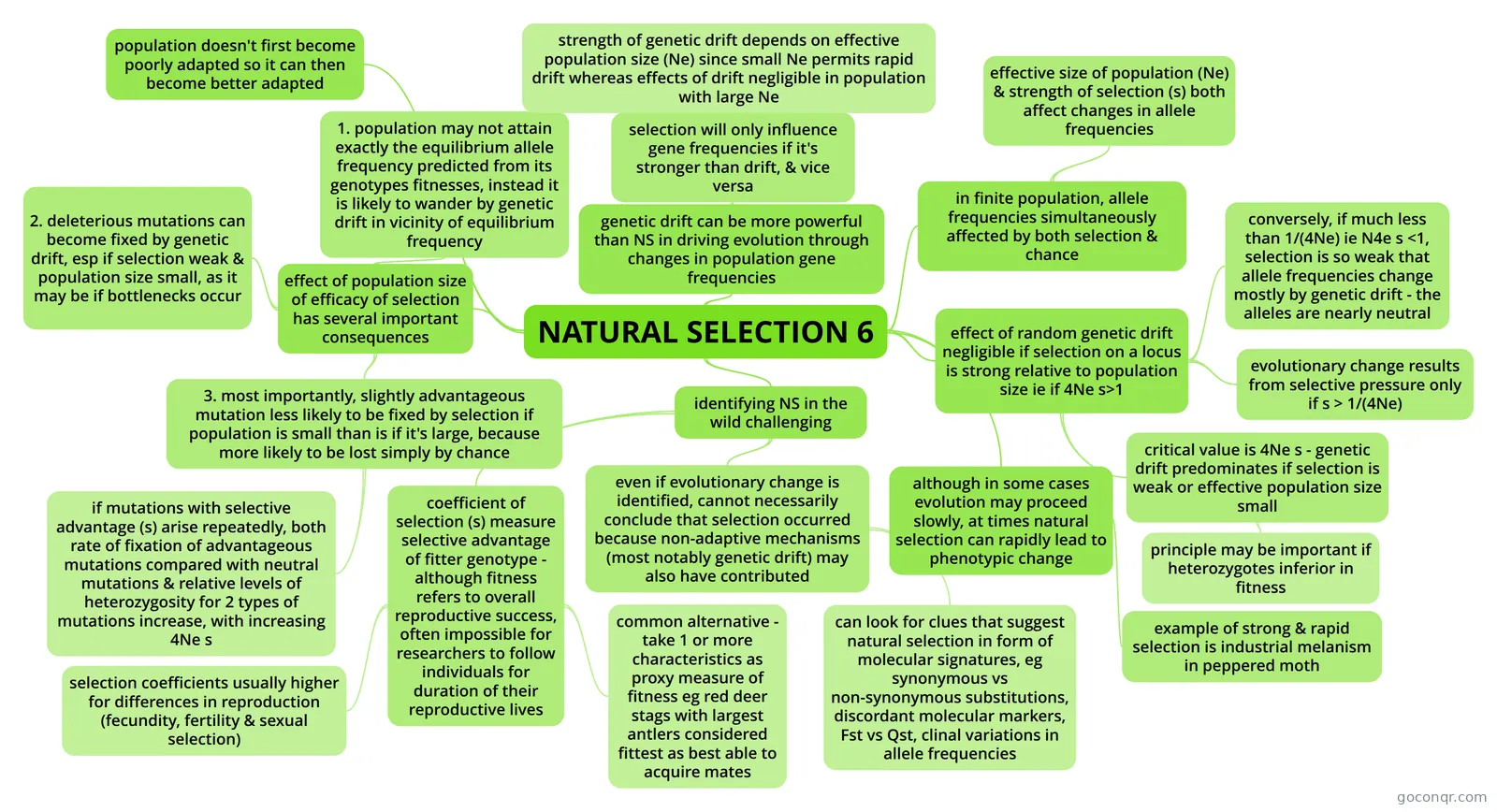
Mind map: natural selection and genetic drift
Conteúdo do mapa
NATURAL SELECTION 6
in finite population, allele frequencies simultaneously affected by both selection & chance
- effective size of population (Ne) & strength of selection (s) both affect changes in allele frequencies
effect of random genetic drift negligible if selection on a locus is strong relative to population size ie if 4Ne s>1
- conversely, if much less than 1/(4Ne) ie N4e s <1, selection is so weak that allele frequencies change mostly by genetic drift - the alleles are nearly neutral
- critical value is 4Ne s - genetic drift predominates if selection is weak or effective population size small
- principle may be important if heterozygotes inferior in fitness
- evolutionary change results from selective pressure only if s > 1/(4Ne)
population doesn't first become poorly adapted so it can then become better adapted
effect of population size of efficacy of selection has several important consequences
- 1. population may not attain exactly the equilibrium allele frequency predicted from its genotypes fitnesses, instead it is likely to wander by genetic drift in vicinity of equilibrium frequency
- 2. deleterious mutations can become fixed by genetic drift, esp if selection weak & population size small, as it may be if bottlenecks occur
- 3. most importantly, slightly advantageous mutation less likely to be fixed by selection if population is small than is if it's large, because more likely to be lost simply by chance
- if mutations with selective advantage (s) arise repeatedly, both rate of fixation of advantageous mutations compared with neutral mutations & relative levels of heterozygosity for 2 types of mutations increase, with increasing 4Ne s
genetic drift can be more powerful than NS in driving evolution through changes in population gene frequencies
- selection will only influence gene frequencies if it's stronger than drift, & vice versa
- strength of genetic drift depends on effective population size (Ne) since small Ne permits rapid drift whereas effects of drift negligible in population with large Ne
- selection will only influence gene frequencies if it's stronger than drift, & vice versa
identifying NS in the wild challenging
- even if evolutionary change is identified, cannot necessarily conclude that selection occurred because non-adaptive mechanisms (most notably genetic drift) may also have contributed
- can look for clues that suggest natural selection in form of molecular signatures, eg synonymous vs non-synonymous substitutions, discordant molecular markers, Fst vs Qst, clinal variations in allele frequencies
- coefficient of selection (s) measure selective advantage of fitter genotype - although fitness refers to overall reproductive success, often impossible for researchers to follow individuals for duration of their reproductive lives
- common alternative - take 1 or more characteristics as proxy measure of fitness eg red deer stags with largest antlers considered fittest as best able to acquire mates
- selection coefficients usually higher for differences in reproduction (fecundity, fertility & sexual selection)
- even if evolutionary change is identified, cannot necessarily conclude that selection occurred because non-adaptive mechanisms (most notably genetic drift) may also have contributed
although in some cases evolution may proceed slowly, at times natural selection can rapidly lead to phenotypic change
- example of strong & rapid selection is industrial melanism in peppered moth
Informações
- Descrição
- Mapa Mental sobre NATURAL SELECTION 6, criado por tomking304 em 09-09-2013.
- Criado por
- tomking304
- Visualizações
- 44
- Avaliação