
Mapa mental
NEGOTIATIONS AND LICENSING
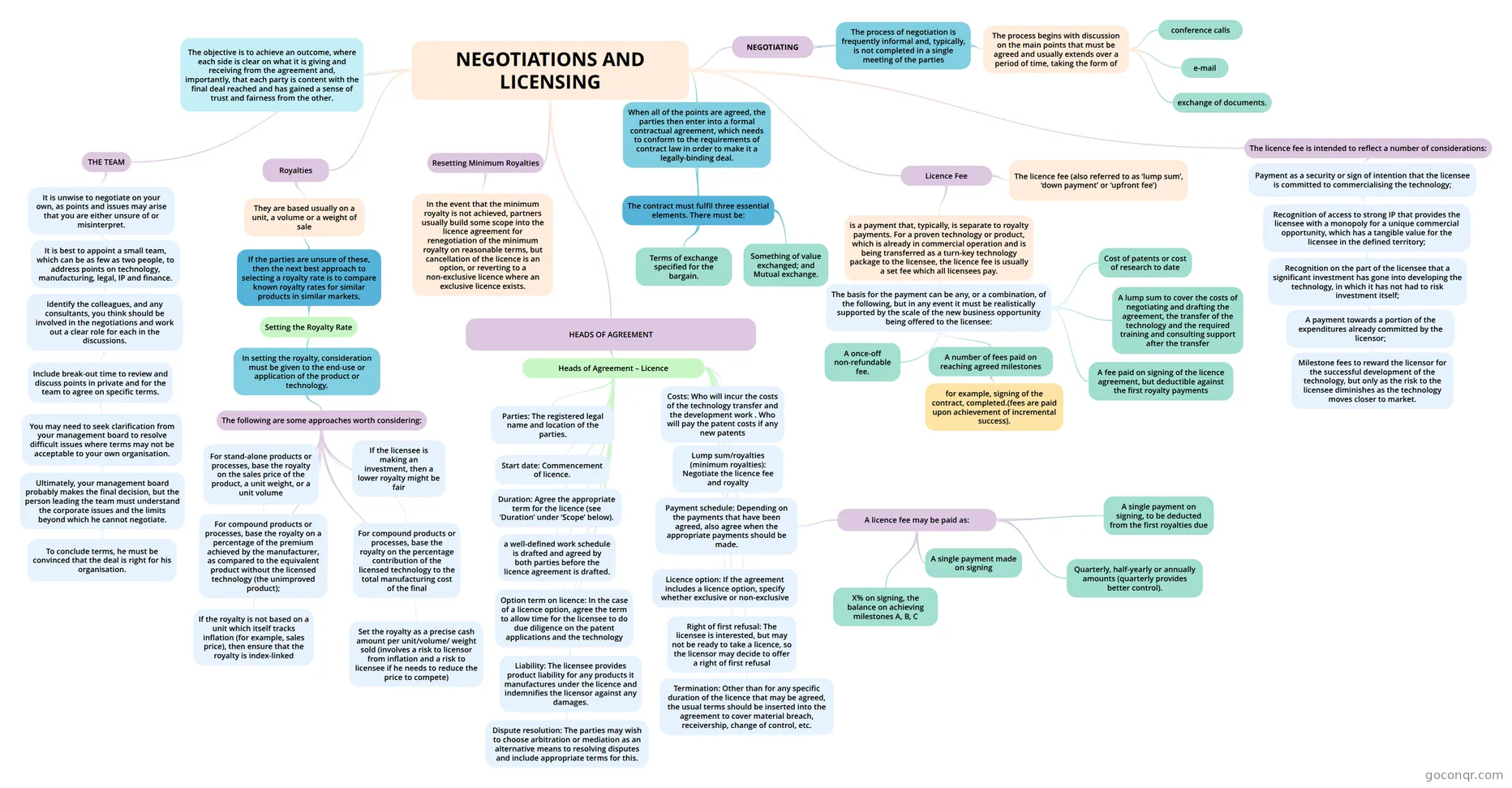
Mind map: Negotiations and licensing
Conteúdo do mapa
NEGOTIATIONS AND LICENSING
The objective is to achieve an outcome, where each side is clear on what it is giving and receiving from the agreement and, importantly, that each party is content with the final deal reached and has gained a sense of trust and fairness from the other.
THE TEAM
- It is unwise to negotiate on your own, as points and issues may arise that you are either unsure of or misinterpret.
- It is best to appoint a small team, which can be as few as two people, to address points on technology, manufacturing, legal, IP and finance.
- Identify the colleagues, and any consultants, you think should be involved in the negotiations and work out a clear role for each in the discussions.
- Include break-out time to review and discuss points in private and for the team to agree on specific terms.
- You may need to seek clarification from your management board to resolve difficult issues where terms may not be acceptable to your own organisation.
- Ultimately, your management board probably makes the final decision, but the person leading the team must understand the corporate issues and the limits beyond which he cannot negotiate.
- To conclude terms, he must be convinced that the deal is right for his organisation.
- Ultimately, your management board probably makes the final decision, but the person leading the team must understand the corporate issues and the limits beyond which he cannot negotiate.
- You may need to seek clarification from your management board to resolve difficult issues where terms may not be acceptable to your own organisation.
- Include break-out time to review and discuss points in private and for the team to agree on specific terms.
- Identify the colleagues, and any consultants, you think should be involved in the negotiations and work out a clear role for each in the discussions.
- It is best to appoint a small team, which can be as few as two people, to address points on technology, manufacturing, legal, IP and finance.
- It is unwise to negotiate on your own, as points and issues may arise that you are either unsure of or misinterpret.
NEGOTIATING
- The process of negotiation is frequently informal and, typically, is not completed in a single meeting of the parties
- The process begins with discussion on the main points that must be agreed and usually extends over a period of time, taking the form of
- conference calls
- exchange of documents.
- The process begins with discussion on the main points that must be agreed and usually extends over a period of time, taking the form of
- The process of negotiation is frequently informal and, typically, is not completed in a single meeting of the parties
When all of the points are agreed, the parties then enter into a formal contractual agreement, which needs to conform to the requirements of contract law in order to make it a legally-binding deal.
- The contract must fulfil three essential elements. There must be:
- Terms of exchange specified for the bargain.
- Something of value exchanged; and Mutual exchange.
- The contract must fulfil three essential elements. There must be:
Licence Fee
- The licence fee (also referred to as ‘lump sum’, ‘down payment’ or ‘upfront fee’)
- is a payment that, typically, is separate to royalty payments. For a proven technology or product, which is already in commercial operation and is being transferred as a turn-key technology package to the licensee, the licence fee is usually a set fee which all licensees pay.
- The basis for the payment can be any, or a combination, of the following, but in any event it must be realistically supported by the scale of the new business opportunity being offered to the licensee:
- A once-off non-refundable fee.
- A number of fees paid on reaching agreed milestones
- for example, signing of the contract, completed.(fees are paid upon achievement of incremental success).
- A fee paid on signing of the licence agreement, but deductible against the first royalty payments
- Cost of patents or cost of research to date
- A lump sum to cover the costs of negotiating and drafting the agreement, the transfer of the technology and the required training and consulting support after the transfer
- The basis for the payment can be any, or a combination, of the following, but in any event it must be realistically supported by the scale of the new business opportunity being offered to the licensee:
The licence fee is intended to reflect a number of considerations:
- Payment as a security or sign of intention that the licensee is committed to commercialising the technology;
- Recognition of access to strong IP that provides the licensee with a monopoly for a unique commercial opportunity, which has a tangible value for the licensee in the defined territory;
- Recognition on the part of the licensee that a significant investment has gone into developing the technology, in which it has not had to risk investment itself;
- A payment towards a portion of the expenditures already committed by the licensor;
- Milestone fees to reward the licensor for the successful development of the technology, but only as the risk to the licensee diminishes as the technology moves closer to market.
- A payment towards a portion of the expenditures already committed by the licensor;
- Recognition on the part of the licensee that a significant investment has gone into developing the technology, in which it has not had to risk investment itself;
- Recognition of access to strong IP that provides the licensee with a monopoly for a unique commercial opportunity, which has a tangible value for the licensee in the defined territory;
- Payment as a security or sign of intention that the licensee is committed to commercialising the technology;
Royalties
- They are based usually on a unit, a volume or a weight of sale
- If the parties are unsure of these, then the next best approach to selecting a royalty rate is to compare known royalty rates for similar products in similar markets.
- Setting the Royalty Rate
- In setting the royalty, consideration must be given to the end-use or application of the product or technology.
- The following are some approaches worth considering:
- For stand-alone products or processes, base the royalty on the sales price of the product, a unit weight, or a unit volume
- For compound products or processes, base the royalty on the percentage contribution of the licensed technology to the total manufacturing cost of the final
- For compound products or processes, base the royalty on a percentage of the premium achieved by the manufacturer, as compared to the equivalent product without the licensed technology (the unimproved product);
- Set the royalty as a precise cash amount per unit/volume/ weight sold (involves a risk to licensor from inflation and a risk to licensee if he needs to reduce the price to compete)
- If the royalty is not based on a unit which itself tracks inflation (for example, sales price), then ensure that the royalty is index-linked
- If the licensee is making an investment, then a lower royalty might be fair
- The following are some approaches worth considering:
- In setting the royalty, consideration must be given to the end-use or application of the product or technology.
- Setting the Royalty Rate
- If the parties are unsure of these, then the next best approach to selecting a royalty rate is to compare known royalty rates for similar products in similar markets.
- They are based usually on a unit, a volume or a weight of sale
Resetting Minimum Royalties
- In the event that the minimum royalty is not achieved, partners usually build some scope into the licence agreement for renegotiation of the minimum royalty on reasonable terms, but cancellation of the licence is an option, or reverting to a non-exclusive licence where an exclusive licence exists.
HEADS OF AGREEMENT
- Heads of Agreement – Licence
- Parties: The registered legal name and location of the parties.
- Start date: Commencement of licence.
- Duration: Agree the appropriate term for the licence (see ‘Duration’ under ‘Scope’ below).
- a well-defined work schedule is drafted and agreed by both parties before the licence agreement is drafted.
- Costs: Who will incur the costs of the technology transfer and the development work . Who will pay the patent costs if any new patents
- Lump sum/royalties (minimum royalties): Negotiate the licence fee and royalty
- Payment schedule: Depending on the payments that have been agreed, also agree when the appropriate payments should be made.
- A licence fee may be paid as:
- A single payment made on signing
- A single payment on signing, to be deducted from the first royalties due
- X% on signing, the balance on achieving milestones A, B, C
- Quarterly, half-yearly or annually amounts (quarterly provides better control).
- A licence fee may be paid as:
- Licence option: If the agreement includes a licence option, specify whether exclusive or non-exclusive
- Option term on licence: In the case of a licence option, agree the term to allow time for the licensee to do due diligence on the patent applications and the technology
- Right of first refusal: The licensee is interested, but may not be ready to take a licence, so the licensor may decide to offer a right of first refusal
- Liability: The licensee provides product liability for any products it manufactures under the licence and indemnifies the licensor against any damages.
- Termination: Other than for any specific duration of the licence that may be agreed, the usual terms should be inserted into the agreement to cover material breach, receivership, change of control, etc.
- Dispute resolution: The parties may wish to choose arbitration or mediation as an alternative means to resolving disputes and include appropriate terms for this.
- Heads of Agreement – Licence
Informações
- Descrição
- Ingeniería Mapa Mental sobre NEGOTIATIONS AND LICENSING, criado por Studios BlackWhite SAS em 11-11-2019.
- Criado por
- Studios BlackWhite SAS
- Visualizações
- 0
- Avaliação
Mais sobre Licensing Negotiations