
Mapa mental
Intro to Archaeology
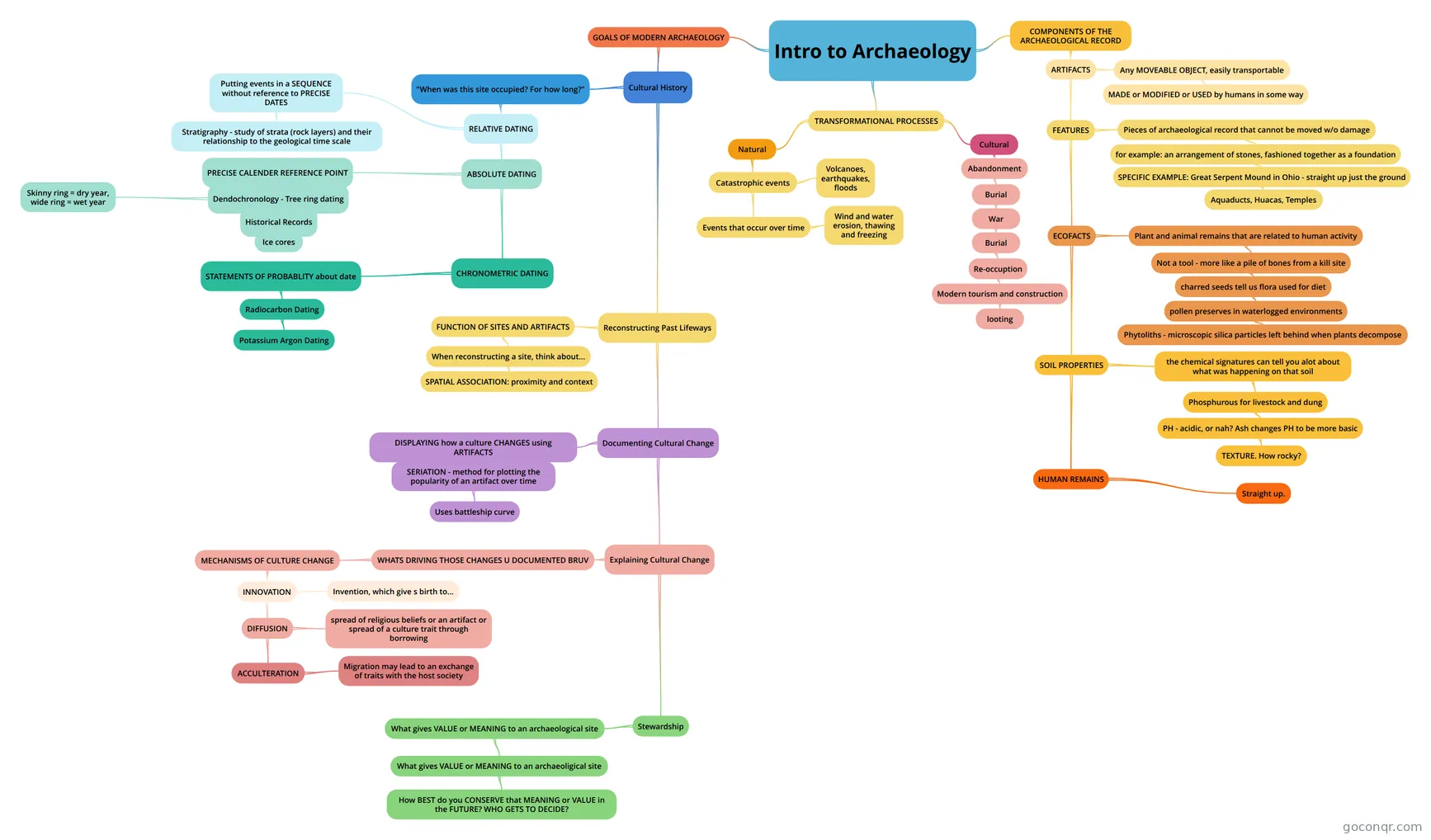
Mind map: Intro to archaeology
Conteúdo do mapa
Intro to Archaeology
GOALS OF MODERN ARCHAEOLOGY
- Cultural History
- Reconstructing Past Lifeways
- Documenting Cultural Change
- Explaining Cultural Change
- Stewardship
- What gives VALUE or MEANING to an archaeological site
- What gives VALUE or MEANING to an archaeoligical site
- How BEST do you CONSERVE that MEANING or VALUE in the FUTURE? WHO GETS TO DECIDE?
- What gives VALUE or MEANING to an archaeoligical site
- What gives VALUE or MEANING to an archaeological site
- WHATS DRIVING THOSE CHANGES U DOCUMENTED BRUV
- MECHANISMS OF CULTURE CHANGE
- INNOVATION
- DIFFUSION
- ACCULTERATION
- Migration may lead to an exchange of traits with the host society
- spread of religious beliefs or an artifact or spread of a culture trait through borrowing
- ACCULTERATION
- Invention, which give s birth to...
- DIFFUSION
- INNOVATION
- MECHANISMS OF CULTURE CHANGE
- Stewardship
- DISPLAYING how a culture CHANGES using ARTIFACTS
- SERIATION - method for plotting the popularity of an artifact over time
- Uses battleship curve
- SERIATION - method for plotting the popularity of an artifact over time
- Explaining Cultural Change
- FUNCTION OF SITES AND ARTIFACTS
- When reconstructing a site, think about...
- SPATIAL ASSOCIATION: proximity and context
- When reconstructing a site, think about...
- Documenting Cultural Change
- "When was this site occupied? For how long?"
- RELATIVE DATING
- ABSOLUTE DATING
- CHRONOMETRIC DATING
- STATEMENTS OF PROBABLITY about date
- Radiocarbon Dating
- Potassium Argon Dating
- Radiocarbon Dating
- STATEMENTS OF PROBABLITY about date
- PRECISE CALENDER REFERENCE POINT
- Dendochronology - Tree ring dating
- Historical Records
- Ice cores
- Skinny ring = dry year, wide ring = wet year
- Historical Records
- Dendochronology - Tree ring dating
- CHRONOMETRIC DATING
- Putting events in a SEQUENCE without reference to PRECISE DATES
- Stratigraphy - study of strata (rock layers) and their relationship to the geological time scale
- ABSOLUTE DATING
- RELATIVE DATING
- Reconstructing Past Lifeways
- Cultural History
COMPONENTS OF THE ARCHAEOLOGICAL RECORD
- ARTIFACTS
- FEATURES
- ECOFACTS
- SOIL PROPERTIES
- HUMAN REMAINS
- Straight up.
- the chemical signatures can tell you alot about what was happening on that soil
- Phosphurous for livestock and dung
- PH - acidic, or nah? Ash changes PH to be more basic
- TEXTURE. How rocky?
- PH - acidic, or nah? Ash changes PH to be more basic
- Phosphurous for livestock and dung
- HUMAN REMAINS
- Plant and animal remains that are related to human activity
- Not a tool - more like a pile of bones from a kill site
- charred seeds tell us flora used for diet
- pollen preserves in waterlogged environments
- Phytoliths - microscopic silica particles left behind when plants decompose
- pollen preserves in waterlogged environments
- charred seeds tell us flora used for diet
- Not a tool - more like a pile of bones from a kill site
- SOIL PROPERTIES
- Pieces of archaeological record that cannot be moved w/o damage
- for example: an arrangement of stones, fashioned together as a foundation
- SPECIFIC EXAMPLE: Great Serpent Mound in Ohio - straight up just the ground
- Aquaducts, Huacas, Temples
- SPECIFIC EXAMPLE: Great Serpent Mound in Ohio - straight up just the ground
- for example: an arrangement of stones, fashioned together as a foundation
- ECOFACTS
- Any MOVEABLE OBJECT, easily transportable
- MADE or MODIFIED or USED by humans in some way
- FEATURES
- ARTIFACTS
TRANSFORMATIONAL PROCESSES
- Natural
- Catastrophic events
- Volcanoes, earthquakes, floods
- Events that occur over time
- Wind and water erosion, thawing and freezing
- Catastrophic events
- Cultural
- Abandonment
- Burial
- War
- Burial
- Re-occuption
- Modern tourism and construction
- looting
- Modern tourism and construction
- Re-occuption
- Burial
- War
- Burial
- Abandonment
- Natural
Informações
- Descrição
- Principles of Archaeology - Intro Content
- Criado por
- Caitlin Mongon
- Visualizações
- 49
- Tags
- Avaliação