
Mapa mental
Alternative Dispute Resolution
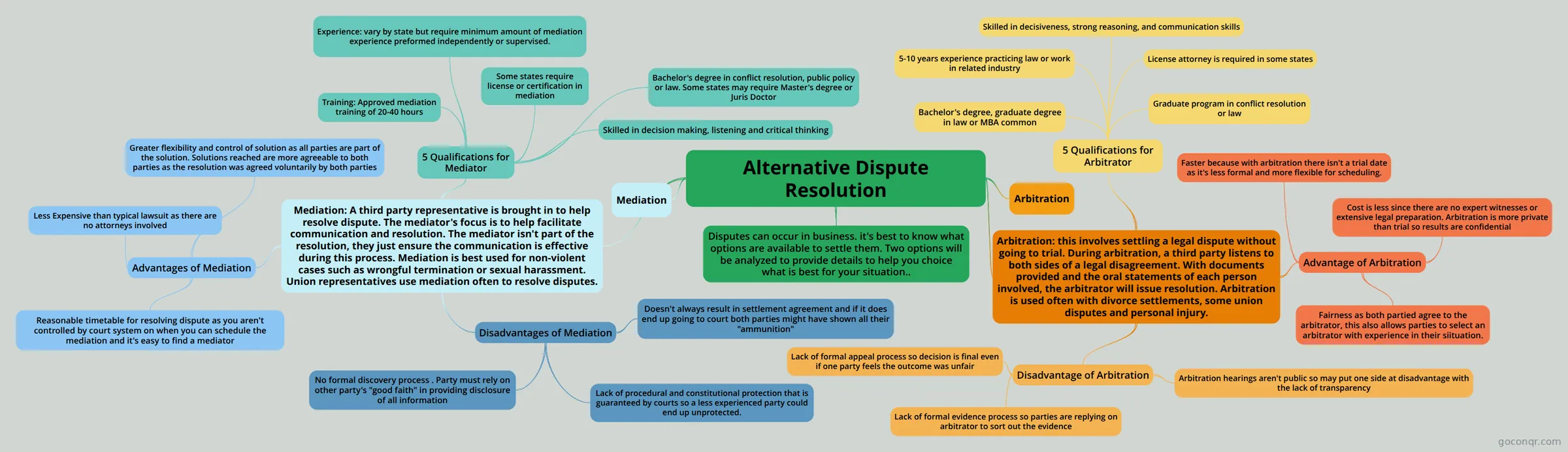
Mind map: Alternative dispute resolution
Conteúdo do mapa
Alternative Dispute Resolution
- Disputes can occur in business. It's best to know what options are available to settle. Two options will be analyzed that businesses can use for dispute resolution.
Mediation: A third party representative is brought in to help resolve dispute. The mediator's focus is to help facilitate communication and resolution. The mediator isn't part of the resolution, they just ensure the communication is effective during this process. Mediation is best used for non-violent cases such as wrongful termination or sexual harassment. Union representatives use mediation often to resolve disputes.
- With mediation, a third party representative is brought in to help. The mediator's focus is to help facilitate communication and resolution. The mediator isn't part of the resolution , they just ensure the communication is effective during this process. Mediation is best used for non-violent cases such as wrongful terminations or sexual harassment. Union representatives use mediation often to resolve workplace disputes.
- 5 Qualifications for Mediator
- Training: Approved mediation training of 20-40 hours
- Approved mediation training of between 20-40 hours.
- Experience: vary by state but require minimum amount of mediation experience preformed independently or supervised.
- This varies by state but require some minimum amount of mediation experience performed independently or supervised.
- Some states require license or certification in mediation
- Some states require license or certification in mediation.
- Bachelor's degree in conflict resolution, public policy or law. Some states may require Master's degree or Juris Doctor
- Bachelor's degree in conflict resolution, public policy or law. Some states may require Master's degree or Juris Doctor.
- Skilled in decision making, listening and critical thinking
- Training: Approved mediation training of 20-40 hours
- Advantages of Mediation
- Reasonable timetable for resolving dispute as you aren't controlled by court system on when you can schedule the mediation and it's easy to find a mediator
- With mediation, you aren't controlled by the court system on when you can schedule. This allows both parties to come up with a schedule that works for all.
- Less Expensive than typical lawsuit as there are no attorneys involved
- With mediation, it's less expensive than typical lawsuit as there are no attorneys or courts involved.
- Greater flexibility and control of solution as all parties are part of the solution. Solutions reached are more agreeable to both parties as the resolution was agreed voluntarily by both parties
- With mediation, all parties are part of the solution. Solution is reached are more agreeable to both parties as the resolution was agreed voluntarily by both.
- Reasonable timetable for resolving dispute as you aren't controlled by court system on when you can schedule the mediation and it's easy to find a mediator
- Disadvantages of Mediation
- Doesn't always result in settlement agreement and if it does end up going to court both parties might have shown all their "ammunition"
- If both parties don't agree on a resolution, it could go to court. This could put one or both parties at a disadvantage since they have shown their "ammunition".
- Lack of procedural and constitutional protection that is guaranteed by courts so a less experienced party could end up unprotected.
- When in court, parties are protected by state and federal laws. When in mediation, parties are unprotected so if they lack experience, they could end up unprotected.
- No formal discovery process . Party must rely on other party's "good faith" in providing disclosure of all information
- Party must rely on other party's "good faith" in disclosing all the information.
- Doesn't always result in settlement agreement and if it does end up going to court both parties might have shown all their "ammunition"
Arbitration: this involves settling a legal dispute without going to trial. During arbitration, a third party listens to both sides of a legal disagreement. With documents provided and the oral statements of each person involved, the arbitrator will issue resolution. Arbitration is used often with divorce settlements, some union disputes and personal injury.
- Arbitration involves settling a legal dispute without going to trial. During arbitration, a third party listens to both sides of a legal disagreement. With documents provided and the oral statements of each person involved, the arbitrator will issue a resolution. Arbitration is used often with divorce settlement, some union disputes and person injury disputes.
- Advantage of Arbitration
- Fairness as both partied agree to the arbitrator, this also allows parties to select an arbitrator with experience in their siituation.
- Fairness as both parties agree to the arbitrator, this also allows parties to select the arbitrator with experience in their situation.
- Faster because with arbitration there isn't a trial date as it's less formal and more flexible for scheduling.
- Arbitration is faster because there isn't a trial date as it's less formal and more flexible for scheduling. Arbitration is more private than trial so results are confidential, results are final as there is no appeal process.
- Cost is less since there are no expert witnesses or extensive legal preparation. Arbitration is more private than trial so results are confidential
- Cost is less since there are no expert witnesses or extensive legal preparation.
- Fairness as both partied agree to the arbitrator, this also allows parties to select an arbitrator with experience in their siituation.
- Disadvantage of Arbitration
- Lack of formal evidence process so parties are replying on arbitrator to sort out the evidence
- There is no formal evidence process so both parties must rely on the arbitrator to sort out the evidence.
- Lack of formal appeal process so decision is final even if one party feels the outcome was unfair
- There is no formal appeal process so decisions are final even if one party feels the outcome was unfair.
- Arbitration hearings aren't public so may put one side at disadvantage with the lack of transparency
- Arbitration hearings aren't public so may put one side at a disadvantage with the lack of transparency.
- Lack of formal evidence process so parties are replying on arbitrator to sort out the evidence
- 5 Qualifications for Arbitrator
- Bachelor's degree, graduate degree in law or MBA common
- Being arbitrator requires a Bachelor's degree, graduate in law or MBA common.
- License attorney is required in some states
- Some states require an arbitrator to be a license attorney.
- 5-10 years experience practicing law or work in related industry
- 5-10 years experience practicing law or working in related industry.
- Skilled in decisiveness, strong reasoning, and communication skills
- Graduate program in conflict resolution or law
- Graduate programs in conflict resolution or law
- Bachelor's degree, graduate degree in law or MBA common
Arbitration
Mediation
Disputes can occur in business. it's best to know what options are available to settle them. Two options will be analyzed to provide details to help you choice what is best for your situation..
Informações
- Descrição
- Mapa Mental sobre Alternative Dispute Resolution, criado por Alice McKenzie em 29-03-2020.
- Criado por
- Alice McKenzie
- Visualizações
- 0
- Histórico
-
- Criado por Alice McKenzie · 29 mar 2020
- Copiado por Alice McKenzie · 29 mar 2020
- Avaliação
Mais sobre Mediation and Conciliation