
Mapa mental
Unit 5 - Nuclear Physics, Thermal Physics plus Option
Conteúdo do mapa
Unit 5 - Nuclear Physics, Thermal Physics plus Option
Radioactivity
- Discovery of the Nucleus
- Rutherford's gold foil experiment used an alpha source to emit alpha radiation (He Nucleus) through a piece of thin gold foil. A detector then measured the deflection of the particle; most passed straight through but about 1 in 2000 were deflected. 1 in 10000 were deflected b angles of more than 90°
- Properties of Radiation
- α - Strong Ionisation - Produce straight tracks in a cloud chamber - Absorbed completely by paper and thin metal foil - Travels only a few centimetres in air β - Weaker at ionising than alpha - Produce wispy tracks in a cloud chamber - Absorbed by 5mm of metal - Range of about one metre in air γ - Very weak ionising effect - Absorbed by several centimetres of lead - Unlimited range in air
- Dangers of Radioactivity
- Ionising radiation can destroy cell membranes which causes cells to die or can damage vital molecules such as DNA directly or indirectly by creating free radical ions which react with vital molecules. Damaged DNA may cause cells to divide and grow uncontrollably, creating a tumour
- Radioactive Decay
- The half life of a radioactive isotope is the time taken for the mass of the isotope to decrease to half the initial mass. A=A0 * e^(-λt)
- Radioactive Isotopes in use
- Radioactive Dating Radioactive Tracers Engine Wear Thickness Monitoring Power Sources for remote devices
- The N-Z Graph
- For light isotopes (Z<20) - N=Z As Z>20 - N>20 α-emitters - Occur above Z=60 β-emitters - Occur to the left of the stability belt γ-emitters - Occur to the right of the stability belt
- N-Z Changes
- A nucleus that emits an α particles moves diagonally downwards and to the left Emitting a β- particle moves diagonally downwards to the right Emitting a β+ particle moves diagonally upwards to the left
- Nuclear Energy Levels
- Emission of a γ photon causes the nucleus to lose energy and move from an excited state to a lower energy state, usually the ground state. The emission of a γ photon is usually caused by the emission of an α or β particle
- Nuclear Radius
- High-Energy Electron Diffraction
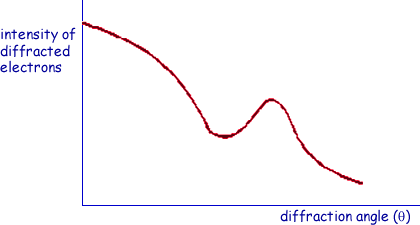
- When a beam of high-energy electrons is directed at a thin solid sample of an element, the incident electrons are diffracted by the nuclei of the atoms in the foil. A detector is used to measure the number of electrons per second diffracted through different angles. The electrons are diffracted by the nuclei because the de Broglie wavelength of such high energy electrons is of the order 10^-15 m, about the same as the diameter of a nucleus. Scattering of the beam electrons by the nuclei occurs due to their charge. The angle of the first minimum is used to calculate the diameter of the nucleus
- Nuclear Density
- Density of a nucleus = 3.4x10^17 kg m^-3 The density of a nucleus is constant, regardless of its radius
- High-Energy Electron Diffraction
- Discovery of the Nucleus
Nuclear Energy
- Energy and Mass
- E=mc²
- Binding Energy
- Binding Energy of a nucleus - Work that must be done to separate a nucleus into its constituent neutrons and protons Binding energy = mc² Mass Defect - The difference between the mass of the separated nucleons and the mass of the nucleus mass defect = Zmp + (A-Z)mn - Mnuc Where Z=protons, mp=mass of proton, mn= mass of neutron, Mnuc=mass of nucleus
- Fission and Fusion
- Thermal Nuclear Reactor
- Safety Features
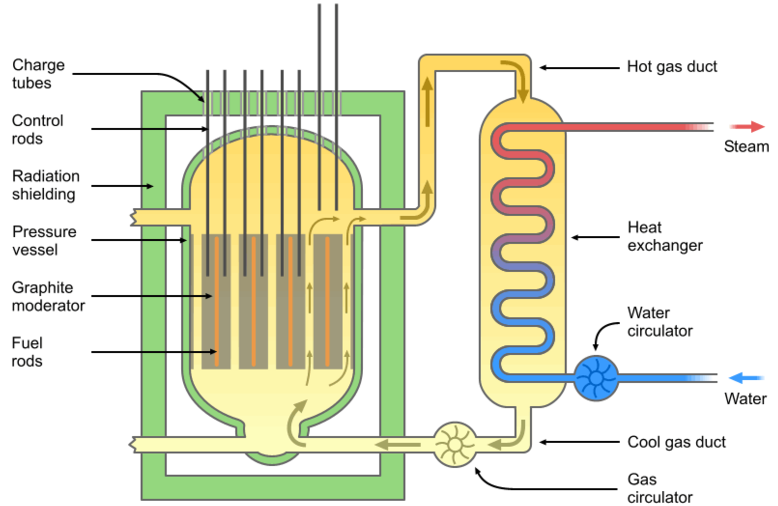
- Reactor core is a thick steel vessel Core is in a building with very thick concrete walls Emergency shut down procedure that inserts control rods fully into the core to stop fission Fuel rods are inserted and removed by remote handling devices
- Radioactive Waste
- High Level - Stored underwater in cooling ponds for up to a year, then transferred in large steel casks to a reprocessing plant where it is then stored in sealed containers in deep trenches at Sellafield Intermediate - Sealed in drums that are encased in concrete and stored in specially constructed buildings with reinforced concrete walls Low - Sealed in metal drums and buried in large trenches
- Safety Features
- Energy and Mass
Thermal Physics
- Internal Energy and Temperature
- Internal energy changes as a result of heat transfer or energy transfer, or work done on or by the objectThe internal energy of an object is the sum of the random distribution of the kinetic and potential energies of its molecules An object at absolute zero has minimum internal energy
- Specific Heat Capacity
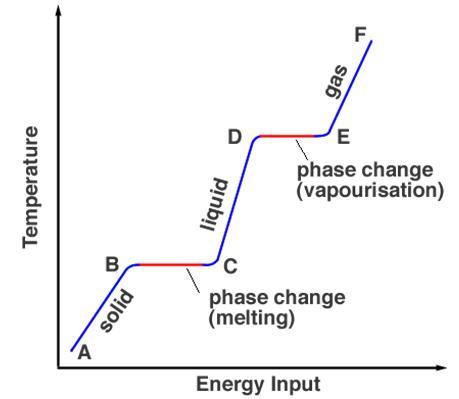
- The specific heat capacity, c, of a substance is the energy needed to raise the temperature of unit mass of the substance by 1K without change of state. Q=mcΔT
- Change of State
- The energy needed to melt a solid at its melting point is referred to as latent heat of fusion The energy needed to vaporise a liquid is referred to as latent heat of vaporisation Energy needed to change state without change in termperature: Q=ml l - Specific latent heat of fusion or vaporisation
- Internal Energy and Temperature
Gases
- The Experimental Gas Laws
- Boyle's Law
- Law of Pressure and GaspV = constant The pressure of a gas at a constant temperature is increased by reducing its volume because the gas molecules travel less distance between impacts, hence there are more impacts per second and pressure is greater
- Charles' Law
- Law of Volume and Temperature V/T = constant
- Pressure Law
- Law of Pressure and Temperaturep/T = constant The pressure of a gas at constant volume is increased by rasing its temperature. The average speed of molecuyles is increased by raising the gas temperature so the impacts of the molecules on the container walls are harder and more frequent, pressure increases
- Boyle's Law
- The Ideal Gas Law
- pV = nRTR - Molar Gas Constantn - Number of Moles pV=NkT N = Number of molecules Boltzmann constant, k = R/Na Na = Avogrado's Constant = 6.023x10^23
- Kinetic Theory of Gases
- pV = 1/3 Nm*c(rms)²
- Derivation of the Equation
- The Experimental Gas Laws
Imagens e arquivos do mapa
Informações
- Descrição
- Physics (Unit 5: Nuclear Physics, Thermal Physics plus Option) Mapa Mental sobre Unit 5 - Nuclear Physics, Thermal Physics plus Option, criado por Dominic Trott em 04-03-2015.
- Criado por
- Dominic Trott
- Visualizações
- 11
- Avaliação