
Nuclear Physics and Nuclear Energy
56 resources created by 40 users
This Nuclear Physics and Nuclear Energy page on GoConqr gathers community-made mind maps, quizzes, flashcards and notes, from atomic structure and radioactive decay to fission, fusion and nuclear power stations. It's built for school students revising a topic and teachers after ready-made material, with a few resources for university students too. There are over 340 resources here, including more than 20 quizzes, over 180 mind maps and more than 90 flashcard decks. Try a quiz to find your gaps, then open the maps that cover them.
Top Nuclear Physics and Nuclear Energy resources
-
13 cardsThe Nuclear reactor Which atoms undergo nuclear fission?
-
10 questionsNuclear Physics: Quiz Rutherford's Gold Foil experiment demonstrated that electrons orbited the nucleus of an atom in fixed orbits.
-
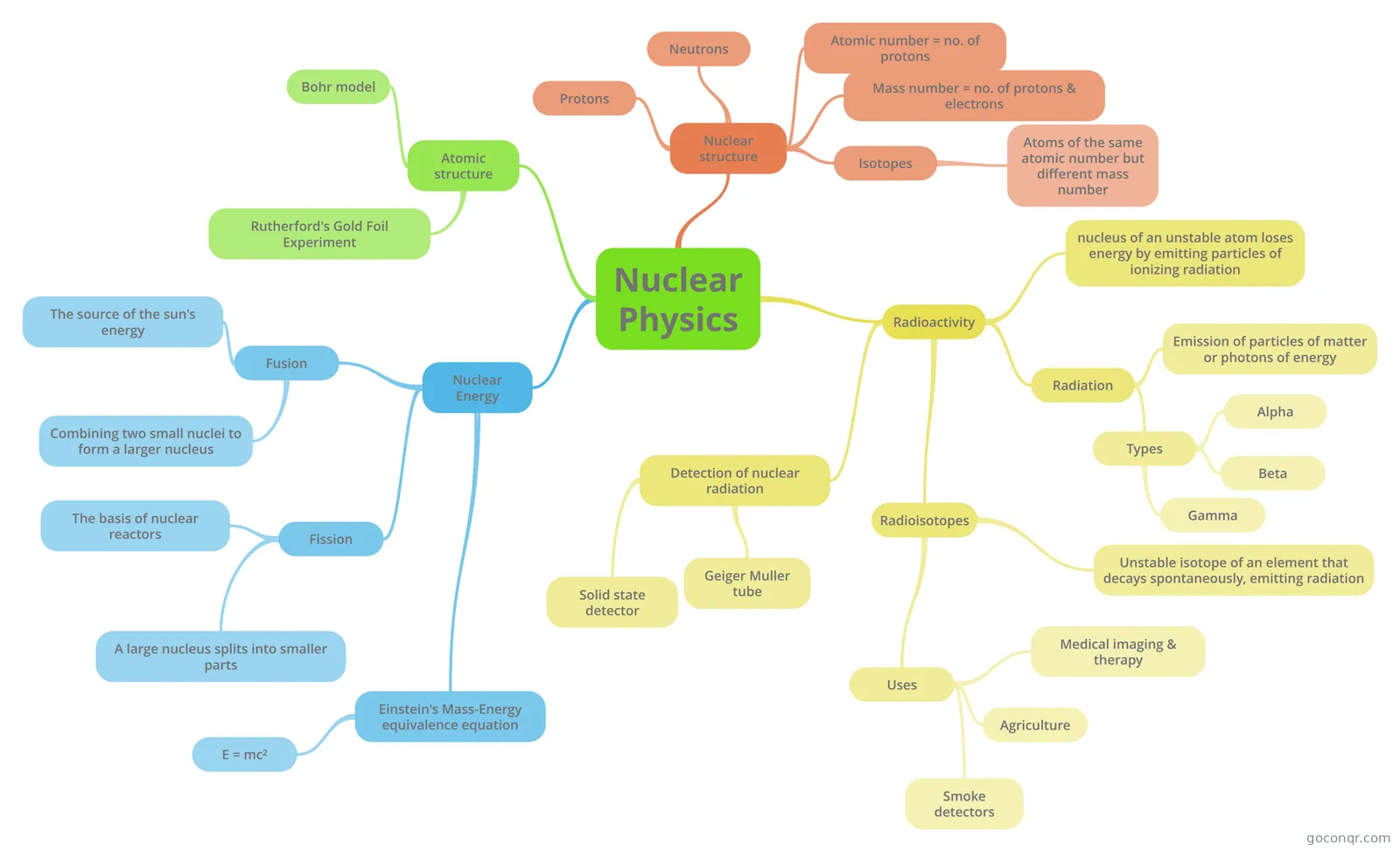 Mind map Nuclear Physics This mind map provides an overview to the structure and function of the components of the nucleus. It cover...
-
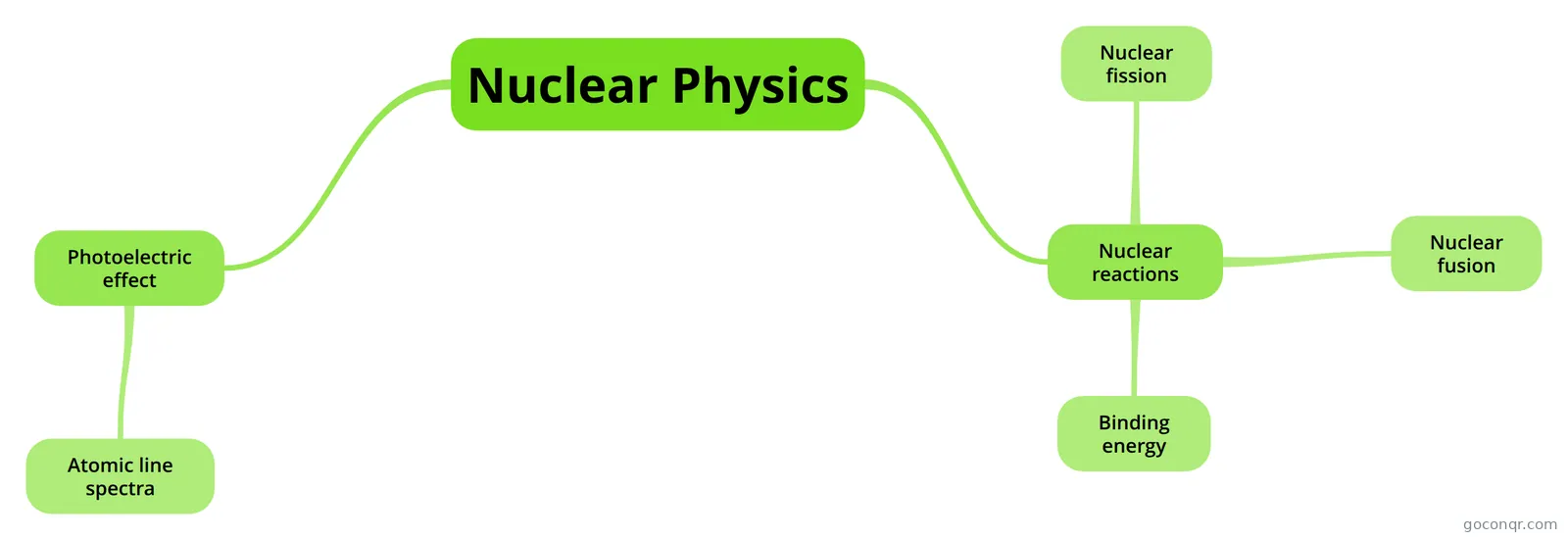 Mind map Nuclear Physics
-
Mind map Nuclear Power
-
 Mind map Nuclear Fission and Fusion
-
Mind map Unit 5 - Nuclear Physics, Thermal Physics plus Option
-
15 cardsnuclear physics ocr A level physics what is another name for the nucleon number
Quizzes
-
10 questionsNuclear Physics: Quiz Rutherford's Gold Foil experiment demonstrated that electrons orbited the nucleus of an atom in fixed orbits.
-
20 questionsAQA GCSE Physics Unit 2.6 Which of these scientists were credited with discovering radioactivity?
-
20 questionsAQA GCSE Physics Unit 2.7 True or false? Nuclear fission is caused by firing a neutron at a fissionable nucleus.
-
11 questionsTypes of Nuclear Reactions A study tool to use for studying nuclear reactions and how to solve them
-
11 questionsNeil Hyatt - Lecture 3 - Nuclear Structure Nuclear Structure Part 1
-
7 questionsNeil Hyatt - Lectures 1 and 2 What is the binding energy?
-
5 questionsCCI03.02.02.- How do nuclear power plants work? The series of events in which neutrons from split uranium nuclei lead to the splitting of more uranium nucl...
-
3 questionsPhysics - P2 What is the correct term for splitting in nuclear power?
Mind maps
-
Nuclear Physics This mind map provides an overview to the structure and function of the components of the nucleus. It cover...
-
Nuclear Physics
-
Nuclear Power
-
Nuclear Fission and Fusion
-
Unit 5 - Nuclear Physics, Thermal Physics plus Option
-
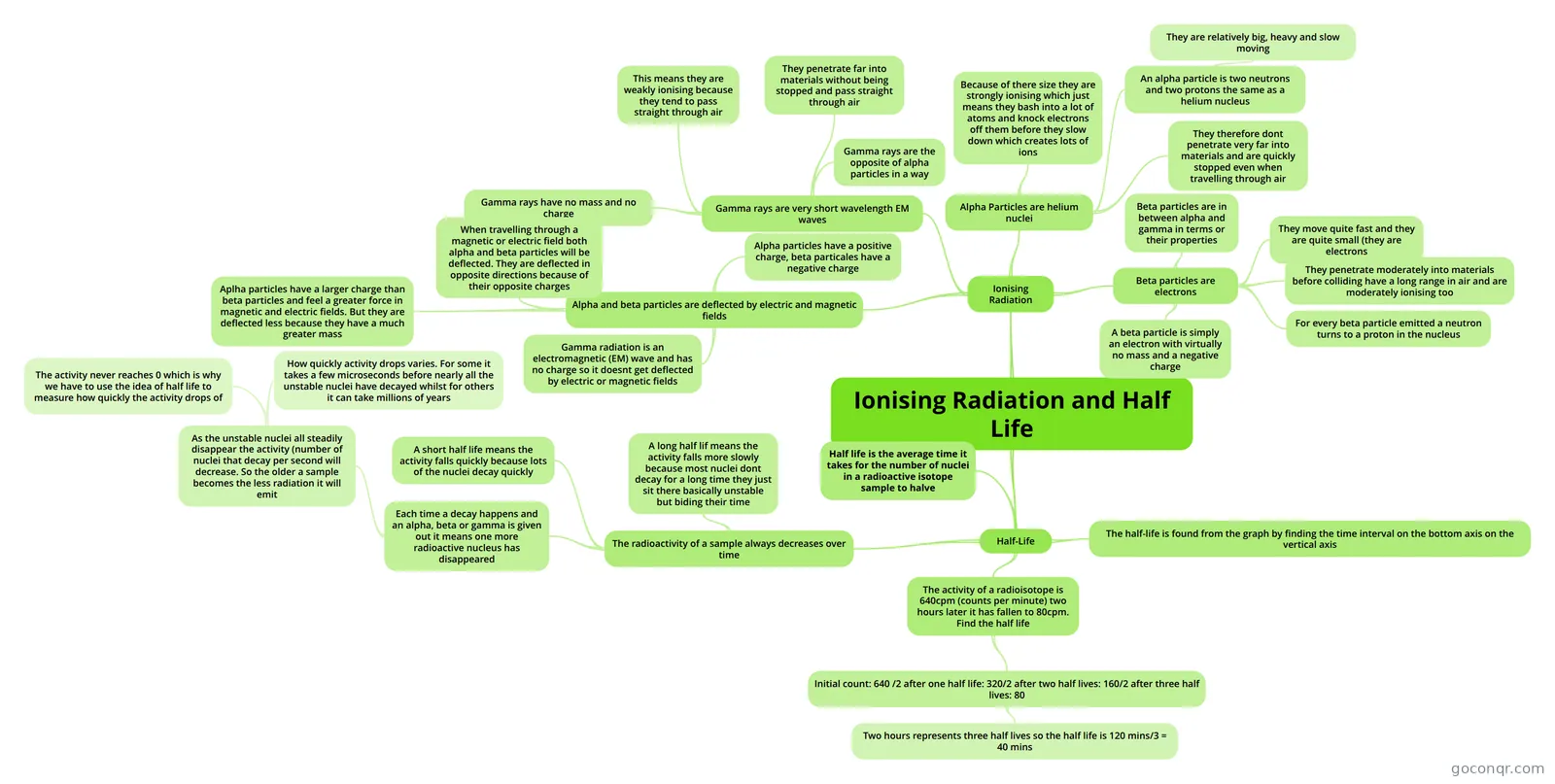 Ionising Radiation and Half Life
-
 P2.6 Nuclear Fission And Nuclear Fusion
-
Physics P2 - Energy from the nucleus
Flashcards
See all 27 flashcards-
13 cardsThe Nuclear reactor Which atoms undergo nuclear fission?
-
15 cardsnuclear physics ocr A level physics what is another name for the nucleon number
-
26 cardsEnergy from the nucleus Yo!
-
20 cardsPhysics - P2 Physics - P2
-
51 cardsRadioactivity
-
35 cardsNuclear Physics What are the 3 types of ionizing radiation?
-
28 cardsRadiation What is a radioactive substance?
-
25 cardsAQA physics unit 5 Conclusions from the Rutherford scatttering
Notes
See all 11 notes-
stable and unstable nuclei The strong nuclear interaction: this is the force that binds nucleons together. Gravity is far too weak to overcome electrostatic forces, so there must be a strong nuclear force to hold it together. Distance and the s...
-
Nuclear Physics: Radioactivity Radioactivity:Spontaneous emission of radiation due to the natural disintegration of an unstable nucleus RadiationEmission of particles of matter or photons of energy Types of RadiationAlpha (α)Beta (β)Gamma (ɣ)
-
Nuclear Physics: Atomic Structure Atomic StructureNegatively charged electrons orbiting a positively charged nucleus Rutherford's Gold Foil Experiment This experiment changed the idea that the atom was made up of a random mixture of electrons an...
-
Nuclear Physics: Nuclear Structure Components of the nucleus - nucleons Protons - positively charged nucleons Neutrons - electrically neutral nucleons Atomic number (Z): The number of protons in the nucleus of an atom Each element has a unique atomic n...
-
RADIOACTIVE DECAY Nuclear decay is- A process of disintegration that occurs when unstable nuclei decay in an attempt to attain stability, until their N/Z (neutron/proton) number falls within the stability limit/ band of stability. Disi...
-
ATOMIC AND NUCLEAR PHYSICS Geiger Marsden/ Rutherford/Charged particle scattering experiment: Beam of alpha particles fired at very thin gold foil; bombard gold atoms. Most of the particles pass through without deflection, some deflected throug...
-
Sub-topic 7.2 Lesson 1 - Unified Atomic Mass Unit Sub-topic 7.2 Lesson 1 - Unified Atomic Mass Unit Textbook References: Tsokos (6th Edition) pp ; Oxford text pp 283 - 284; Syllabus Outcomes Covered In This Lesson: Understandings: The unified atomic mass unit Applica...
-
Nuclear Physics: Radioactive Decay Radioactive Decay When radiation is emitted from a nucleus, it undergoes decay The amount of decay is dependent on the type of emission Alpha Emission Emission of a helium nucleus from a large atom Here is the symbol ...
Slides
More Physics topics
About Nuclear Physics and Nuclear Energy
GoConqr OriginalWhat this unit covers
The resources follow the topic from the atom outwards. The Mind Map called Nuclear Physics covers atomic structure, Rutherford's Gold Foil Experiment, the Bohr model, protons, neutrons, atomic number and radioactivity. A second Mind Map of the same name moves on to the photoelectric effect, atomic line spectra, nuclear reactions, binding energy, fission and fusion.
Where to start
Begin with the notes, because they set out the ideas in order.
- Read the notes on atomic structure, then the notes on nuclear structure, which explain nucleons and atomic number.
- Move to the notes on radioactivity and the notes on stable and unstable nuclei, which look at the strong nuclear interaction.
- Finish with the notes on nuclear energy, then the Mind Maps Nuclear Fission and Fusion and Nuclear Power.
Using quizzes and maps together
Open a mind map first to see how the ideas connect. Then take the Quiz Nuclear Physics: Quiz, which tests points such as what Rutherford's experiment showed and how line spectra are measured. Where an answer surprises you, go back to the map branch for that idea. Other quizzes cover beta decay and electron capture, nuclear stability and types of nuclear reactions.
Revision with flashcards
The flashcard deck The Nuclear reactor asks which atoms undergo fission, why uranium splits when hit by a neutron, and what fuel rods are made of. There are also decks on beta decay and binding energy. Some resources name GCSE Physics, A-level Physics, IB and IB Physics, so check that a resource matches your course before you rely on it.
Where it fits
This unit sits in the Atomic, Nuclear and Modern Physics strand of Physics. Pick one resource that matches what you are studying this week, and use the others to test yourself on it.
Frequently asked questions
Which resource should I start with?
Start with the Mind Map called Nuclear Physics, which gives an overview of atomic structure, Rutherford's Gold Foil Experiment, the Bohr model, nuclear structure and radioactivity. After that, read the notes on atomic structure and nuclear structure, then try the quiz Nuclear Physics: Quiz to see what has stuck.
What do the mind maps cover?
They cover atomic structure, radioactivity, ionising radiation and half-life, binding energy, fission, fusion and nuclear power. There are also maps on Chernobyl, the development of nuclear energy and fission, fusion and stars. Over 180 mind maps are listed, so you can usually find one that fits your topic.
Are the resources free to use?
Yes. Every resource listed here is free to open, study and take, with no account needed. They were made by GoConqr users, not by GoConqr itself. If you want your quiz scores saved, or want to make your own quizzes, mind maps, flashcards and notes, you can add a free account.
Which exams do these resources suit?
Most resources are at secondary level. The listed ones mention GCSE Physics, A-level Physics, IB and IB Physics. A small share is aimed at university students. Check the title and content of each resource against your own course before using it.
What kinds of flashcards are there?
There are over 90 flashcard decks. Examples include The Nuclear reactor, Types of decay, Beta decay, Binding energy and fission, and Controlled Nuclear reactors. Use them for quick recall of definitions, decay types and how a reactor works.
What if I cannot find what I need?
Try a neighbouring topic. Fission, fusion, radioactivity and nuclear energy each have their own maps, notes and decks, and the wording of titles varies. You can also build your own mind map or flashcards on the missing point.