
Mapa mental
Trauma-and-Stress-Related Disorders
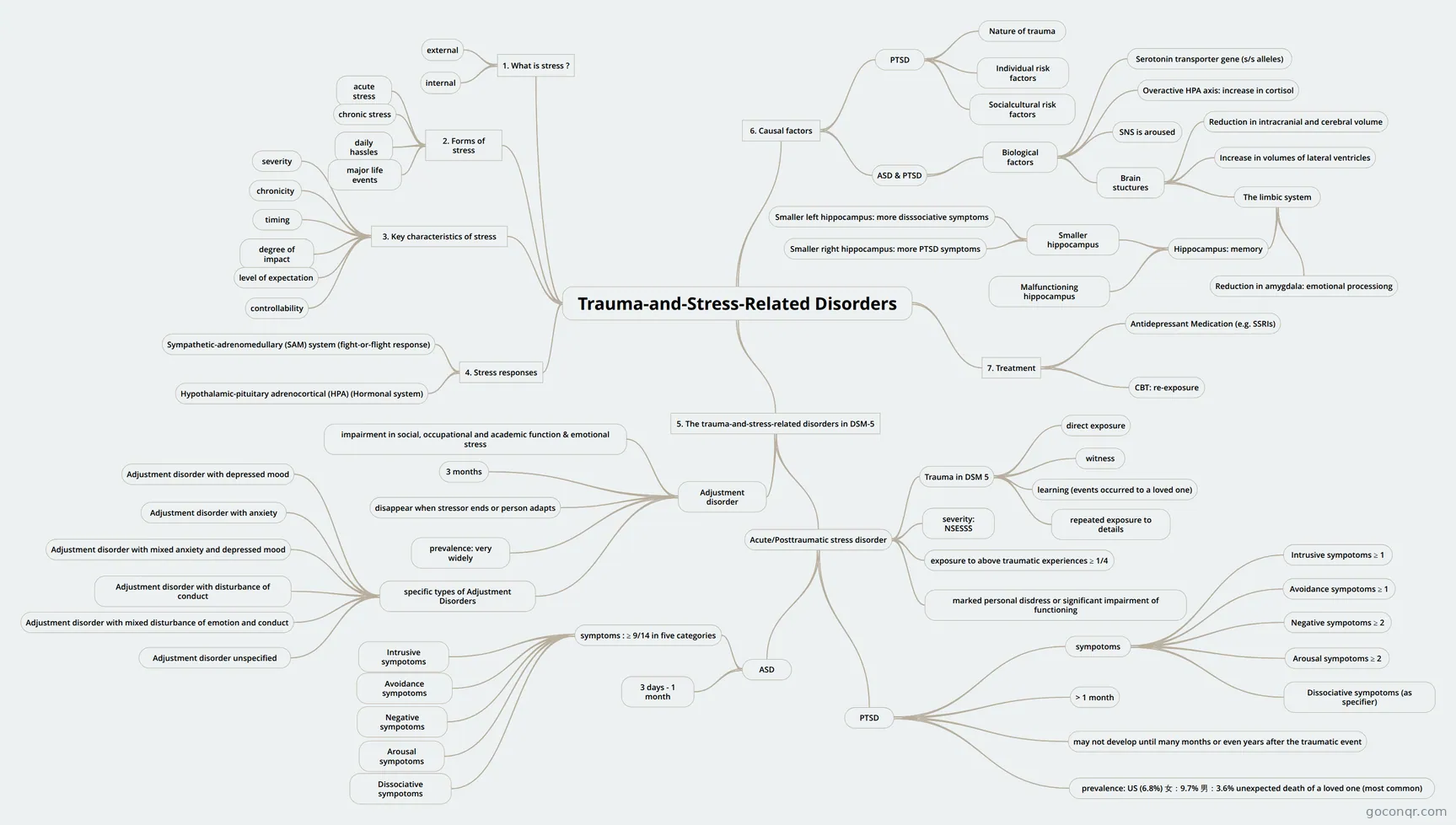
Mind map: trauma and stress related disorders
Conteúdo do mapa
Trauma-and-Stress-Related Disorders
1. What is stress ?
- external
- internal
2. Forms of stress
- acute stress
- chronic stress
- daily hassles
- major life events
3. Key characteristics of stress
- severity
- chronicity
- timing
- degree of impact
- level of expectation
- controllability
4. Stress responses
- Sympathetic-adrenomedullary (SAM) system (fight-or-flight response)
- Hypothalamic-pituitary adrenocortical (HPA) (Hormonal system)
5. The trauma-and-stress-related disorders in DSM-5
- Adjustment disorder
- impairment in social, occupational and academic function & emotional stress
- 3 months
- disappear when stressor ends or person adapts
- prevalence: very widely
- specific types of Adjustment Disorders
- Adjustment disorder with depressed mood
- Adjustment disorder with anxiety
- Adjustment disorder with mixed anxiety and depressed mood
- Adjustment disorder with disturbance of conduct
- Adjustment disorder with mixed disturbance of emotion and conduct
- Adjustment disorder unspecified
- Acute/Posttraumatic stress disorder
- Trauma in DSM 5
- direct exposure
- witness
- learning (events occurred to a loved one)
- repeated exposure to details
- PTSD
- sympotoms
- Intrusive sympotoms ≥ 1
- Avoidance sympotoms ≥ 1
- Negative sympotoms ≥ 2
- Arousal sympotoms ≥ 2
- Dissociative sympotoms (as specifier)
- > 1 month
- may not develop until many months or even years after the traumatic event
- prevalence: US (6.8%) 女:9.7% 男:3.6% unexpected death of a loved one (most common)
- sympotoms
- exposure to above traumatic experiences ≥ 1/4
- ASD
- symptoms : ≥ 9/14 in five categories
- Intrusive sympotoms
- Avoidance sympotoms
- Negative sympotoms
- Arousal sympotoms
- Dissociative sympotoms
- 3 days - 1 month
- symptoms : ≥ 9/14 in five categories
- marked personal disdress or significant impairment of functioning
- severity: NSESSS
- Trauma in DSM 5
- Adjustment disorder
6. Causal factors
- PTSD
- Nature of trauma
- Individual risk factors
- Socialcultural risk factors
- ASD & PTSD
- Biological factors
- Serotonin transporter gene (s/s alleles)
- Brain stuctures
- The limbic system
- Reduction in amygdala: emotional processiong
- Hippocampus: memory
- Smaller hippocampus
- Smaller left hippocampus: more disssociative symptoms
- Smaller right hippocampus: more PTSD symptoms
- Malfunctioning hippocampus
- Smaller hippocampus
- Reduction in intracranial and cerebral volume
- Increase in volumes of lateral ventricles
- The limbic system
- SNS is aroused
- Overactive HPA axis: increase in cortisol
- Biological factors
- PTSD
7. Treatment
- Antidepressant Medication (e.g. SSRIs)
- CBT: re-exposure