
Mapa mental
Basic Punctuation Rules
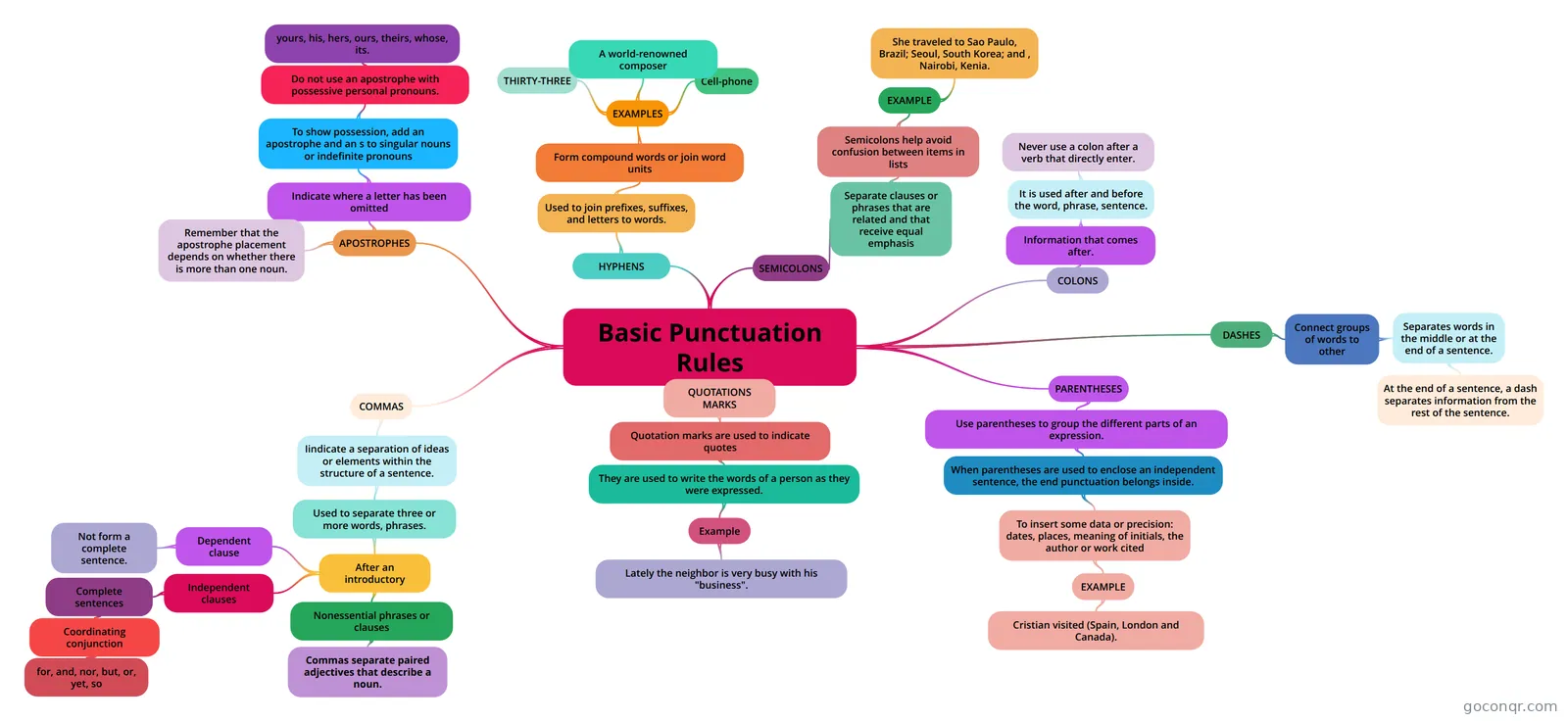
Mind map: Basic punctuation rules
Conteúdo do mapa
Basic Punctuation Rules
COMMAS
- Iindicate a separation of ideas or elements within the structure of a sentence.
- Used to separate three or more words, phrases.
- After an introductory
- Dependent clause
- Not form a complete sentence.
- Nonessential phrases or clauses
- Commas separate paired adjectives that describe a noun.
- Independent clauses
- Complete sentences
- Coordinating conjunction
- for, and, nor, but, or, yet, so
- Coordinating conjunction
- Complete sentences
- Dependent clause
- After an introductory
- Used to separate three or more words, phrases.
- Iindicate a separation of ideas or elements within the structure of a sentence.
QUOTATIONS MARKS
- Quotation marks are used to indicate quotes
- They are used to write the words of a person as they were expressed.
- Example
- Lately the neighbor is very busy with his "business".
- Example
- They are used to write the words of a person as they were expressed.
- Quotation marks are used to indicate quotes
PARENTHESES
- Use parentheses to group the different parts of an expression.
- When parentheses are used to enclose an independent sentence, the end punctuation belongs inside.
- To insert some data or precision: dates, places, meaning of initials, the author or work cited
- EXAMPLE
- Cristian visited (Spain, London and Canada).
- EXAMPLE
- To insert some data or precision: dates, places, meaning of initials, the author or work cited
- When parentheses are used to enclose an independent sentence, the end punctuation belongs inside.
- Use parentheses to group the different parts of an expression.
APOSTROPHES
- Indicate where a letter has been omitted
- To show possession, add an apostrophe and an s to singular nouns or indefinite pronouns
- Do not use an apostrophe with possessive personal pronouns.
- yours, his, hers, ours, theirs, whose, its.
- Do not use an apostrophe with possessive personal pronouns.
- To show possession, add an apostrophe and an s to singular nouns or indefinite pronouns
- Remember that the apostrophe placement depends on whether there is more than one noun.
- Indicate where a letter has been omitted
HYPHENS
- Used to join prefixes, suffixes, and letters to words.
- Form compound words or join word units
- EXAMPLES
- THIRTY-THREE
- Cell-phone
- A world-renowned composer
- EXAMPLES
- Form compound words or join word units
- Used to join prefixes, suffixes, and letters to words.
COLONS
- Information that comes after.
- It is used after and before the word, phrase, sentence.
- Never use a colon after a verb that directly enter.
- It is used after and before the word, phrase, sentence.
- Information that comes after.
DASHES
- Connect groups of words to other
- Separates words in the middle or at the end of a sentence.
- At the end of a sentence, a dash separates information from the rest of the sentence.
- Separates words in the middle or at the end of a sentence.
- Connect groups of words to other
SEMICOLONS
- Separate clauses or phrases that are related and that receive equal emphasis
- Semicolons help avoid confusion between items in lists
- EXAMPLE
- She traveled to Sao Paulo, Brazil; Seoul, South Korea; and , Nairobi, Kenia.
- EXAMPLE
- Semicolons help avoid confusion between items in lists
- Separate clauses or phrases that are related and that receive equal emphasis
Informações
- Descrição
- Mapa Mental sobre Basic Punctuation Rules, criado por Diana Romero em 06-08-2020.
- Criado por
- Diana Romero
- Visualizações
- 0
- Avaliação