
Punctuation and Capitalization
514 resources created by 417 users
This Punctuation and Capitalization page on GoConqr gathers community-made quizzes, mind maps, flashcards, notes and slides, from commas, apostrophes and colons to dialogue and capitalising titles. It's built for school students practising their punctuation, and for teachers after ready-made material. There are over 490 resources here, including more than 70 quizzes, over 270 mind maps and more than 110 flashcard decks, mostly at secondary level. Pick a topic, try a quiz to find your gaps, then make your own set.
Top Punctuation and Capitalization resources
-
12 questionsCommas in Addresses - Grade 3 When writing addresses, you need a comma between...
-
10 questionsPunctuating Dialogue - Grade 3 When writing a dialogue, you must start a new line on the page each time a new character starts speaking.
-
13 cardsApostrophes Apostrohes are used for two different purposes - what are they?
-
10 questionsPunctuation quiz When I get older I will be able to drive
-
10 questionsColons vs. Semi-Colons Which of the following is a colon?
-
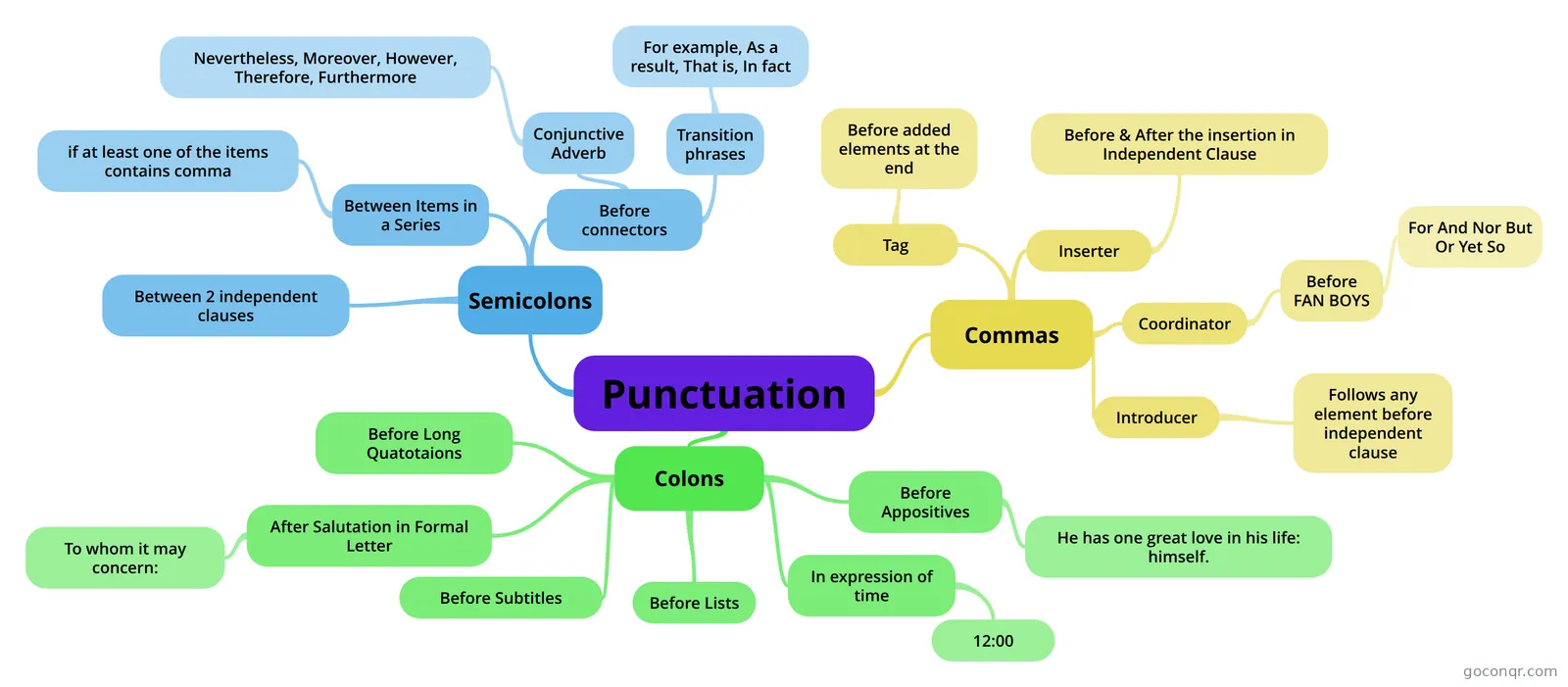 Mind map Punctuation
-
7 questionsCommas, Capitalization, and Numbers 1. After being lost in the cave for 6 days the hiker cut off his own arm like a boss.
-
10 questionsPunctuating Dialogue - Grade 5 When writing dialogue, you must create a new line each time someone new starts speaking.
Quizzes
See all 81 quizzes-
12 questionsCommas in Addresses - Grade 3 When writing addresses, you need a comma between...
-
10 questionsPunctuating Dialogue - Grade 3 When writing a dialogue, you must start a new line on the page each time a new character starts speaking.
-
10 questionsPunctuation quiz When I get older I will be able to drive
-
10 questionsColons vs. Semi-Colons Which of the following is a colon?
-
7 questionsCommas, Capitalization, and Numbers 1. After being lost in the cave for 6 days the hiker cut off his own arm like a boss.
-
10 questionsPunctuating Dialogue - Grade 5 When writing dialogue, you must create a new line each time someone new starts speaking.
-
10 questionsCheck your punctuation knowledge The comma , is used to...? Choose ALL the correct answers.
-
16 questionsLesson 11 punctuation quiz Choose the most accurate version below:
Mind maps
See all 277 mind maps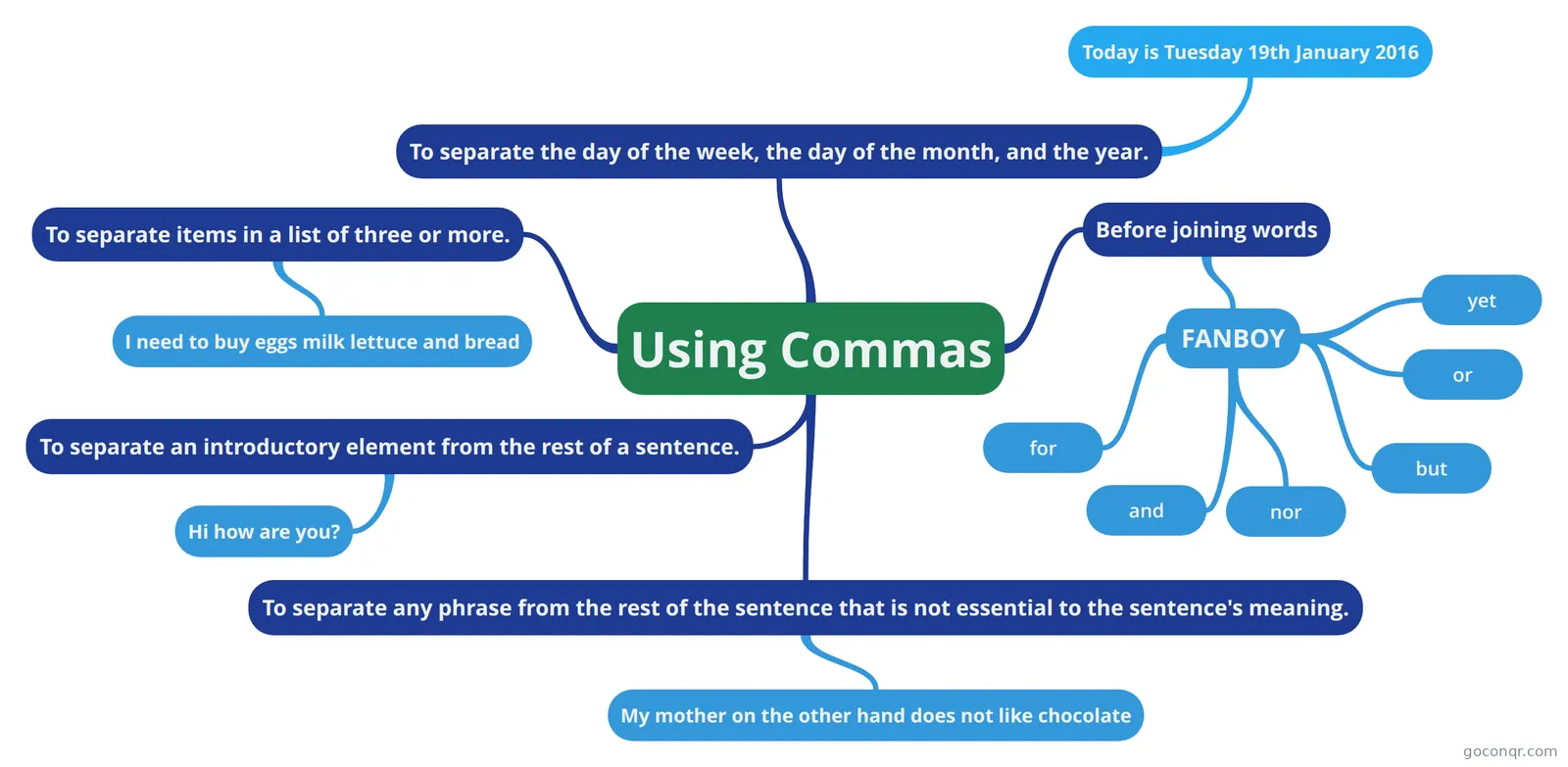
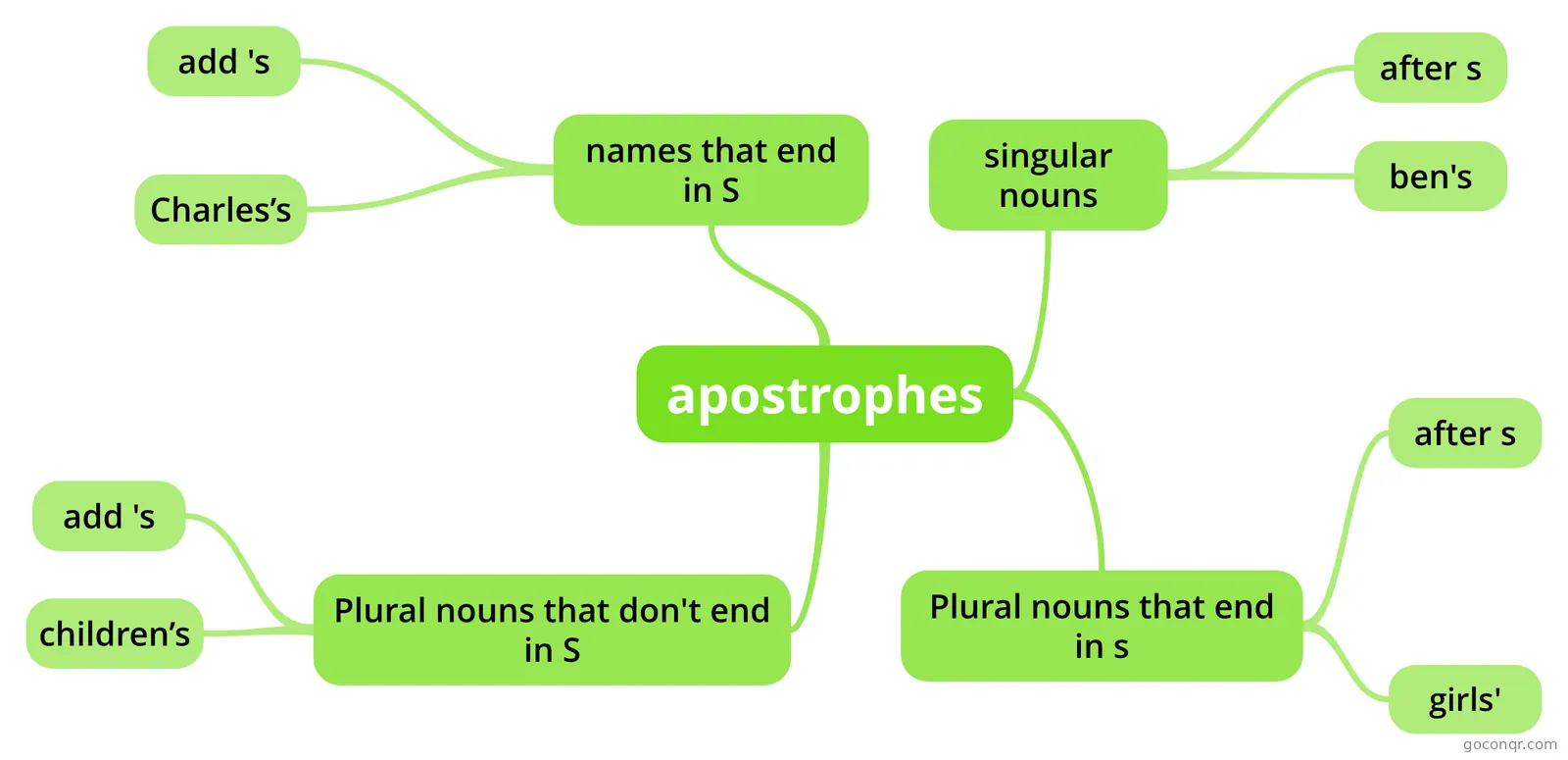
Flashcards
See all 120 flashcards-
13 cardsApostrophes Apostrohes are used for two different purposes - what are they?
-
3 cardsQUESTION AND EXCLAMATION MARKS QUESTION AND EXCLAMATION MARKS
-
7 cardsPunctuation Learning punctuation
-
59 cardspamod2unit8morepunctuation What is an appositive expression? Give an example.
-
30 cardscwsillichompnotes Competent writers almost always use commas for one of two purposes
-
90 cardsLanguage Arts Commas vs. Semicolons Many companies make sugar-free soft drinks, which are flavored by synthetic chemicals...
-
11 cardsPunctuation Marks Wilson Guerra
-
9 cardsfichas Centro colombo americano PUNCTUATION
Flowcharts
See all 12 flowcharts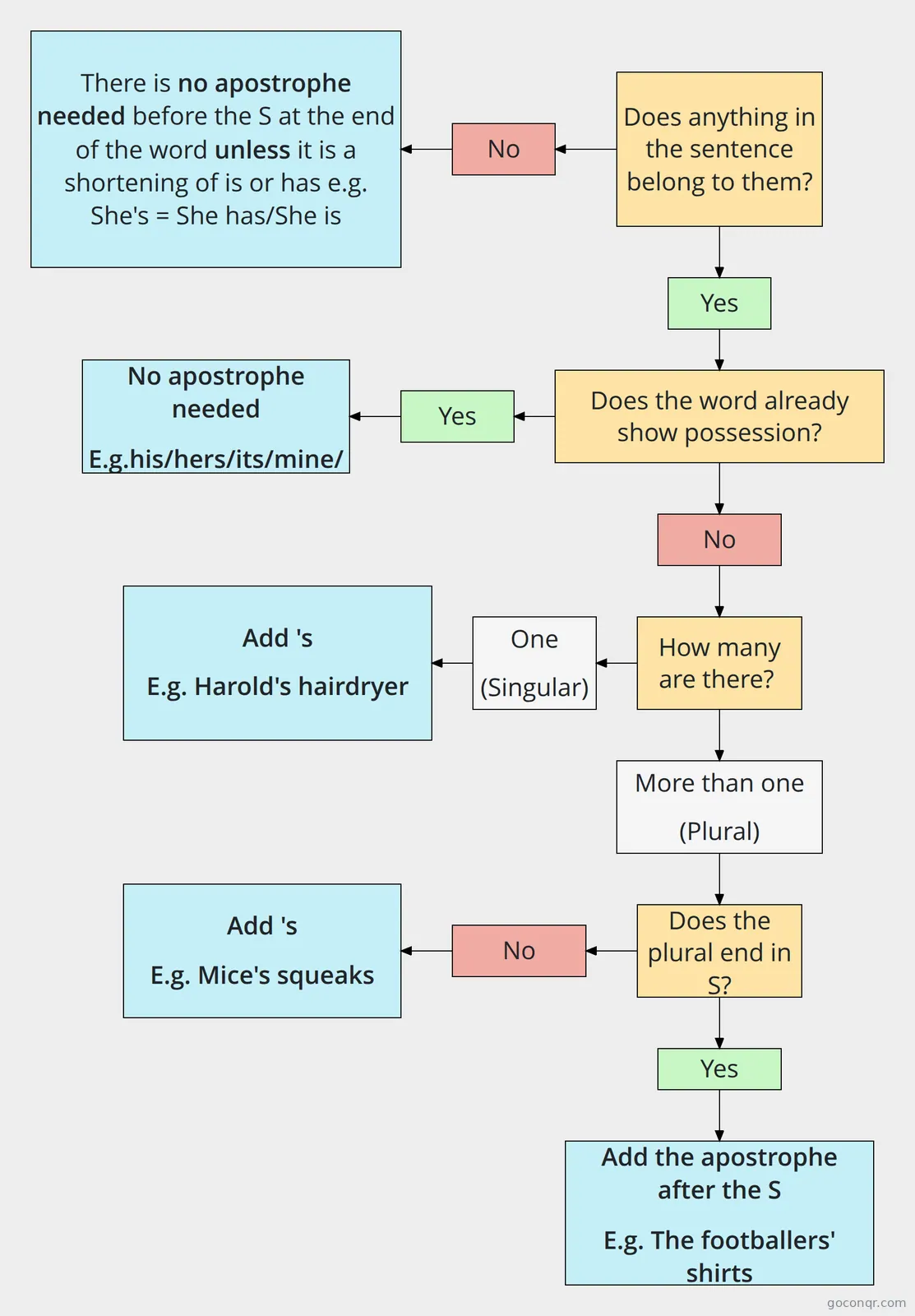
Notes
See all 12 notes-
punctuation The Punctuation Rules Technological University of Tecamachalco ANDREA JUAREZ TORAL Teacher: Dolores Vega Espinoza Accountancy 16/ JUNIO/ 2021 The most common use of the period is at the end of a sentence, when w...
-
Using Commas In a Time magazine essay, "In Praise of the Humble Comma," author Pico Iyer compares the comma to "a flashing yellow light that asks us only to slow down." But when do we need to flash that light, and when is it bette...
-
Untitled Commas in Introductory Phrases:Put a comma after a phrase at the beginning of the sentence if it is at least 3 words.In the beginning of the semester, we studied commas.On top of the fridge by the door, there was a pu...
-
Punctuation/Mechanics Apostrophes - An apostrophe is a punctuation mark used in contractions to replace missing letters. The contraction "we'll" stands for "we will," with the apostrophe replacing "wi." It can also show possession, as in "...
-
English punctuation: Using Commas, Colons, Semi-colons and Dashes In a Time magazine essay, "In Praise of the Humble Comma," author Pico Iyer compares the comma to "a flashing yellow light that asks us only to slow down." But when do we need to flash that light, and when is it bette...
-
English Language - created from Mind Map Punctuation Capital Letter (C) Full Stop (.) Comma (,) Semi-colons (;) Colon (:) Question Mark (?) Exclamation Mark (!) Quotations Marks(") Parenthesis ( ( ) ) Hyphen (-) Dash ( - ) Apostrphe Start Sentences Proper No...
-
Module 3: Punctuation Punctuation, when we read, are sign posts for the reader. We speak with punctuation more naturally, but in writing, we need to use it in the right way.Full Stops are needed when reading to take a breath! A full stop e...
-
ELA 10: Ultimate Grammar and Punctuation Notes ELA 10: Ultimate Grammar and Punctuation Notes coordinating conjunction - FANBOYS conjunctive adverb - also, however, therefore, instead subordinate conjunction - after, although, since Comma - Creates pauses in sente...
Slides
See all 12 slidesTopics in Punctuation and Capitalization
More English language topics
About Punctuation and Capitalization
GoConqr OriginalWhat this unit covers
This unit sits in the strand Grammar: Words and Sentences, within English language. The resources focus on the marks that shape a sentence and on the rules for capital letters. Commas get the most attention, with several mind maps, flowcharts, flashcard decks and quizzes on their uses. You will also find material on apostrophes, colons, semicolons, dashes, ellipses, quotation marks, periods and capitalising titles.
Where to start
Begin with the mind map called Punctuation. It sorts commas by job: the introducer, the coordinator, the inserter and the tag. It also reminds you to put a comma before the FAN BOYS conjunctions when they join two independent clauses. That gives you a clear picture before you test yourself.
Next, try the Punctuation quiz or Check your punctuation knowledge. They ask you to fix sentences, such as a list of shopping items or a line of speech, and some questions let you choose all the correct answers.
Going deeper, topic by topic
- Commas: read the slides called Comma rules, then try Commas in Addresses - Grade 3 or Comma Usage.
- Colons and semicolons: Colons vs. Semi-Colons asks you to spot each mark and say what it does.
- Apostrophes: the Apostrophes flashcards cover omission and possession, and include checks on forms such as should've.
- Dialogue: Punctuating Dialogue - Grade 3 and Punctuating Dialogue - Grade 5 cover new lines for new speakers and where end punctuation goes.
- Capitals: Capitalizing Titles and Capitalization rules help with the other half of the unit.
Using quizzes and maps together
Read a mind map first, then close it and take a quiz on the same topic. Where you slip up, go back to the map or a flashcard deck and look at that rule again. Notes such as English punctuation: Using Commas, Colons, Semi-colons and Dashes give fuller explanations when a map feels too short.
Teachers can pick a quiz or a set of slides and use it as it is with a class. Some resources are in Spanish or mix languages, so check a title before you share it.
Make it your own
Choose one mark that keeps catching you out, work through the resources on it, and then write a few sample sentences of your own. Turning the rules into your own maps and flashcards is a good way to see what you remember.
Frequently asked questions
Which resource should I open first?
Start with the mind map called Punctuation. It groups commas into introducers, coordinators, inserters and tags, and mentions the FAN BOYS conjunctions. Once you have read it, try the Punctuation quiz to see which rules you already know and which need another look.
Are the resources free to use?
Yes. Every resource listed on this page is free to open, study and take, with no account needed. They were made by GoConqr users rather than by GoConqr itself, so styles and levels of detail vary from one resource to the next.
What do the mind maps cover?
The mind maps cover commas most often, including titles on the seven basic uses of the comma. Others look at apostrophes, dashes, semicolons and periods, general punctuation marks and capitalisation rules. They work well as a quick refresher before you take a quiz.
Is there anything on dialogue and quotation marks?
Yes. Punctuating Dialogue - Grade 3 and Punctuating Dialogue - Grade 5 cover starting a new line for each speaker and placing punctuation inside quotation marks. There is also a quiz called Developing Dialogue and a flashcard deck on quotation marks.
Which levels do these resources suit?
Most of the resources on this page are at secondary level, so they suit school students practising punctuation and capitalisation. A few are simpler, and teachers can pick from them for classroom use. At least one resource mentions Functional Skills English.
What if I cannot find the topic I need?
Try a nearby term, such as comma, semicolon, apostrophe or capital letters, since many resources use different titles for the same rule. You can also make your own quiz, mind map, flashcards or notes with a free account, which also saves your quiz scores.