
Mapa mental
DEVELOPMENTAL PSYCHOLOGY_2_3_1_1
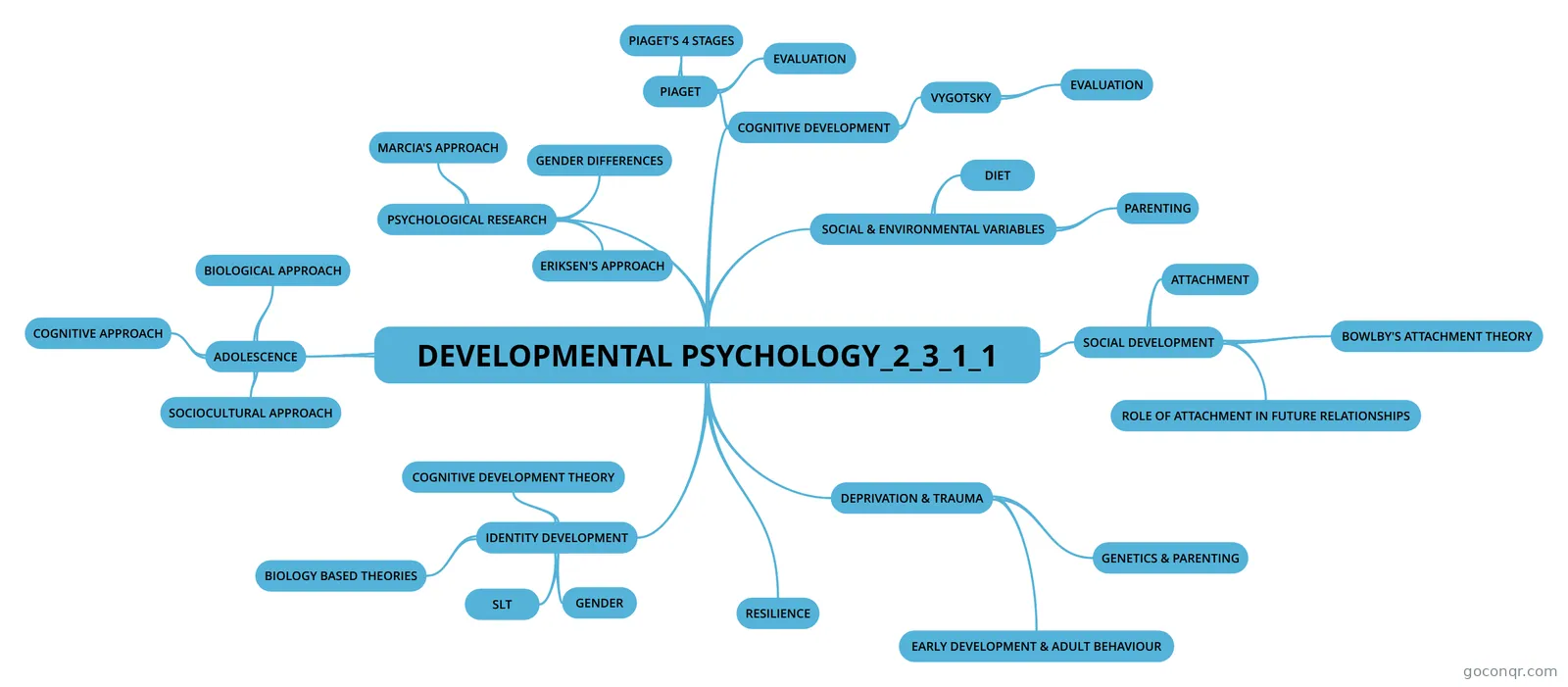
Mind map: Developmental psychology
Conteúdo do mapa
DEVELOPMENTAL PSYCHOLOGY_2_3_1_1
COGNITIVE DEVELOPMENT
- PIAGET
- 1. Piaget argued that knowledge developed through schemas. 2. Schemas are mental representations of the world & how the individual interacts with it. 3. Schemas help order our thinking and act as mental shortcuts. 4. They influence perception & attention. 5. As a child develops, his schemas develop as a result of his interaction with the world. 6. All children are born with an innate range of schemas (sucking, reaching, gripping). 7. These, in turn, are modified as a result of experience - ADAPTATION. 8. Piaget also argued that children actively construct knowledge as a result of their interaction with new objects & experiences. 9. For this reason, Piaget is also known as a constructivist. 10. The child's interaction with new events & objects, as well as the mixing of these with existing knowledge, cause him to develop cognitively. 11. ASSIMILATION - This occurs when new events can be fitted into existing schemas of what the child already understands - dog example. 12. ACCOMMODATION - This occurs when new events do not fit existing schemas. 13. Either a schema has to be modified to allow the new world view, or a new schema has to be created - calling a dog a horse. 14. These 2 processes clearly demonstrate the Piagetian child. 15. He is an active learner who is constantly engaged with the world, testing & retesting ideas. 16. Piaget saw children as little scientists who are always engaged in creating, then testing hypotheses.
- PIAGET'S 4 STAGES
- 1. SENSORIMOTOR STAGE (0-2) - infant has no formal schema for itself or the world. 2. It only knows the world through it sense and motor actions it performs. 3. PROFOUND EGOCENTRISM - infant can't distinguish between itself & the environment as it has no real knowledge of the world around it. 4. LACK OF OBJECT PERMANENCE - when it cannot see an object, it ceases to exist for the infant (develops at about 8 months) 5. Piaget's claims have been contradicted by other researchers. 6. Bower (1982) constructed a simple experiment wherby a child was shown an object and then a screen placed between object and child. 6. Object was removed, and then screen taken away. 7. Bower claimed the children showed enough surprise at the disappearance of the object, to argue that object permanence was more flexible than Piaget envisaged. 1. PRE-OPERATIONAL STAGE (2-7) - The child still relies on external appearances rather than internal logic. 2. Object permanence is established and the stage ends with the emergence of concrete operations. 3. Egocentism still dominates. 4. CENTRATION - the tendency to focus on only 1 aspect of an object or situation at a time. 5. CONSERVATION - children show a lack of this - the realisation that objects can remain the same despite a change in appearance - example with water in different sized glasses. 6. CLASSIFICATION LIMITATION - the child's inability to classify similar objects into the same groups (shape & colour). 7. Criticisms of this stage - Piaget was interested in SYMBOL USE in play (using a broom as a sword). 8. This suggests a more sophisticated understanding of objects than the simple lack of conservation ability can portray. 9. Another criticism was the negative tone used to describe this stage. 10. He focuses on what the child CAN'T do rather than what it can achieve. 11. Children at this stage have been shown to have active imaginations. 12. Field et al. (1982) found that 4-5 year olds can spend as much as 20% of their playtime constructing sophisticated roles for different objects beyond their intended use (brooms as horses). 13. Children also construct complicated role plays (mommy & daddy games). 14. They give explicit instruction in sometimes, lengthy monologues before the play begins. 15. Children can also develop imaginary friends, with complex characters. 16. This used to be seen as a sign of disturbance, but now it is seen as a product of a rich imagination and part of normal development. 17. They are a significant phenomena in childhood. 18. They act as guardians and protectors. 19. Some children can't distinguish them from real people, but most understand the difference. 20. It has been theorised that children with imaginary friends are able to develop linguistic and mental skills younger than those who don't have. 1. CONCRETE OPERATIONAL STAGE (7-11) - OPERATIONS refer to definitive rules or schemas, but they can only be applied to real objects. 2. Piaget claimed that children did not have the mental ability for logic, in this stage. 3. CONSERVATION - has developed - example with coloured beads. 1. FORMAL OPERATIONAL STAGE - (11+) - the child's mental structures are so well developed that ideas and problems can be manipulated mentally without the need for physical objects. 2. Children can use their imaginations. 3. They can think about hypothetical problems and abstract concepts. 4. Piaget believed everyone reaches this stage by 20.
- EVALUATION
- STRENGTHS 1. Piaget produced the first comprehensive theory of child cognitive development. 2. He modified the theory to take account of criticism and believed it would constantly change as new evidence came to light. 3. The theory is biology based and sees the child as a determined, dynamic thinker, & Piaget was the first person to investigate whether biological maturation drove cognitive development. 4. He also discovered the concept of CONTRUCTIVISM. WEAKNESSES 1. Piaget's methods are too formal. 2. Piaget failed to differentiate between competence (what a child is capable of doing) and performance (what a child can do). 3. The idea of biological readiness has been questioned. 4. Piaget has been criticised for under-estimating the role of language in cognitive development. 5. Piaget has also been criticised for under-estimating the role of social development in cognitive development. 6. He has been criticised for under-estimating children's cognitive abilities in general as many children show more abilities at younger ages than Piaget suggested. 7. Piaget over-estimated people's formal operational ability (research shows that only 1/3 of the population reach this late stage of cognitive development). 8. The theory is very descriptive but doesn't provide a detailed explanation for the stages. 9. The model can be seen as too rigid and inflexible.
- VYGOTSKY
- 1, Vygotsky's main contribution is his focus on the importance of social interaction, culture & language in a child's cognitive development. 2. Vygotsky divided the intellect into basic innate capabilities which he called elementary functions. 3. He argued that these functions could only develop into higher functions through cultural influence. 4. Vygotsky thought of culture as a body of knowledge, held by people of greater knowledge or in books - hence the importance he placed on language development in cognitive development. 5. Vygotsky hypothesised that the child begins to interact with the world through its actions, but society places meaning on those actions through social interaction. 6. A child tries to reach for an object but fails to grasp it, An adult hands the object to the child. The original movement by the child takes on a new meaning - from reaching for an object to communicating with an adult. 7. The primary way we communicate with the world is by language, not physical gestures. 8. Language for children, is a way to produce change in others. 9. However, when language becomes internalised, it converges with thought, & eventually we are able to direct & control our thinking by using language. 10. We develop an inner voice for thinking, & a more complex, vocabulary-rich voice for communication with others. 11. Vygotsky stressed the importance of culture through the zone of proximal development (ZPD). 12. The ZPD is the distance between the child's current abilities, and their potential abilities under adult supervision. 13. Expert instruction wakens a series of functions that can be extended under suprtvision from an expert (usually an adult). 14. These abilities would lie dormant and unused if they were left untutored.¨ 15. This shows the difference between the Piagetian individual construction approach, and the importance of social construction put forward by Vygotsky. 16. Wood et al. (1976) introduced the idea of scaffolding as development of Vygotsky's ZPD theory in which the disorganised & spontaneous thoughts presented by the child are responded to with the more systematic, logical & rational conceps of a more knowledgeable (ususally adult) helper VYGOTSKY'S 3 STAGES 1. PRE-INTELLECTUAL SOCIAL SPEECH (0-3) - thought is not constructed using language, & speech is only used to enact social change (receiving objects from a parent). 2. EGOCENTRIC SPEECH (3-7) - language helps to control the child's own behaviour & is spoken out loud (verbalising actions when playing games). 3. INNER SPEECH (7+) - the child uses speech silently to develop their thinking, & publicly for social communication.
- EVALUATION
- STRENGTHS 1. The concept of scaffolding has bee useful from a teaching perspective as the quality of the scaffolding provided by parents could predict the child's success in the classroom. 2. This can be applied to reading & maths problems in early development. 3. Those children who are supported at home will be more confident in the classroom. 4. The value that Vygotsky placed on inner speech has also received support. 5. He argued that the inner voice was a key part of learning & cognitive development. 6. Behrend et al. (1992) quantified inner speech by observing the amount of whispering & lip movement children engaged in when given a task. 7. They found that children who used the greatest amount of inner speech tended to perform better on tasks. 8. Vygotsky makes an important contribution to developmental psychology as he emphasizes the importance of social interaction on cognitive development - an area lacking in Piaget's approach. WEAKNESSES 1. Vygotsky's approach has been criticised for placing too much emphasis on the social environment and for being too vague in his outline of social influence. 2. It should be noted however, that Vygotsky died at the age of 38, so his work as a cognitive developmental researcher was still in its infancy - had he lived longer he would have advanced his theories & been able to respond to peer-review. 1. Vygotsky and Piaget's ideas should not be seen as dramatically opposed to each other. 2. In many ways they compliment each other & an integration of both views might be a productive way forward. 3. However, there is a lack of empirical support for Vygotsky's ideas - this is largely explained by his emphasis on processes rather than outcomes (processes are harder to test for).
- PIAGET
SOCIAL & ENVIRONMENTAL VARIABLES
- This part of the chapter examine how various social and environmental factors affect an individual with their cognitive development. The social environment can influence the peer group the child becomes attached to as he or she grows up, and this may limit or enhance the child's cognitive growth.
- DIET
- When it comes to diet there have been many debates on how poor diet effect on children's behaviour and cognitive development. The effect of diet begins before the child is born; for example, sea food is the primary source of omega- 3 fatty acids which are essential for neural developement: Study 1: Hibbeln et al (2007) compared to groups of women (those consuming high levels of omega- 3 fatty acids and those consuming low level of levels of the same). They found that the children of those mothers who had a low seafood intake during pregnancy had lower motor (movement and coordination) skillls and lower social development and communication skills than the children of the mothers who consumed high levels of seafood. Raloff (1989) studied 1023 6th- grade children over the course of one year and found those who were given free school breakfasts improved their maths and science scores. study 2: The benefits of breakfast (Food Research Action Centre, 2010). Breakfast has wide cognitive- behavioural benefits. A meta- analysis of breakfast programme studies by the food research action Centre (FRAC) in the USA came to the following conclusion - Children who skip breakfast are less able to distinguish among similar images, show increased errors, and have slower memory recall. - Children experiencing hunger have lower math scores and are more likely to have to repeat work - or even an academic year. - Behavioural, emotional and academic problems are more prevalent among children with hunger. - Children experiencing hunger are more likely to be hyperactive, absent and tardy, in addition to having behavioural and attention problems more often than other children. - Children who are undernourished score lower on cognitive tests when they miss breakfast. - Teens experiencing hunger are more likely to have been suspended from school, have difficulty getting along with other children, and have no friends. - Children with hunger are more likely to have repeated a grade, received special education services, or received mental health councelling, than low-income children who do not experience hunger. Caution should be used when attributing improved cognitive fuctioning to a healthy diet. A healthy diet can have less qualifitably measurable affects on a child such as increased self-esteem, improved personal dicipline and a greater sense of responsibility all of which would have an effect on school grades. Study 3 & supported study: Cook et al. (1996) found children who participate in universal school breakfast programmes have lower rates of absence and tardiness, which would inevitably improve their cognitive development simply because they are in the school more. This is supported by McLaughing et al. (2002) who found that schools which provide universal school breakfast have higher breakfast participation, especially when breakfasts served in the classroom, and students who significantly increase their breakfast participation are more frequently in attendance and on time.
- PARENTING
- Parenting refers to the act(s) of supporting a child physically, emotionally, socially and intellectually. The duties of parents differ according to cultural variations and expectations: some cultures (e.g. Japan) give some parenting duties to siblings to promote responsibility. In the USA, the Michigan Department of Education (MDE, 2002) in 2001 argued that the most consistent predictors of a child's academic achievement and social adjustment were parent expectations: parents of high-achieving students set higher standards for their children's educational activtities than parents of low-achieving students and this drove educational ahievement and therefore cognitive development. The MDE stated that when parents are involved, students have: - higher grades, test scores and graduation rates - increased motivation and better self esteem - better school attendance - lower rates of suspension - decreased use of drugs and alcohol - fewer instances of violent behaviour. Overall, the MDE found families whose children are doing well in school exhibit the following charecteristics. - They have an established daily family routine such as providing time and a quiet place to study, assigning responsibility for household chores, being firm about bedtime and having dinner together. - They monitor out-of-school activities such as setting limits on TV-watching, checking up on children when parents are not home, arranging after-school activties and supervised care. - They model the value of learning, self- discipline, and hard work, such as communicating through questioning and conversation, demonstrating that achievement comes from working hard. - They encourage children's development and progress in school by maintaining a warm and supportive home, showing interest in children's progress at school, helping with homework, discussing the value of a good education and possible career options, staying in touch with teachers and social staff. - They encourage reading, writing, and discussions among family members such as reading, listening to children read and talking about what is being read. Moscovici (1993) assumes that the students with higher self-esteem will do better in school and in personal relationships and will therefore succeed more in their chosen area of employment. Isolating one variable (e.g. diet or parenting) and attributing to it a relatve level of cognitive development lacks some degree of ecological validity and is more useful in academic debate rather than real world analysis.
SOCIAL DEVELOPMENT
- ATTACHMENT
- 1. Attachment is a durable, strong and close emotional bond between two people; when separation occurs, the result is distress. 2. First attachments in infancy are of particular interest to psychologists as they appear to have significant consequences for the later development of the individual, especially in terms of relationships. 3. There is an evolutionary support for a biological explanation of attachment: babies who are attached to a loving care-giver are more likely to survive and be better adjusted. 4. Attachment can be inherited, predetermined drive and demonstrates during its initial stages as biologically controlled signals such as smiling, grasping, babbling and crying. 5. In turn, these behaviours evoke caring acts from the parent necessary for healthy growth.
- BOWLBY'S ATTACHMENT THEORY
- 1. A key theorist for the developmental concept of attachment. 2. Bowlby’s attachment theory was first published in 1951 but has been adapted and improved many times over the years by Bowlby himself and other researchers. 3. Like Piaget, Bowlby’s theories have been heavily criticized and adapted but he provided a solid theoretical footprint to stimulate debate and further research. 4. His basic assumptions are the following: · Between 6 and 30 months, children are likely to form emotional attachments to familiar care-givers, usually the mother, especially if the adults are sensitive and receptive to child communications, For example, facial expressions and hand gestures, crying and laughing. · The emotional attachments of children manifest themselves in their preferences for familiar people; they seek proximity to those people and especially in times of Distress, and then use familiar adults as a secure base from which to explore the environment. · Emotional attachments contribute to later emotional and personality development and the type of behaviour toward familiar adults shown by young children has some continuity with the social behaviours they will show later in maturity.· Events that interfere with attachment, such as abrupt separation or the inability of carers to be responsive, sensitive or consistent in their interactions have short- term and long-term consequences.· Attachment schemas guide early attachment and later relationships. Bowlby argues that a developing child forms a mental representation of their first attachment relationship (the internal working model). This schema acts as a model for expectations of behaviour and care-giving from others. The motivation to form attachment is biologically predetermined but the schema can be modified by the growing experience.5. The model has important implications for the development of the self. If a child receives consistent love and affection from their care- giver, they develop a schema in which they are worthy of love and affection. 6. Bowlby argued that such children will develop confidence and be able to act in the same way. 7. If a child is being given hostile experiences they will develop an internal working schema in which they are worthy of such treatment and will keep repeating the pattern of abuse. 8. A strange situation- Main and Solomon (1990) based on Ainsworth et al. Aim- was to provide empirical support for Bowlby’s theories. Procedure- Children being observed for 20 minutes while care- givers and strangers enter and leave the room. · Parent and infant are introduced to the experimental room · Parent and infant are alone and he doesn’t participate while the child explores. · Stranger enters, converses with parent, then approaches infant. The parent leaves. - Stranger’s behaviour is geared to that of the infant. · Parent greets and comforts the infant then leaves again. · Infant is then alone.- Stranger enters and gears behaviour to that of infant.· Then parent enters, greets infant, picks it up and leaves unobtrustively. The aspects observed were the following:· The amount of exploration the infant engages in. · The infant’s reaction at the departure of the care-giver.- The level of anxiety displayed when the infant is alone with the stranger.· The infant’s behaviour during and after the reunion with the caregiver. Results- They categorized the infants into 3 groups:- Type A: Avoidant or detached· Type B :Securely attached· Type C: Ambivalent or anxious resistant Main and Solomon (1990) added a 4th type· Type D : Insecure/ disorganized/ disoriented attachment Criticism- A strange situation can be criticized for lacking ecological validity and realism as their goal is to produce quantifiable results in a controlled environment. It also lacks cross-cultural applicability, the technique relies on brief separations and reunions of 20 minutes but 20 minutes can be used to draw broad conclusions about a complex human process. 9. Attachment patterns are different between families and siblings. Some factors that influence the process are (a) parental sensitivity, (b) child temperament, (c) family circumstances.
- ROLE OF ATTACHMENT IN FUTURE RELATIONSHIPS
- Research on adult attachment is guided by the assumption that the same motivational systems which give rise to emotional bonds between caregivers and their children are responsible for the bond that develops between adults in emotionally intimate relationships. This has been challenged by some researchers but overall it is accepted that adult attachment is influenced by childhood attachment patterns. Hazan and Shaver (1987) studied parent – child relationships and romantic couplings. They asked people to recall their childhood experiences and argued that adults who were secure in their romantic relationships were mote likely to recall their childhood relationships with parent as being affectionate, caring and accepting.They also note infant-and-care-giver relationships and adult romantic partners share the following features: Both feel safe when the other is nearby and responsive Both engage in close, intimate, bodily contact Both feel insecure when the other is inaccessible Both share discoveries with one anotherBoth play with one another’s facial features and exhibit a mutual fascination and preoccupation with one another Both engage in “baby talk” On the basis ofthese parallels, Hazan and Shaver argued that adult romantic love is a property of the attachment behavioral system, as well as the motivational system that give rise to care-giving and sexualityAccording to Fraley and Shaver (2000), secure infants tend to become the most well-adjustedadults, to get along with their peers and are well liked. Generally, secure adults tend to be more satisfied in their relationships, then insecure adults.Their relationships are characterized by greater longevity, trust, commitmentand interdepence and they are more likely to use romantic partners as a secure base from which to explore the world. In addition, secure adults are more likely than insecure adults to seek support from their partners when distressedand they are more likely to provide support to their distressed partners. Cultural differences in attachment (Miyake et al., 1985) According to these researchers, Japanese mothers place great value on developing close relationships with young infants and are rarely separated from them. They also place prominence on allowing children to develop their own identity and tosolve problems within a wider social group. Essentially, children are raised in a closer relationship with the mother but as conscious members of the wider social milieu. Miyake contrasts this style with American parenting whichchildren are encouraged to be independent from a young age and adults intervene to solve problems within a group setting. As a result, American children show greater avoidant attachment than Japanese children – which can be interpretedas showing greater independence – whereas Japanese children show higher ratesof secure attachment – leading to greater sensitivity to group needs as adults.
- ATTACHMENT
DEPRIVATION & TRAUMA
- Early development and adult disease prevalence There has been a great deal of research in early development experiences and later adult behavior patterns. The Adverse Childhood Experiences study (Felleti et al., 1998) examined exposure to seven categories of adverse events during childhood (e.g. sexual abuse, physical abuse, witnessing domestic violence). This study found a clear correlation between the number of adverse events in childhood and adult health and the prevalence rates of diseases such as heart disease, cancer, chronic lung disease and various risk behaviors. In addition, with four or more adverse childhood events, the risk for various medical conditions significantly increased,
- EARLY DEVELOPMENT & ADULT BEHAVIOUR
- Early development and adult behavior Empirical Research: The pit of despair (Harlow and Suomi, 1971)Harlow aimed to produce clinical depression in Rhesus monkeys and then monitor their behavior as they developed. He designed a device to isolate monkeys and so cause them to be depressed. Technically, it was called a vertical chamber apparatus. However, Harlow wanted a more dramatic name and insisted on calling it the “pit of despair” to stimulate debate and gain notoriety. He had at first wanted to call it the “dungeon of despair” and also used terms like “well of despair” and “well of loneliness”. It was simply a steel cage that denied the monkey any connection with the outside world or any other living organism: an animal form of a prison isolation wing. Baby monkeys were placed in these steel boxes soon after birth; four were left for 30 days, four for six months, and four for an entire year.After 30 days, the “total isolates” were found to be enormously distributed. After being isolated for a year, they barley moved, did not explore or play, and were incapable of having sexual relationships. Two of them refused to eat and eventually starved to death. Harlow also wanted to test how isolation would affect parenting skills, but the isolates were so badly damaged they unable to mate. At that stage, artificial insemination had not been developed and so Harlow devised what he called a “rape rack”, to which the female isolates became parents, he found they were actually unable to parent their offspring, either abusing them or neglecting them. Having no social experiences themselves, they were incapable of engaging in appropriate social interaction with others – including their own young: one mother held her baby’s face to the floor and chewed off his feet and fingers while another crushed her baby’s head and many others simply ignored their offspring. The main outcome of Harlow’s experiment is to demonstrate the importance of love and nurturing on later life. At that time, it was commonplace to advise parents to limit bodily contact to avoid excessive amounts of emotional stimulation of the child – seen as a form of spoiling or over – indulgence. However, Harlow’s experiments have been heavily criticized for violating ethical standards in psychological methods. He has also been criticized for deliberately designing the apparatus to cause shock and revulsion in his colleagues, ostensibly to generate controversy – naming his apparatus the he did and avoiding technical language is an example of this.However, the most damning criticism comes from Deborah Blum, who argues that the studies simply produce the results that are common sense: monkeys are very social animals, when placed in isolation, they emerge badly damaged (Blum, 2002). Generalizing animal findings to humans should always be carried out cautiously, but is seems reasonable to argue that depriving human youngsters of a loving,nurturing environment will produce adults who are less well adjusted emotionally and socially. The examples of deprivation and trauma can be seen in the Jamie Bulger case and the Edlington torture case. · Jamie Bulger was 2-year-old-boy who was abducted, tortured and murdered by Robert Thompson and Jon Venables who were both 10 years old at the same time of the killing. - In the Edlington torture case, two brothers aged 10 and 11, subjected two other boys to sadistic and brutal violence over 90-minute period which they partially filmed. · In both cases, the crimes were planned and coordinated by children still at primary school. · Paul Britton argues that disturbed children nearly always come from disturbed backgrounds, with violence and neglect as the norm and where the parents have reacted to the children’s emotional development. · Britton argues such environments produce a strong urge to exert power and control over others to compensate for the high levels of emotional unpredictability, constant feelings of humiliation and general lack of control in their own lives. · Being in control over a victim outweighs any moral constraint or knowledge of wrongdoing. · Such inhibitors are nearly always weak in children raised in abusive environments · Jamie Bulger’s parents argued one of the killers, Robert Thompson, showed clear signs of being an undiagnosed psychopath, a personality disorder characterized by an extreme lack of empathy and morality despite the ability to appear normal. · This is a disorder in which an individual uses charisma, violence, sex, and manipulation to control others to fulfill his/her own needs. · Such people violate social norms and but feel no remorse. · Such behaviour has been shown to have genetic causes and it seem likely that the emotional sensitivity which impacts moral frameworks is under the influence of biological mechanisms.
- GENETICS & PARENTING
- · According to Dobbs/2004) most of us have genes that make us able to thrive in challenging environments. · He uses a flower metaphor: able to take root and survive almost anywhere. · However, Dobbs argues some people are more like the orchid: fragile and fickle. · Dobbs calls this approach the orchid hypothesis: with a poor environment and poor parenting, orchid children can end up depressed, drug-addicted, or in jail.· With a right environment and good parenting, they can grow up to be society’s most creative, successful, and happy people. · There is genetic predisposition to vulnerability and this can be acted on positively or negatively environment the child is raised in. · Suomi (2005): Study 1Aim: the aim of the study was to investigate the correlation between the rearing styles and adult behaviour.Method: Two groups were studied. One group was reared in a nurturing, supportive environment. The second one in a less supportive, non-nurturing environment where they were left to fend for themselves with their siblings. Findings: The non-nurtured group had low levels of serotonin and high levels of aggression and the opposite was true of those reared with a close relationship with their mothers. Study 2Aim: To investigate the clear links between the rearing styles and adult behaviour. Method: The researcher identified two types of adult monkey with trouble managing complex adult relations. Findings: One type, which the researcher called depressed, accounted for about 20% of each generation. These monkeys are slow to leave their mother’s sides when young, even when pushed away by the parent. As adults they are tentative, withdrawn and anxious, and they form fewer bonds and alliances than other monkeys.The other type, generally, male the researcher called bullies; they do not know how to calibrate their aggression and read signs from other monkeys to moderate their behaviour. They account for approximately 10% of each generation Study 3:Aim: the aim of the study was to investigate the correlation between the rearing styles and adult behaviour.Method: the researcher tested the monkeys with a “coctail hour” procedure whereby they were given unrestricted access to an alcoholic drink for an hour. Most monkeys have three or four drinks and then stop. However, according to Suomi, bullies do not know how to stop. In this way, the reasercher was able to demonstrate their predisposition to extreme behaviour. Findings: the depressed monkeys mature late and stay within their mother’s family circles for a long time allowing them to acquire the social and diplomatic skill necessary for communal living. Bullies seldom make friends, their aggression and risk-taking lead to social rejection and, therefore, isolation. Most die before reaching adulthood and few mate. Conclusion: The bullies are genetically predisposed to engage in risk-taking and anti-social behaviour but they also came from harsh mothers who deprived their offspring to form attachments though socializing .- Suomi argues that his results mirror real world studies on humans. Study 4: Caspi et al.(2002)Aim: to investigate the correlation between the rearing styles and adult behaviour.Method: Participants were children from New Zealand. The researchers have observed their behaviour for 26 years and they conducted genetic tests on participants. Findings: The researchers found that children were muchmore likely to be grow up to be aggressive and antisocial if they had inherited a “short” version of a gene called MAOA., a gene that helps to break down neurotransmitters such as serotonin. MAOA production is less efficient in the individuals with the “short” version of the gene. However, these individuals became antisocial only if they had experienced an abusive upbringing. Conclusion:The individuals with the short version of the gene and good mothering were completely normal.
RESILIENCE
- 1. Resilience can be defined as; the process of avoiding adverse outcomes or doing better than expected when confronted with major assaults on the developmental process (Luthar et al. 2000). 2. Schoon and Bartley (2008) suggest that there is consistent evidence for serious harm to be caused by the experience of poverty and adverse life events. 3. Factors such as; socio-economic disadvantage, material hardship and family breakdown greatly increase the risk of developing later problems such as educational failure, behavioural problems, psychological distress or poor health. 4. Still, Schoon and Bartley argue that some people seem to be more able to "beat the odds" and do well, in despite the experience of adversity. Strategies to build resilience 1.Schools have a duty of delivery beyond the explicit curriculum of academic subjects but within the hidden curriculum of the school environment. 2. This represents an active acceptance that schools teach values, build emotional worlds and create expectations in children beyond the classroom. 3.According to Sagor (1996) and Wang et al. (1994), schools can provide support to students, particularly those at risk, through resilience-building experiences that focus on 5 themes; 1. Competency (feeling successful) 2. Belonging (feeling valued) 3.Usefulness (feeling needed) 4. Potency (feeling empowered) 5. Optimism (Feeling encouraged and hopeful) 4. Ackerman (1997) argues schools can also be more explicit in developing resilience in children, particularly those who have been hit by unexpected adversity such as divorce. He explains how group therapy, peer therapy, classroom meetings, individual counselling and play therapy all build resilience if delivered consistently. 5, The New York Center for Children suggest following strategies for building resilience and preventing further abuse; 1. Home-visiting programmes - Have been found to be effective in reducing child abuse particularly in low-income families.The purpose is to increase access to healthcare and provide a psychological boost, lowering rates of maternal depression and thus enhancing the formation of attachment between mother and baby. This programme serves to remind the mother of her obligations to care for the child and demonstrate a wider social interest in her parenting skills. 2. Teen-mother parent education. Britner and Repucci (1997) found groups for adolescent mothers were effective in providing peer support and reducing social isolation and depression. The programme also involved the extended family in the baby´s care providing a wider social support network for new mothers. 3.Head Start and Early Head start programmes. Love et al. (2005) found parents who participated in Early Head start programmes became more emotionally supportive, better at stimulating language development, and used less corporal punishment. 4.After-School programmes in all high-risk communities. Mahoney et al. (2005) carried out a longitudal study of th effect of after-school programmes on the development of academic performance and motivation for disadvantaged children. They found participants who participated in a full year´s after-school programme achieved better test scores, reading achievement and over all motivation. 5.Schoon and Bartley (2008) - Sources of resilience pg.203 6. Elder and Conger (2002) examined data from several Iowa counties to see how the farm crisis of the 1980´s and 1990´s affected children growing up in rural parts of the USA. They found a large number of young people had been protected from the worst social aspects of the crisis and were on paths to successful development and long-term achievement. They also noted that many of the children grew up to be academically successful and law-abiding. They were able to identify 5 resource mechanisms; 1. Strong intergenerational bonds, joint avtivity between parents and children 2. Being socialized into productive roles in work and social leadership; stressing non-material goals. 3. A network of positive engagement in church, school and community life 4. Close ties with grandparents, support from grandparents 5. Strong family connections with the community. Therefore, in resiliency research it seems there are 2 factors that are important when it comes to building resilience; 1. The child should have a close relationship with at least one parent; even children who suffer from extreme early deprivation can be resilient as long as the rearing environment is loving and supportive. 2. The temperament of the child and it´s ability be self-critical and to seek support when needed. 3. Access for the child to a well-rounded social and educational support network in the community.
IDENTITY DEVELOPMENT
- GENDER
- 1. Humans are categorized based on their biological sex, which is their sexual characteristics and sexuality, which is the people a person finds sexually attractive. 2.Gender role is a schema or a set of behaviours, rights, duties and obligations of being male or female. 3.Women can adopt masculine identity and some adopt a feminine one. 4.Identity formation is an active cognitive process and is thus open to influence from inherent physiological processes as well as from social forces (media, cultures, parenting, etc.) 5. Gender role is a schema, a mental guide for action and steering an individual towards a socially agreed construction of gender expression. 6. Most cultures expect different genders to behave differently but many cultures do not expect gender roles to be distinctive and twofold. Examples: a. Native American and Canadian first Nation indigenous groups allow for multiple genders to exist in the same time in a person via a two-spirit concept. This means that a person can be both male and female. b. In Oman, the Xanith form an accepted third gender in a strictly gender-segregated society. They are ususally homosexual prostitutes who dress as males but have female mannerisms. They mingle with women but have their own households performing both male and female tasks. c.Western cultures have a notion known as androgyny. Androgynous individuals have a mixture of feminine and masculine characteristics and are freer. 7. According to most psychologists, by the age of 3, most children have an understanding of gender; by the age of 7 they know that a person's biological characteristics are fixed and the person will remain male or female (gender constancy). 8. There is some evidence that genders differ in their enthusiasm for gender role identity. 9. Huston (1983) found children become less strict in their gender stereotyping as they mature. 10. Carter and Patterson (1982) noted that as they move through childhood, boys have an increasing preference for male stereotyped activities but girls have less enthusiasm for female stereotyped activities. 11. Different approaches are used to explain gender gender role formation and development: a. social learning theory (SIT) b. cognitive developmental theory c. biology-based theories 12. Approaches have been adapted over years of research.
- SLT
- 1. SLT theory assumes children learn gender-appropriate and gender-inappropriate behaviour via processes present in the environment/ culture such as modelling and conditioning through reward and punishment. 2. Reinforcement can be direct and explicit. 3. Archer and Lloyd (2002) report on women observed playing with a 4-month. old baby. The baby was either dressed as a boy or a girl. They were given a choice of toys to play with. Lloyd found found they chose gender-appropriate toys depending on how the baby was dressed. This study has some defects, especially the demand characteristics placed on the women. 4. Lamb and Roopnarine (1979) observed nursery- age children at play and found they reinforced each other for gender-appropriate play. Reinforcement was more potent if it came from the same gender as the child being reinforced. 5. Leary et. al. (1982) found children who were frequent television watchers are more likely to hold stereotyped ideas about gender and conform more to gender role preferences - suggesting the potency of modelling behaviour from media. 6. Lewis (1972) observed parent-child interaction and found boys were encouraged to be active and independent while girls were encouraged to be passive and dependent. 7. Western-centric studies have a degree of ecological validity as they were conducted as observations but they were also in a time when gender roles were more clearly defined and caution must be used when contemporizing the results either to current Western society or to other cultures. 8. Mead (1935)- Gender role differences reflect cultural diversity- page 207 9. Mead's cross-cultural consistencies are supported by Williams and Best (1990) who found gender expectations in children as young as 5 years old; these expectations become firmer and more pronounced by the age of 8. They also found that the male characteristics of aggression, strength and cruelty, and the female characteristics of gentleness and appreciativeness showed remarkable uniformity across cultures. This uniformity was stronger in collectivistic societies and weaker in individualist societies. 10. The SLT has traditionally seen children as passive receivers of the effects of conditioning and modelling. 11. Recent revisions by Bussey and Bandura (1992) have modified the theory to take account of the child's active participation in gender role development. 12. Perception and motivation are cognitive processes and are not fully explained by social learning theory.
- COGNITIVE DEVELOPMENT THEORY
- 1. This approach focuses on the mental events which lead to gender identity and then role enactment. 2. Kohlberg (1966) argued children acquire greater understanding of gender as cognition matures. 3. Children acquire a gender concept and then and then actively seek information from members of the same gender for clues on how to behave. Once they understand gender is fixed they become increasingly motivated to find information on appropriate behaviours. 4. Kohlberg thought gender identity was acquired between the ages 2 and 3. Between the ages 3 and 7 the child understands gender is largely fixed but can still change if there is a change in appearance such as hair or clothing. 5. Marcus and Overton (1978) report gender conservation occurs at the same time as other forms of conservation suggesting the process has clear cognitive developmental origins. 6. Kohlberg argued children actively construct their gender role knowledge and this is supported by Slaby and Frey (1975) who divided 2-5- year- olds into 2 groups: 1 where they considered to have high gender constancy and the other group considered to have low gender constancy. Their results showed that children with high gender constancy had more same- sex bias in the attention. This shows children actively seek and then respond to appropriate gender models. 7. However, Kohlberg's theory does not address how most children come to prefer gender- appropriate toys and garments long before they have gender constancy. This is addressed with schema theory. 8. Gender schema theory says that children form mental guides for action linked around concept clusters that give information on how to behave gender- appropriately. 9. Clusters develop before the children have an understanding of gender constency. 10. Liben and Signorella (1993) found that children who were shown pictures of adults angaged in percceived gender inversion behaviour disregarded the information and forgot it. Thus children are actively engaged in constructing their world view and only select information that supports their vision of gender- appropriate behaviour. 11. Fagot (1985) found that parents and teachers positively reinforce the feminine behaviour stereotype and negatively reinforce masculine behaviour.
- BIOLOGY BASED THEORIES
- 1. This approach assumes behaviour is the result of physiological mechanisms. 2. There is strong evidence that much of our gender role identity is linked to innate natural processes, but this explanation to explain a complex cognitive & social construction, like gender role behaviour, is unrealistic. ROUGH & TUMBLE (R&T) PLAY 1. It is widely accepted that R&T play is the result of hormonal changes in young male mammals, in particular, an increase in testosterone in early infanthood & at puberty. 2. Most research into R&T play (humans & non-human primates), indicates that R&T play creates valuable practice for the complex social interactions that creatures need to undertake in order to become competent, socially mature adults. 3. Over the past 25 years, in Western society, there has been an increasing reduction of the time & space allocated for children to engage in such play, while over the same period, concerns about poor socialisation of young people have been increasingly raised. 4. Michael Thompson has written extensively about the unique world of boys & how schools & modern society frequently årevent boys from expressing themselves the way they are naturally inclined to. 5. He has argued that many teachers overreact to boys' behaviour in classrooms, since most R&T play is non-violent & will not lead to violence. 6. He says we need to change our views and looks to other cultures (Japan) where rules and appropriate behaviour guidelines for socialising & play are left in the hands of the children, not the adults. 7. O'Donnell & Sharp (2004) argue that R&T play situations in which boys explore a sense of nationalism & territory, show human similarity to other mammal species which also use physical & expressive play. 8. Jarvis (2006) observed children in a primary school in the UK & concluded that boys show a clear preference for R&T play, as well as showing gender differences & awareness in R&T play-based fantasy games. 9. She gives an evolutionary argument to explain the prevalence of this behaviour in young males: boys need to know how to compete with other boys for resources & access to female mates, and those who are more practiced, are likely to be more successful. 10. Females occupy a primarily nurturing role in primate societies & do not need to engage in R&T play, as it doesn't serve an evolutionary purpose. 11. Girls predominantly engage in complex social & emotional interactions, as well as grooming activity, which is aso prevalent in primate societies. 12. CAH is a condition resulting from åre-natal exposure to male androgens. 13. Berenhaum & Snyder (1995) found that girls with the condition showed a significantly greater preference for boys' toys & activities, while boys with the condition did not differ significantly from the non-CAH control group in any way. 14. This clearly shows the impact of hormones on behaviour. 15. Beach (1974) found female dogs exposed to male hormones were more likely to urinate like male dogs. 16. Young et al. (1964) found that female monkeys exposed to male hormones were more likely to engage in R&T play. 17. Viewing gender specific behaviour from just a biological viewpoint, while ignoring social & cognitive factors, will not give a balanced view.
- GENDER
ADOLESCENCE
- Adolescence is typically defined as the transitional periods between childhood & adulthood.
- COGNITIVE APPROACH
- 1. From a cognitive developmental perspective, adolescence can be defined as the period when the Piagetian notion of formal operational thought develops. 2. This allows for consideration of new beliefs & possibilities.
- SOCIOCULTURAL APPROACH
- 1. Adolescence can also be defined through a political or or socially constructed paradigm. 2. WHO defines it as the period between 10 & 20 years of age. 3. However, this does not take into account the varying social roles undertaken in many cultures as a consequence of adolescence. 4. In the West, 18 or 19 year olds may still be seen as adolescents, but in other cultures, 14 year olds may be expected to marry and perform adult functions in the community. 5. The culture of the TEENAGER developed in post-WW2 America & teenagers quickly became an interesting source of social research, & for corporations manufacturing specific products (films, jeans, cars, hair products) to sell to them. 6. A modern equivalent is the recent increase in interest in the pre-teens from market researchers. 7. They have discovered that many young children in the West have a degree of disposable income & can be persuaded to spend it on ring-tones, toys, games, if properly targeted.
- BIOLOGICAL APPROACH
- 1. From a biological perspectve, adolescence is a rapid increase in growth & the redistribution of muscle tissue & body fat. 2. The pituitary gland increases the amount of sex hormones entering the bloodstream (oestrogen - girls/ testosterone - boys). 3. The individual becomes biologically capable of producing & nurturing children. 4. Boys start producing sperm at around 15 years, & girls start menstruating somewhat earlier. 5. This transition is known as puberty. 6. Girls develop broader hips and breasts, while boys develop muscle mass and their shoulders widen. 7. There is increasing evidence that puberty is being induced sooner because of environmental toxins - some girls are menstruating at a much younger age than previous generations. 8. The physical changes of the body can cause problems for teenagers as they develop. 9. Some of these problems centre on the notion of body image (the perception of one's own body). 10. The physical changes taking place during puberty represent constant challenges to a teenager's self-image. 11. Body image is shaped by perception, emotion, physcial sensation, modd, physical experience & environment. 12. It is influenced strongly by self-esteem & self-evaluation, moreso than by external evaluation by others. 13. It is also influenced by cultural messages, norms and society's standards of appearance & attractiveness. 14. Research has shown the following findings: # 50-80% of adolescent girls feel negatively about their body shape or size; # 49% of teenage girls say they know someone with an eating disorder; # Only 33% of girls say that they are at the right weight for their body , while 58% want to lose weight & 9% want to gain weight. # 66% of females think that their current size is too large (21% of males feel like this). # Over 33% of males think their current size is too small (10% of females feel like this). # While only 30% of older adolescents consider their current size acceptable to themselves, 85% of females & 95% of males considered their current size socially acceptable for others. # 85% of young women worry a lot about how they look & twice as many males as females say they are satisfied with their appearance. # "The way I look" is the most important indicator of self-worth for girls. # For boys, self-worth is based on ability rather than looks. 15. For boys, puberty brings characteristics typically admired by society - height, speed, broadness, strength. 16. For girls, puberty brings characteristics often perceived as less desireable - body shape gets rounder with increased body fat. 17. The media are major sources of challenges to perception over physical change: # Adolescents watch on average 28 hours of TV a week; # American youth spend on average 900 hours a year in school and an average of 1023 hours a year watching TV; # The average American consumes 11.8 hours per day of all kinds of media; # Children view more than 200 commercials per year; # 75% of all adolescents spend at least 6 hours a week watching music videos. # 8 million children at 12000 schools across the US watch TV at school everyday - the programme includes 10 minutes of news & current events, & 2 minutes of advertisements for products like candy, chips & beauty products. 18. Brownwell & Napolitano (1995) illustrate how the body-image expectations of pre-teens can be distorted with their "If Barbie & Ken were real" study. 19. Barbie's neck would be too long and thin to support the weight of her head, & her upper body proportions would make it difficult for her to walk upright. 20. Ken's huge barrel chest and enormous neck would make it almost impossible for him to wear a shirt.
PSYCHOLOGICAL RESEARCH
- ERIKSEN'S APPROACH
- 1. In the 1950s, Erikson put forward an assumption that adolescence is a period of stress & uncertainty brought about by intense physical change, which causes a crisis in identity. 2. This view was developed when he worked with emotioinally & behaviourally disturbed youngsters as a therapist, and is credited with developing the phrase IDENTITY CRISIS. 3, Erikson suggests that teenagers cannot achieve a sense of identity because of the intense biological changes taking place in their bodies. 4. He argued that this crisis is normal & an essential part of identity construction for later adulthood. 5. Erikson's theory has 4 main components which represent areas that an adolescent has trouble processing: 1. Intimacy - they fear commitment as it could involve a loss of identity; 2. Time - they believe both, that time may bring about change, as well as being afraid that it may not bring about change. 3. Industry - an inability to concentrate, orenormous energy spent in 1 singular area - called diffusion of industry. 4. Negative identity - they display rude and snobbish behaviour towards the role offered either by their family and/or society. 6. Erikson also looks at the notion of psychosocial moratorium - the temporary suspension of activity during the period of ID formation, when the adolescent is moving between childhood (when ID is clearer) & adulthood (when a new ID has to emerge). 7. This is often recognised by those around teenagers, when society & family members allow adolescents to "find themselves", & try on different identities in an effort to find one that suits them best. 8. This is seen as the dominant task of this age group & the resolution forms the basis of the adult identity. EVALUATION 1. While Erikson states that adolescence is associated with low self-esteem & low productivity, this is not always the case. 2. Adolescence is more likely to be associated with positive identity formation & can be a time of community projects and charity work. 3. Offer et al. (1981) conducted a meta-analysis of adolecence literature & concluded that most American teenagers can be characterised as being confident, happy & self-satisfied. 4. Erikson did not conduct any empirical research to support his view. 5. His theory was based on teenager observations undergoing therapy in the 1940s and 1950s. 6. This represents a biased sample & also has scientific shortcomings in method. 7. This does not mean we should reject his notions, but we should exercise caution when generalising to a larger group. 8. In 1969 he argued that females develop their sense of identity later than males, as part of their identity & social status is dependent on the types of men they will marry. 9. This view is seen as largely outdated in Western society, although may still be applied to non-Western cultures. 10. Erikson's notion of identity construction was formed at a time when people stayed in the same job their whole lives, & he centred his notion of identity on a career & marriage partner. 11. It was also a time when people could be easily identified via socio-economic class & ethnic background. 12. Modern culture, technology & globalisation has made identity less fixed and more fluid.
- MARCIA'S APPROACH
- 1. Marcia reformulated Erikson’s work in order to test it empirically. 2. His basic approach is focused on the notions of crisis and commitment. 3. Crisis occurs when re-evaluation of previous choices and values occurs. Commitment occurs after the re-evaluation and the individual must take on a set of roles and ideologies. 4. After developing a semi-structured interview for identity research, Marcia proposed identity statuses as psychological identity development. These are the following: · Identity diffusion-The adolescent does not have sense of having choices, has not made a commitment. · Identity foreclosure- The adolescent is willing to commit to some relevant roles, values, goals for the future. He doesn’t conform to others’ expectations of others regarding their future. Thus they do not have a range of options. · Identity moratorium- The adolescent is in a crisis, exploring various commitments and is ready to make choices to which he hasn’t yet committed. - Identity achievement- The adolescent has gone through an identity crisis and has made a commitment to a sense of identity that he has chosen. 5. Identity is determined largely by the choices and commitments made regarding specific personal and social attributes. 6. These proposals are not stages and should not be viewed as a sequential process. Evaluation 7. Marcia’s approach was an extension of Erikson’s original work and was an attempt to make it more empirically prosperous and therefore more useful. 8. Confusion and crisis decline as adolescence blossoms. 9. Meilman (1979) looked at 12-24- year old males and found that identity achievers rose steadily after they turned 15 years old. 10. They were more active, dynamic and constructive which connects to what we know about teenagers and their predisposition to try out different identities in explicit ways. 11. Marcia used mostly middle class, white male American fathers and sons in his sample and conducted his interviews in the 1960s and 70s. Thus it is not always appropriate for generalization to wider cultures in contemporary settings.12. Waterman and Waterman (1975) - Marcia’s theory suffers from cohort effects (dependent on particular groups in society). They argued that many of the fathers in Marcia’s approach matured in the pre-WWII period and thus achieved an earlier adulthood. The sons in the sample reached adolescence in the 1950s-60s when the attitudes had shifted. This is a binary, all-or-nothing approach and an oversimplification of a complex human process.13. Archer (1982)- tested identity statuses in different areas and found that 5% had the same identity statuses in al areas. Thus, people are at different stages towards identity formation in different areas of their lives. 14. Condon (1988) studied Inuit in the Canadian Arctic circle. He found that individuals who were seen as adolescents in Western culture were treated as adults from the onset of puberty.
- GENDER DIFFERENCES
- 1. Recent studies have shown gender differences in identity development & these can be linked to biological processes. 2. Lenroot et al. (2007) examined evidence from 829 MRI scans taken from 387 subjects aged between 3 & 27 years. 3. They argued that brain development differences between males & females are much larger than height differences. 4. The evidence from MRI scans suggest that young women reach full brain developmental maturity between 21 & 22 years of age, while men don't reach this until nearly 30 years of age. 5. Such differences are rarely noted in educational literature, but Lenroot et al. do note that what is developmentally appropriate for a 6 year old girl, may not be developmentally appropriate for a 6 year old boy. 6. Killgore & Yurgelun-Todd (2004) support these findings. 7. They conducted fMRI scans during a test requiring participants to respond to images of fearful faces. 8. They argued emotional development occurs at different rates in males & females, and this is linked to brain development.
- ERIKSEN'S APPROACH
Informações
- Descrição
- Mapa Mental sobre DEVELOPMENTAL PSYCHOLOGY_2_3_1_1, criado por Kate Reed em 20-04-2015.
- Criado por
- Kate Reed
- Visualizações
- 33
- Histórico
-
- Criado por Kate Reed · 20 abr 2015
- Copiado por Rebecca Hansen N · 20 abr 2015
- Copiado por Daria Sibirius · 20 abr 2015
- Copiado por Mohammed Alizi · 20 abr 2015
- Copiado por Kate Reed · 20 abr 2015
- Copiado por Mohammed Alizi · 20 abr 2015
- Copiado por Kate Reed · 20 abr 2015
- Avaliação
Mais sobre Cognitive Development