
Mapa mental
Inflammation.
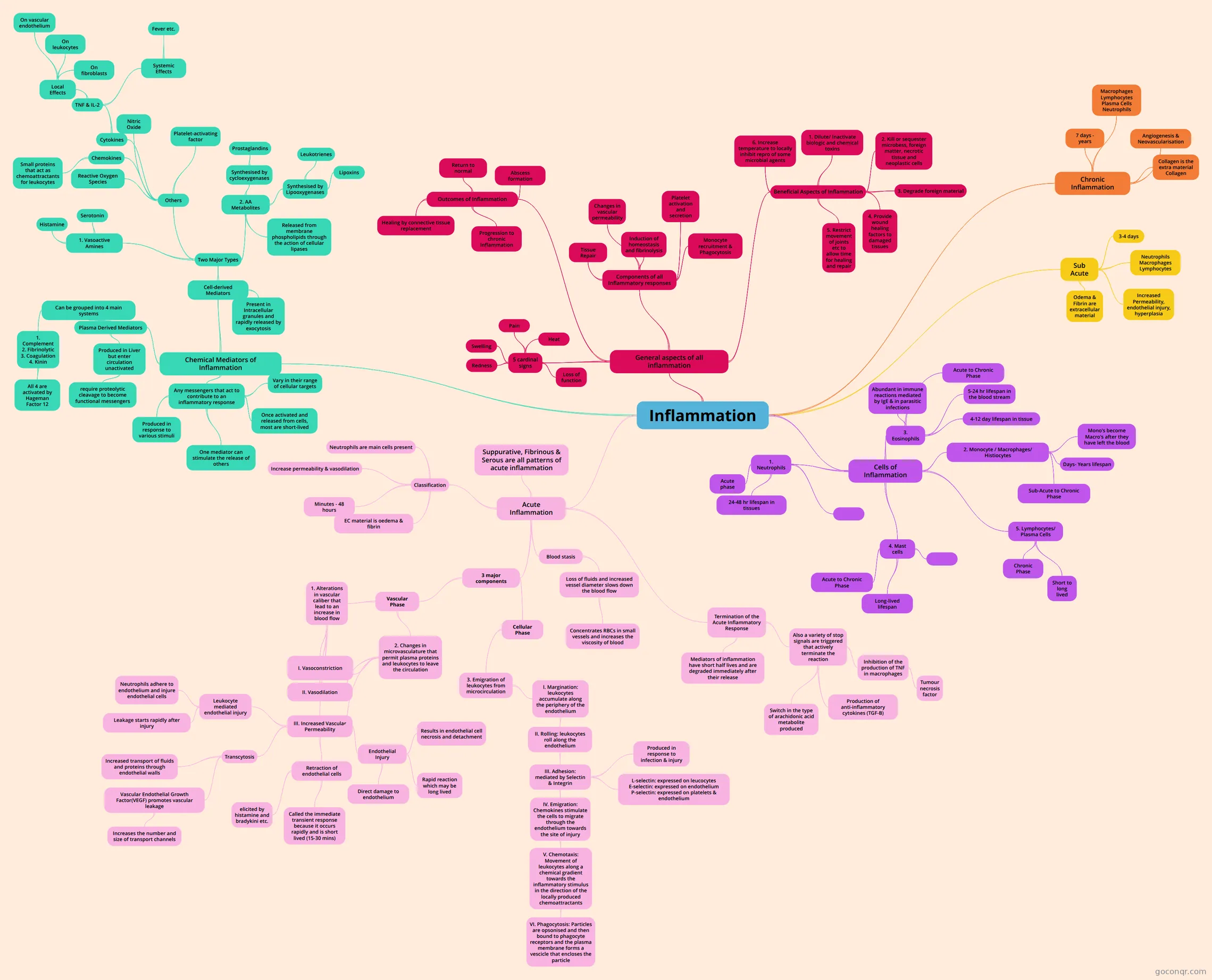
Mind map: Inflammation
Conteúdo do mapa
Inflammation
General aspects of all inflammation
- 5 cardinal signs
- Heat
- Redness
- Swelling
- Pain
- Loss of function
- Components of all Inflammatory responses
- Changes in vascular permeability
- Induction of homeostasis and fibrinolysis
- Platelet activation and secretion
- Monocyte recruitment & Phagocytosis
- Tissue Repair
- Beneficial Aspects of Inflammation
- 1. Dilute/ Inactivate biologic and chemical toxins
- 2. Kill or sequester microbess, foreign matter, necrotic tissue and neoplastic cells
- 3. Degrade foreign material
- 4. Provide wound healing factors to damaged tissues
- 5. Restrict movement of joints etc to allow time for healing and repair
- 6. Increase temperature to locally inhibit repro of some microbial agents
- Outcomes of Inflammation
- Return to normal
- Abscess formation
- Healing by connective tissue replacement
- Progression to chronic Inflammation
- 5 cardinal signs
Acute Inflammation
- Classification
- Minutes - 48 hours
- Neutrophils are main cells present
- Increase permeability & vasodilation
- EC material is oedema & fibrin
- 3 major components
- Vascular Phase
- 1. Alterations in vascular caliber that lead to an increase in blood flow
- I. Vasoconstriction
- II. Vasodilation
- III. Increased Vascular Permeability
- Retraction of endothelial cells
- elicited by histamine and bradykini etc.
- Called the immediate transient response because it occurs rapidly and is short lived (15-30 mins)
- Endothelial Injury
- Direct damage to endothelium
- Rapid reaction which may be long lived
- Results in endothelial cell necrosis and detachment
- Leukocyte mediated endothelial injury
- Neutrophils adhere to endothelium and injure endothelial cells
- Leakage starts rapidly after injury
- Transcytosis
- Increased transport of fluids and proteins through endothelial walls
- Vascular Endothelial Growth Factor(VEGF) promotes vascular leakage
- Increases the number and size of transport channels
- Retraction of endothelial cells
- 2. Changes in microvasculature that permit plasma proteins and leukocytes to leave the circulation
- 1. Alterations in vascular caliber that lead to an increase in blood flow
- Cellular Phase
- 3. Emigration of leukocytes from microcirculation
- I. Margination: leukocytes accumulate along the periphery of the endothelium
- II. Rolling: leukocytes roll along the endothelium
- III. Adhesion: mediated by Selectin & Integrin
- Produced in response to infection & injury
- L-selectin: expressed on leucocytes E-selectin: expressed on endothelium P-selectin: expressed on platelets & endothelium
- IV. Emigration: Chemokines stimulate the cells to migrate through the endothelium towards the site of injury
- V. Chemotaxis: Movement of leukocytes along a chemical gradient towards the inflammatory stimulus in the direction of the locally produced chemoattractants
- VI. Phagocytosis: Particles are opsonised and then bound to phagocyte receptors and the plasma membrane forms a vescicle that encloses the particle
- V. Chemotaxis: Movement of leukocytes along a chemical gradient towards the inflammatory stimulus in the direction of the locally produced chemoattractants
- III. Adhesion: mediated by Selectin & Integrin
- II. Rolling: leukocytes roll along the endothelium
- I. Margination: leukocytes accumulate along the periphery of the endothelium
- 3. Emigration of leukocytes from microcirculation
- Vascular Phase
- Blood stasis
- Loss of fluids and increased vessel diameter slows down the blood flow
- Concentrates RBCs in small vessels and increases the viscosity of blood
- Loss of fluids and increased vessel diameter slows down the blood flow
- Termination of the Acute Inflammatory Response
- Mediators of inflammation have short half lives and are degraded immediately after their release
- Also a variety of stop signals are triggered that actively terminate the reaction
- Switch in the type of arachidonic acid metabolite produced
- Production of anti-inflammatory cytokines (TGF-B)
- Inhibition of the production of TNF in macrophages
- Tumour necrosis factor
- Suppurative, Fibrinous & Serous are all patterns of acute inflammation
- Classification
Cells of Inflammation
- 1. Neutrophils
- Acute phase
- 24-48 hr lifespan in tissues
- 2. Monocyte / Macrophages/ Histiocytes
- Sub-Acute to Chronic Phase
- Days- Years lifespan
- Mono's become Macro's after they have left the blood
- 3. Eosinophils
- Acute to Chronic Phase
- 5-24 hr lifespan in the blood stream
- 4-12 day lifespan in tissue
- Abundant in immune reactions mediated by IgE & in parasitic infections
- 4. Mast cells
- Acute to Chronic Phase
- Long-lived lifespan
- 5. Lymphocytes/ Plasma Cells
- Chronic Phase
- Short to long lived
- 1. Neutrophils
Chemical Mediators of Inflammation
- Any messengers that act to contribute to an inflammatory response
- Produced in response to various stimuli
- One mediator can stimulate the release of others
- Vary in their range of cellular targets
- Once activated and released from cells, most are short-lived
- Plasma Derived Mediators
- Produced in Liver but enter circulation unactivated
- require proteolytic cleavage to become functional messengers
- Can be grouped into 4 main systems
- 1. Complement 2. Fibrinolytic 3. Coagulation 4. Kinin
- All 4 are activated by Hageman Factor 12
- 1. Complement 2. Fibrinolytic 3. Coagulation 4. Kinin
- Produced in Liver but enter circulation unactivated
- Cell-derived Mediators
- Present in Intracellular granules and rapidly released by exocytosis
- Two Major Types
- 1. Vasoactive Amines
- Histamine
- Serotonin
- 2. AA Metabolites
- Synthesised by cycloexygenases
- Prostaglandins
- Synthesised by Lipooxygenases
- Leukotrienes
- Lipoxins
- Released from membrane phospholipids through the action of cellular lipases
- Synthesised by cycloexygenases
- Others
- Platelet-activating factor
- Reactive Oxygen Species
- Nitric Oxide
- Cytokines
- TNF & IL-2
- Local Effects
- On vascular endothelium
- On leukocytes
- On fibroblasts
- Systemic Effects
- Fever etc.
- Local Effects
- TNF & IL-2
- Chemokines
- Small proteins that act as chemoattractants for leukocytes
- 1. Vasoactive Amines
- Any messengers that act to contribute to an inflammatory response
Chronic Inflammation
- 7 days - years
- Macrophages Lymphocytes Plasma Cells Neutrophils
- Angiogenesis & Neovascularisation
- Collagen is the extra material Collagen
Sub Acute
- 3-4 days
- Neutrophils Macrophages Lymphocytes
- Odema & Fibrin are extracellular material
- Increased Permeability, endothelial injury, hyperplasia
Informações
- Descrição
- Mapa Mental sobre Inflammation., criado por jemmaguyton em 02-05-2015.
- Criado por
- jemmaguyton
- Visualizações
- 0
- Avaliação