
Mapa mental
Adaptations HT
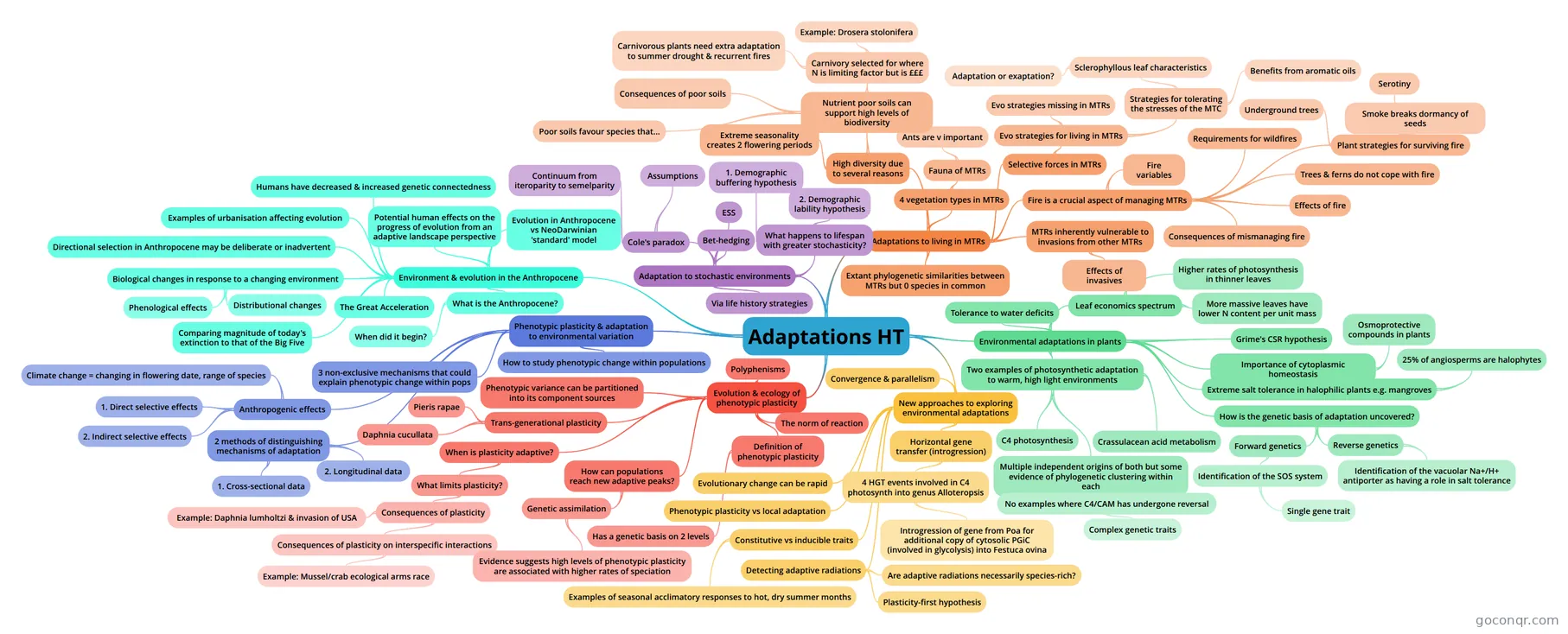
Mind map: Environmental adaptations
Conteúdo do mapa
Adaptations HT
Adaptation to stochastic environments
- Via life history strategies
- A life history strategy is a unique combo of investment in survival, development & reproduction - Each constrained by limited resources, physiological limitations & microevolutionary processes - All cannot be maximised otherwise Darwinian demon
- Cole's paradox
- For an annual species, the absolute gain in intrinsic population growth which could be achieved by changing to the perennial reproductive habit would be exactly equivalent to adding one individual to the average litter size – expect everyone to be semelparous, but then we find iteroparous, more likely to evolve change of one more to litter than change to different strategy Why complicate your life? Put it all into reproduction!
- Continuum from iteroparity to semelparity
- Assumptions
- - No costs of reproduction e.g. immortality - Juveniles are not fragile - Lack of stage-specific density-dependence
- Bet-hedging
- Short-term sacrifice for long-term benefit Sometimes it can payoff e.g. drought & those that have not germinated will survive Long-term expected growth rate higher when bet hedging with seeds Difficult to become fixed as environments constantly changing
- ESS
- The strategy that cannot be invaded by any other
- What happens to lifespan with greater stochasticity?
- - Key prediction from life history theory is that random (iid) variation in environmental conditions select for annual species {independent and identically distributed} → we expect variation to select for short-lived species so why still long-lived species? - More stochasticity = more covariation in vital rates = more stochastic population growth rate so long-lived must be bad - Typically yes BUT species have evolved strategies to deal with such temporal variation: buffering vs tracking environmental variation
- 1. Demographic buffering hypothesis
- Organisms should buffer their most influential vital rates against environmental variation (not all traits can be buffered so least influential impacted by environment)
- 2. Demographic lability hypothesis
- For some wild populations it is beneficial for most important vital rates to have relatively high variability; great deal of intra-specific variation in temporal demographic variation
- Via life history strategies
Adaptations to living in MTRs
- Extant phylogenetic similarities between MTRs but 0 species in common
- High diversity due to several reasons
- 1. Diversity has to be created & maintained 2. Created by pushing together of many species during periods of climate change 3. Maintained by: - Extreme seasonality creating 2 flowering periods - Nutrient poor soils with v deep water tables - Fire restarting successional clock - Unpredictable variables creating dynamic, heterogeneous matrix of selective forces - Human activity - Absence of dominating tree species
- Extreme seasonality creates 2 flowering periods
- Nutrient poor soils can support high levels of biodiversity
- Consequences of poor soils
- 1. Prevents domination by one species 2. Makes intensive agriculture feasible 3. Leads to significant elevation of nutrients after fire 4. Leads to temporary elevation of nutrients after rain by increasing activity of decomposers
- Poor soils favour species that...
- 1. fix nitrogen (e.g. members of the Fabaceae) 2. catch animals 3. have strong mycorrhizal associations - such as orchids 4. are parasitic (disputed because the host plant must be vigorous enough to support the parasite) - Dryandra scrub in W Australia kills all other seedlings that grow
- Carnivory selected for where N is limiting factor but is £££
- Carnivorous plants need extra adaptation to summer drought & recurrent fires
- Example: Drosera stolonifera
- Consequences of poor soils
- 4 vegetation types in MTRs
- 1. Forests e.g. coastal redwoods in California 2. Woodlands e.g. Pinus woodland in Europe 3. Scrub: all have very similar scrubland apart from Chile 4. Grasslands Present Mediterranean-type climate does not correspond exactly with Mediterranean-type vegetation
- Fauna of MTRs
- - Very few large herbivores (not much to eat, plants have defensive mechanisms) e.g. bears & elk (CA) baboons & rock hyrax/badger (SA) - Migrating & resident birds are abundant (seasonality means birds may come to MTRs to breed in spring) e.g. laughing kookaburras (WA) - Many specialist pollinators in WA - Ants are very important
- Ants are v important
- Very important in seed dispersal e.g. SW Australia 1,500 spp. (19%) have myrmecochorous seeds (dispersed by ants) Elaiosome (fat body attached to outside of seed) contains chemicals that trigger seed-carrying behaviour - seeds taken to ants' nest before elaiosome is removed
- Selective forces in MTRs
- 1. Annual precipitation generally limiting but unpredictable & variable: average min. 100-400mm & average max. 250-1000mm (100mm or less = arid) 2. High fire frequency (every 12-20 years, tropical is every century) 3. Winter rains at fairly high temperatures 4. Soil moisture available at depth during droughts 5. Temperature favourable for growth all-year-round (max. only 35°C) 6. Extended drought7. High summer temperatures
- Evo strategies for living in MTRs
- 1. Water-trapping devices 2. Water-conserving devices 3. Fire-stimulated germination 4. Re-sprouting behaviours 5. Secondary plant substances 6. Deep roots 7. Evergreen 8. Nitrogen acquisition 9. Metabolism at high water stress 10. Small leaves 11. Sclerophyllous tissue 12. Metabolic conservation of reserves
- Evo strategies missing in MTRs
- 1. Succulents (cannot live in fire-prone environment, can move in for short period in fire absence) 2. Ferns (no fire, maybe bracken?) 3. Plants that cannot avoid seasonal drought 4. Aquatic marginal plants (no standing water) 5. C4 & CAM photosynthesis (high input/output strategy - not hot enough), not even facultative 6. Pachycaul stems - Tenerife euphorbias (swollen fleshy stem)
- Strategies for tolerating the stresses of the MTC
- Seasonal drought Retreating strategies: 1.Underground perennating organs e.g. bulbs, corms & tubers (in many species) 2. Above ground perennating organs e.g. rhizomes in irises 3. Seeds - many species 4. Deciduous - summer (euphorbias on Crete) Leaf features to reduce loss: 5. Thick cuticle - cherry laurel 6. Sunken stomata - proteas 7. Indumentum & hairy leaves - Californian oaks 8. Oils for waterproofing & evaporation to lose heat - Cistus in Portugal 9. Rolled leaves - rosemary & pine 10. Sclerophyllous foliage - Quercus in Portugal
- Sclerophyllous leaf characteristics
- 1. Sclerenchymatous cell walls* 2. Evergreen (individual leaves lasting 24 months)* 3. Low SA:V 4. Spiky & grass-like 5. In-rolled leaf margins 6. Sunken stomata 7. Thick cuticle 8. Indumentum (hairs, generally on lower surface) 9. Tanins, resins or aromatic oils * = compulsory
- Adaptation or exaptation?
- Benefits from aromatic oils
- 1. Facilitating heat loss by evaporation 2. Water conservation by waterproofing surfaces 3. Sun screen reducing UV damage 4. Antibiotics against pathogens 5. Allelopathy (chemical inhibition of one plant by another) by creation of layer of toxic leaf litter 6. Nutrition for N-fixing bacteria 7. Increasing flammability of foliage 8. Attracting animal such as pollinators 9. Repelling animals such as herbivores 10. Inter-plant warning communication
- Fire is a crucial aspect of managing MTRs
- Requirements for wildfires
- 1. Fuel: plants 2. Ignition: lightning (or volcanoes) & Homo sapiens (ancestors used fire in sustainable way) 3. Oxygen: from oxygenic photosynthesis
- Fire variables
- 1. Height: canopy/understory/surface/ground 2. Area specific: age/size/topography 3. Intensity including temp: fuel load/fuel type 4. Duration: speed/seasonality 5. Frequency: annual to centennial
- Plant strategies for surviving fire
- 1. Die and recolonise from outside 2. Survive in situ - Grow back from seeds - re-seeders: soil seed bank, canopy seed bank in canopy cones - Sprout back from buds - re-sprouters: buds below ground/in canopy
- Underground trees
- Smoke breaks dormancy of seeds
- Serotiny
- Trees & ferns do not cope with fire
- Effects of fire
- 1. Removal or pests & diseases 2. Recycling of nutrients & removal of toxic leaf litter e.g. Cistus 3. Resetting of successional clock provides opportunities for ephemerals, annuals & geophytes 4. More light reaches soil/soil warmed by sun 5. Creating heterogeneity/habitat fragmentation -> maintains speciation 6. Prevents intergenerational hybrids/generates genetic bottlenecks (opportunity for speciation)
- Consequences of mismanaging fire
- 1. Loss of species diversity & local extinctions 2. Biological invasions e.g. African cheat grass that burns annually thus eliminating re-sprouters & woody re-seeders (changes fire regime from every 10 years to 1 year) 3. Soil erosion when plants die – plants are the “green glue” (can lead to landslides) 4. Loss of property 5. Loss of human lives
- Requirements for wildfires
- MTRs inherently vulnerable to invasions from other MTRs
- Effects of invasives
- 1. Invasions reduce species diversity by local extinctions due to out-competing/predating native species, leading to a cascade of changes 2. Invasions can change soil conditions e.g. by increasing fertility local extinctions of Fabaceae can result 3. Invasions can change fire regimes (frequencies) resulting in local extinctions & deaths 4. Invasions can change water tables resulting in local extinctions & economic losses 5. Inheritors of the Earth: How Nature Is Thriving in an Age of Extinction by Chris Thomas has a different view
- Effects of invasives
Environmental adaptations in plants
- Tolerance to water deficits
- 1. Morphology e.g. leaf traits - Small leaf size, leaf mass per unit area, pubescence, surface reflectance; sunken stomata, deciduousness 2. Life-history strategies - Short-lived ephemerals (drought escapers) vs long-lived perennials (drought tolerators) 3. Cellular mechanisms e.g. biochemistry - Stress tolerance at cellular level (compatible solutes, antioxidants, heat shock proteins) - C4 & CAM photosynthesis
- Leaf economics spectrum
- - Species from resource-rich environments tend to have fast growth & leaf traits suited for fast or ‘acquisitive’ resource capture [high specific leaf area (SLA), mass-based leaf nitrogen concentration & net photosynthetic rate] - Species from resource-poor environments are characterised by slow growth & ‘conservative’ resource capture traits (low SLA, leaf nitrogen concentration & net photosynthetic rate) - Species adapted to high-stress environments typically have conservative leaf traits & inherently slow growth rates - SLA: leaf area per unit mass
- Higher rates of photosynthesis in thinner leaves
- More massive leaves have lower N content per unit mass
- Grime's CSR hypothesis
- Highlights the importance of stress & disturbance & relative growth rate (RGR) Stress: light, water, temperature, nutrients Disturbance: herbivores, pathogens, physical damage Ruderals complete their life cycle very quickly
- Importance of cytoplasmic homeostasis
- - Maintenance of essential internal cell functions in the face of different external challenges (e.g. salinity) - Vacuole & cytosol have very different requirements: - Vacuole: low pH, high Ca2+, high Na+, Cl- - Cytosol: near neutral pH, low Ca2+, relatively low Na+, Cl-, high compatible solutes e.g. sucrose, glycine betaine, proline - Vacuole membrane is extremely important boundary - Need to maintain osmotic balance
- Osmoprotective compounds in plants
- Cytoplasmic compatible solutes which don't disrupt the hydration shells of macromolecules e.g. proline, glycine betaine & sucrose
- Extreme salt tolerance in halophilic plants e.g. mangroves
- - Stilt roots allow roots to still obtain oxygen - Saltbush (& mangroves) have highest salinity tolerance, there is slight stimulation of growth at moderate levels of NaCl
- 25% of angiosperms are halophytes
- How is the genetic basis of adaptation uncovered?
- Forward genetics
- Screening for abnormal phenotypes in mutagenised population, then identifying (e.g. by mapping) gene responsible
- Identification of the SOS system
- - Isolation of sos (salt overly sensitive mutants) - Screen of a mutagenised population of Arabidopsis thaliana on media with or without supplemental NaCl, or on low K media with or without supplemental Ca - Identified 3 genes (SOS1, SOS2, SOS3 - salt overly sensitive) implicated in salt tolerance
- Single gene trait
- Reverse genetics
- Having selected candidate gene, test for phenotypic effects by gene knock-out or knock-down (loss of function) or by overexpression (gain of function)
- Identification of the vacuolar Na+/H+ antiporter as having a role in salt tolerance
- - Overexpression of candidate vacuolar Na+/H+ antiporter (AtNHX1) increases salt tolerance in Arabidopsis thaliana - Testing function of a putative salt tolerance gene by overexpression in transgenic plants - overexpression = salt tolerance - AtHKT1 locus identified as being involved in Na transport
- Forward genetics
- Two examples of photosynthetic adaptation to warm, high light environments
- C4 photosynthesis
- - A CO2 concentrating mechanism - Found in tropical grasses & sedges (monocots) (very fast growth rates) AND stress-tolerant halophytes (eudicots)- Among most productive plants on Earth: ~25% of global annual terrestrial net primary productivity - Found in ~3% of angiosperms - >65 independent origins- 8 independent origins of C4 in grasses- Convergence on common amino acid changes in independent lineages e.g. substitution of alanine for serine at position 780
- Crassulacean acid metabolism
- - Found in terrestrial succulents of seasonally arid, semi-desert habitats (also orchids, bromeliads) - Good examples of phylogenetic niche conservatism - Phylogeny of Bromeliaceae: 3 origins of epiphytism, 4 origins of CAM photosynthesis
- Multiple independent origins of both but some evidence of phylogenetic clustering within each
- No examples where C4/CAM has undergone reversal
- - In grasses, C4 photosynthesis evolved first to allow survival in drier, more stressful environments - In chenopods/amaranths, salt tolerance is ancestral trait & has undergone several losses as C4 photosynthesis was gained
- Complex genetic traits
- No examples where C4/CAM has undergone reversal
- C4 photosynthesis
- Tolerance to water deficits
New approaches to exploring environmental adaptations
- Convergence & parallelism
- Convergent substitutions are similar mutations which arise through different routes; parallel substitutions are mutations which arise through precisely the same pathway
- Horizontal gene transfer (introgression)
- 4 HGT events involved in C4 photosynth into genus Alloteropsis
- Introgression of gene from Poa for additional copy of cytosolic PGiC (involved in glycolysis) into Festuca ovina
- 4 HGT events involved in C4 photosynth into genus Alloteropsis
- Detecting adaptive radiations
- 1. Common ancestry → evidence from phylogenies 2. Phenotype-environmental correlation → statistical tests 3. Trait utility → correlations & statistical tests 4. Rapid speciation → rate tests from phylogenies - Crucial importance of phylogenetically independent contrasts
- Are adaptive radiations necessarily species-rich?
- - Galápagos finches only 15 extant species yet large range of divergent phenotypes - Huge diversity of life-forms in bromeliad genus Brocchinia (only 20 spp.) - Some species-rich, rapid radiations may be non-adaptive e.g. ecological niche conservatism in SA ice plants (Aizoaceae), ca. 1500 spp. in subfamily Ruschioideae (morphologically very similar) – a result of a 'key innovation' (and if so, what was it)
- Plasticity-first hypothesis
- Phenotypic plasticity precedes & possibly facilitates adaptive evolution Rests on the observation that phenotypic plasticity often produces developmental variants that can enhance fitness under stressful conditions Difficult to demonstrate: must compare fitness of induced vs canalised novel phenotypes in ancestral vs novel environment
- Constitutive vs inducible traits
- Constitutive traits are continuously expressed but inducible traits may only be expressed under certain environmental conditions, or at a certain stage of development
- Examples of seasonal acclimatory responses to hot, dry summer months
- 1. Encelia farinosa (Asteraceae) shows plasticity in leaf morphology: covered by dense pubescence which turns silver to reflect radiation 2. Mesembryanthemum crystallinum (Aizoaceae) shows inducibility of CAM photosynthesis: during dry season when under water stress
- Phenotypic plasticity vs local adaptation
- - Importance of the 'common garden experiment' (Turesson, 1922): studied elevation, plants smaller at higher elevations - Reciprocal transplant experiments: take plants from north & south, grow together, if differences seen then underlying genetic mechanism, if same then due to phenotypic plasticity - Local adaptation strictly requires demonstration of 'home-field advantage' (do better in home conditions) - Analysis of gene × environment interactions
- Evolutionary change can be rapid
- 1. The peppered moth, Biston betularia - different colour morphs in response to pollution 2. Local populations of metal-tolerant grasses under electricity pylons e.g. Zn-tolerant under pylons, Cu-tolerant near copper mines/smelters, metallophytes such as Viola lutea which are tolerant of calamine soils (ZN, Pb, Cd) 3. Evolution of pesticide resistance in insect populations 4. Responses to climate change 5. Range expansion or responses to biotic invasion - Major debate as to relative importance of pre-existing standing genetic variation vs. de novo mutation as sources of favourable alleles
- Convergence & parallelism
Evolution & ecology of phenotypic plasticity
- Polyphenisms
- A polyphenism is a polymorphism with an environmental trigger Can be induced... In response to sudden changes in the environment Variation in annual cycle Variable responses to repeated variable environments Response to consistent change over lifespan
- Definition of phenotypic plasticity
- Phenotypic plasticity is the ability of a given genotype to produce a range of phenotypes in different environments OR Phenotypic plasticity is the component of the phenotype that results from the interaction of genes and the environment (not formally needed)
- Has a genetic basis on 2 levels
- 1. Plasticity genes 2. Genetic variation in plasticity
- The norm of reaction
- A norm of reaction is an array of phenotypes that will be developed by a single genotype over an array of environments
- Phenotypic variance can be partitioned into its component sources
- Simplest is VP = VG + VR If effect of genes depends on environment then we should write: VP = VG + VE + VG*E + VR VR = residual (unexplained)VG = genetic varianceVE = variance due to environmentVG*E = interaction of two (due to phenotypic plasticity) → not product of G+E but variance resulting from their interaction
- Trans-generational plasticity
- Pieris rapae
- Daphnia cucullata
- When is plasticity adaptive?
- - If plastic genotype performs better than non-plastic one across a range of conditions - Generally, we expect to see evolution of plasticity when: 1. Environment is variable in time at shorter scale than generation time 2. Environment varies in space at smaller scale than average dispersal distance
- What limits plasticity?
- - Potential costs e.g. sensory (needed to measure environment) or developmental apparatus - Information reliability - Lag time (how long it takes to show developmental response) - Developmental range e.g. constraints on growth rate or nutrient processing rate
- Consequences of plasticity
- 1. Modulating natural selection i.e. gene-phenotype relationship complex 2. Interspecific interactions 3. Innovation & spread to new environments 4. Facilitating genetic change - genetic assimilation
- Consequences of plasticity on interspecific interactions
- 1. Effects of predators on in induced defences in prey 2. Ecological arms-races in predator & prey (or herbivore/plant) defences 3. Character displacement between competing species?
- Example: Mussel/crab ecological arms race
- Example: Daphnia lumholtzi & invasion of USA
- How can populations reach new adaptive peaks?
- Genetic assimilation
- - With little plasticity, a new environment displaces the phenotype a little from the optimum, causing selection towards smaller values of the phenotype distribution - Shifts in phenotypic values might be caused by plasticity in related traits e.g. plasticity in behaviour may lead to exploitation of a new resource in a new environment (reach a new adaptive peak)
- Evidence suggests high levels of phenotypic plasticity are associated with higher rates of speciation
- Genetic assimilation
- Polyphenisms
Phenotypic plasticity & adaptation to environmental variation
- How to study phenotypic change within populations
- - Use a cross-sectional study - ignores info about individual identity - Given a long-enough time series it may be relatively easy to demonstrate a change in mean phenotype of population over time
- 3 non-exclusive mechanisms that could explain phenotypic change within pops
- 1. Evolution 2. Phenotypic plasticity 3. Migration, or movement, linked to phenotype
- 2 methods of distinguishing mechanisms of adaptation
- 1. Cross-sectional data
- 2. Longitudinal data
- Anthropogenic effects
- 1. Direct selective effects
- Where human activity applies selection pressure directly though that activity
- 2. Indirect selective effects
- Where human activity causes a change in the environment, which acts as a novel selective force
- Climate change = changing in flowering date, range of species
- 1. Direct selective effects
- How to study phenotypic change within populations
Environment & evolution in the Anthropocene
- What is the Anthropocene?
- Defined as a new Geological Epoch, following the Holocene, during which humans have become the dominant force in driving changes in the composition and structure of the Earth's land surface – coined in 2000
- When did it begin?
- - Seeking a sudden change in global systems – a ‘golden spike’ that acts as a clear marker for change - Two candidates identified by Lewis & Maslin (2015): 1. 1610: OrbisGSSP – CO2 drop probably caused by population crash in Americas following European invasion & introduction of diseases, no longer using land for crops so increase in CO2 fixation as wild grew back 2. 1964: Bomb GSSP – spike in 14C in tree rings as a consequence of nuclear tests
- The Great Acceleration
- Post 1950 we see dramatic changes in almost everything e.g. population, GDP, water use, fertiliser consumption, McDonald's, international tourism (industrialisation and globalisation)
- Comparing magnitude of today's extinction to that of the Big Five
- - Because rate and magnitude are so intimately linked, a critical question is whether current rates would produce Big-Five-magnitude mass extinctions in the same amount of geological time that we think most Big Five extinctions spanned - Answer is YES: Current extinction rates for mammals, amphibians, birds & reptiles, if calculated over the last 500 years are faster than or as fast as all rates that would have produced the Big Five extinctions over hundreds of thousands or millions of years
- Biological changes in response to a changing environment
- Phenological effects
- Distributional changes
- - Climate-related - Invasive & introduced species
- Directional selection in Anthropocene may be deliberate or inadvertent
- Examples of urbanisation affecting evolution
- 1. Pollution from steel mills in industrial cities causes higher mutation rates in herring gull as compared with nonindustrial cities or rural areas 2. Increased urbanisation leads to stronger genetic drift & decreased genetic diversity in white-footed mice due to isolation 3. A major river, buildings & woodlands increase resistance to gene flow in the common wall lizard 4. Urban white clover consistently evolved decreased antiherbivore chemical defences in cities compared with suburban and rural populations
- Humans have decreased & increased genetic connectedness
- Potential human effects on the progress of evolution from an adaptive landscape perspective
- 1. Humans add a new peak that reduces the distinctiveness of old peak (3 populations merge) - diversity decreases 2. Humans add a new peak that does not reduce the distinctiveness of old peaks - diversity increases 3. Humans flatten & lower adaptive peaks (change gradient) - diversity decreases 4. Humans raise & steepen adaptive peaks (make peaks more distinct) - divergence increases
- Evolution in Anthropocene vs NeoDarwinian 'standard' model
- - Selection – or agent of selection is sometimes teleological (with particular goal e.g. increased fish size) versus ‘blind’ with respect to outcome - Rates of change are more rapid than any previous – with possible exception of mass extinctions - Long-distance movements break down isolation by distance, local adaptation, population genetic structure - Local effects may hugely increase genetic structuring
- What is the Anthropocene?
Informações
- Descrição
- Mapa Mental sobre Adaptations HT, criado por Naomi Hawrylak em 08-10-2020.
- Criado por
- Naomi Hawrylak
- Visualizações
- 0
- Avaliação