
Mapa mental
Sexual Selection & Human Reproductive Behaviour
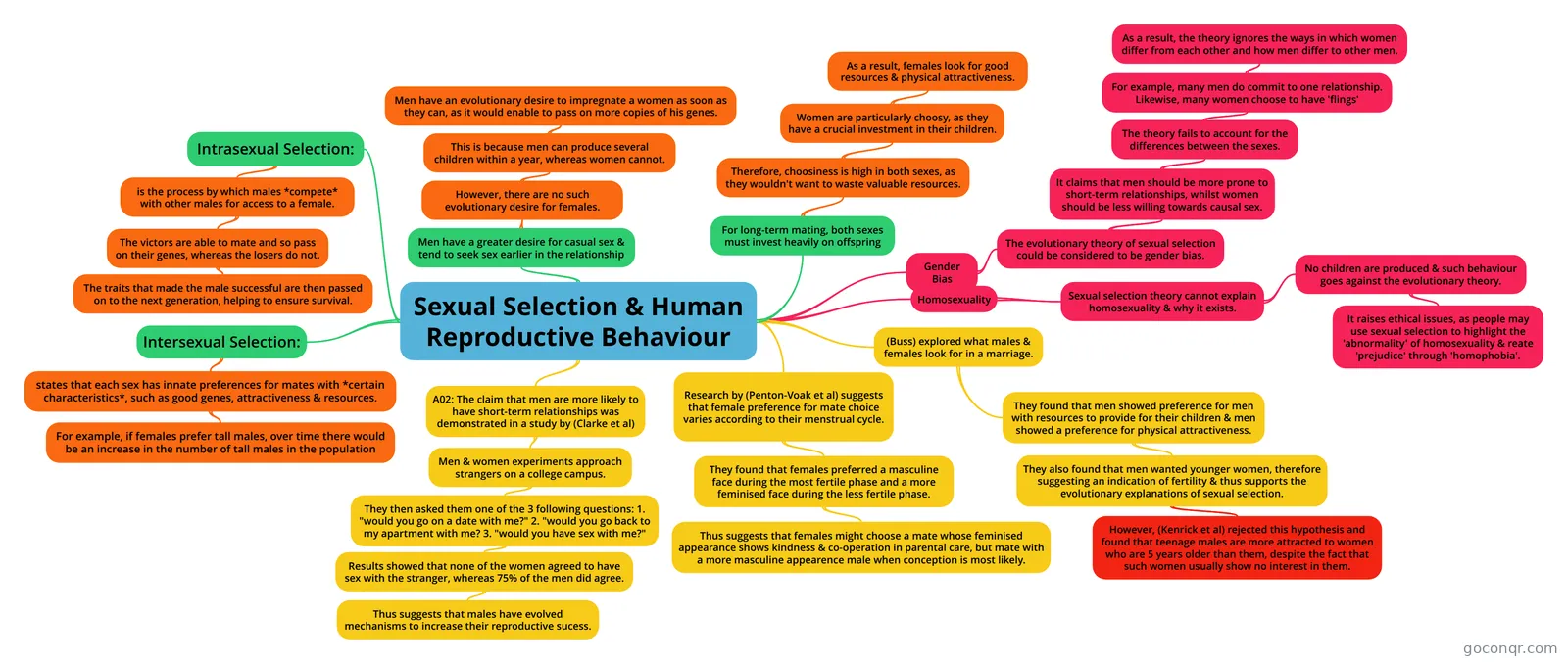
Mind map: Sexual selection & human reproductive behaviour
Conteúdo do mapa
Sexual Selection & Human Reproductive Behaviour
Intrasexual Selection:
- is the process by which males *compete* with other males for access to a female.
- The victors are able to mate and so pass on their genes, whereas the losers do not.
- The traits that made the male successful are then passed on to the next generation, helping to ensure survival.
- The victors are able to mate and so pass on their genes, whereas the losers do not.
- is the process by which males *compete* with other males for access to a female.
Intersexual Selection:
- states that each sex has innate preferences for mates with *certain characteristics*, such as good genes, attractiveness & resources.
- For example, if females prefer tall males, over time there would be an increase in the number of tall males in the population
- states that each sex has innate preferences for mates with *certain characteristics*, such as good genes, attractiveness & resources.
Men have a greater desire for casual sex & tend to seek sex earlier in the relationship
- However, there are no such evolutionary desire for females.
- This is because men can produce several children within a year, whereas women cannot.
- Men have an evolutionary desire to impregnate a women as soon as they can, as it would enable to pass on more copies of his genes.
- This is because men can produce several children within a year, whereas women cannot.
- However, there are no such evolutionary desire for females.
For long-term mating, both sexes must invest heavily on offspring
- Therefore, choosiness is high in both sexes, as they wouldn't want to waste valuable resources.
- Women are particularly choosy, as they have a crucial investment in their children.
- As a result, females look for good resources & physical attractiveness.
- Women are particularly choosy, as they have a crucial investment in their children.
- Therefore, choosiness is high in both sexes, as they wouldn't want to waste valuable resources.
A02: The claim that men are more likely to have short-term relationships was demonstrated in a study by (Clarke et al)
- Men & women experiments approach strangers on a college campus.
- They then asked them one of the 3 following questions: 1. "would you go on a date with me?" 2. "would you go back to my apartment with me? 3. "would you have sex with me?"
- Results showed that none of the women agreed to have sex with the stranger, whereas 75% of the men did agree.
- Thus suggests that males have evolved mechanisms to increase their reproductive sucess.
- Results showed that none of the women agreed to have sex with the stranger, whereas 75% of the men did agree.
- They then asked them one of the 3 following questions: 1. "would you go on a date with me?" 2. "would you go back to my apartment with me? 3. "would you have sex with me?"
- Men & women experiments approach strangers on a college campus.
Research by (Penton-Voak et al) suggests that female preference for mate choice varies according to their menstrual cycle.
- They found that females preferred a masculine face during the most fertile phase and a more feminised face during the less fertile phase.
- Thus suggests that females might choose a mate whose feminised appearance shows kindness & co-operation in parental care, but mate with a more masculine appearence male when conception is most likely.
- They found that females preferred a masculine face during the most fertile phase and a more feminised face during the less fertile phase.
(Buss) explored what males & females look for in a marriage.
- They found that men showed preference for men with resources to provide for their children & men showed a preference for physical attractiveness.
- They also found that men wanted younger women, therefore suggesting an indication of fertility & thus supports the evolutionary explanations of sexual selection.
- However, (Kenrick et al) rejected this hypothesis and found that teenage males are more attracted to women who are 5 years older than them, despite the fact that such women usually show no interest in them.
- They also found that men wanted younger women, therefore suggesting an indication of fertility & thus supports the evolutionary explanations of sexual selection.
- They found that men showed preference for men with resources to provide for their children & men showed a preference for physical attractiveness.
Gender Bias
- The evolutionary theory of sexual selection could be considered to be gender bias.
- It claims that men should be more prone to short-term relationships, whilst women should be less willing towards causal sex.
- The theory fails to account for the differences between the sexes.
- For example, many men do commit to one relationship. Likewise, many women choose to have 'flings'
- As a result, the theory ignores the ways in which women differ from each other and how men differ to other men.
- For example, many men do commit to one relationship. Likewise, many women choose to have 'flings'
- The theory fails to account for the differences between the sexes.
- It claims that men should be more prone to short-term relationships, whilst women should be less willing towards causal sex.
- The evolutionary theory of sexual selection could be considered to be gender bias.
Homosexuality
- Sexual selection theory cannot explain homosexuality & why it exists.
- No children are produced & such behaviour goes against the evolutionary theory.
- It raises ethical issues, as people may use sexual selection to highlight the 'abnormality' of homosexuality & reate 'prejudice' through 'homophobia'.
- No children are produced & such behaviour goes against the evolutionary theory.
- Sexual selection theory cannot explain homosexuality & why it exists.
Informações
- Descrição
- Relationship Essay Plans Mapa Mental sobre Sexual Selection & Human Reproductive Behaviour, criado por Louise-Anne Mir em 13-05-2015.
- Criado por
- Louise-Anne Mir
- Visualizações
- 0
- Avaliação
Mais sobre Sexual selection and partner preferences