
Mapa mental
WHY CLIL & DEFINING CLIL
Conteúdo do mapa
WHY CLIL & DEFINING CLIL
The acronym CLIL was originally defined in 1994, and launched in 1996 by UNICOM, University of Jyväskylä (in Finland) and the European Platform for Dutch Education.
- Subjects are taught through a foreign language with dual focused aims, namely the learning of content, and the simultaneous learning of a foreign language.
- This was later extended to include learning through any language that is not the first language of the learner.
1.7. HOW DO WE DECIDE ON THE CONTENT?
- So there appear to be three aspects missing in standard foreign language teaching, if by 'standard' we judge the approach as represented by its most successful and best selling textbooks. Language teaching appears to lack.. 1. conceptual authenticity/depth (disposable content) 2. functional logic (why are we doing this today?) 3. conceptual continuity (conceptual sequencing).
- There appears to be a problem at the heart of the practice, a problem that was never solved by methodological innovation alone. The question of content and then of the methodology that best works alongside it-are crucial considerations when discussing the issue of paradigm change in language teaching. LIL claims to have the answers.
- Spanish Reforma of 1991 (Diseño Curricular Base, MEC 1991), the curriculum was divided up into three sections or 'blocks'. This was the framework which would allow valid and reliable assessment of the content of those blocks. The blocks were 'Conceptos. Procedimientos, Actitudes' (Concepts, Procedures/Skills, Attitudes). What was interesting about these three blocks was that they were all considered to be 'Contenidos' (Contents).
- We have already considered the curious distinction between a language syllabus and a 'normal' syllabus, we complained of a lack of conceptual authenticity (disposable content which is enslaved to the underlying linguistic objective), a lack of functional logic (why are we doing this today?) and also of a lack of conceptual continuity (conceptual sequencing). What CLIL seems to consist of - in terms of the most minimal of considerations - is some kind of thematic continuity, over a reasonable period of time.
- There appears to be a problem at the heart of the practice, a problem that was never solved by methodological innovation alone. The question of content and then of the methodology that best works alongside it-are crucial considerations when discussing the issue of paradigm change in language teaching. LIL claims to have the answers.
- So there appear to be three aspects missing in standard foreign language teaching, if by 'standard' we judge the approach as represented by its most successful and best selling textbooks. Language teaching appears to lack.. 1. conceptual authenticity/depth (disposable content) 2. functional logic (why are we doing this today?) 3. conceptual continuity (conceptual sequencing).
One of the most useful was written by Marsh D (2002): Content and Language Integrated Learning (CLIL) refers to any dual focused educational context in which an additional language, thus not usually the first language of the learners involved, is used as a medium in the teaching and learning of non-language content. It is dual-focused because whereas attention may be predominantly on either subject specific content or language, both are always accommodated.
David Graddol calls CLIL: an approach to bilingual education in which both curriculum content (such as science or geography and English are taught together. It differs from simple English-medium education in that the learner is not necessarily expected to have the English proficiency required to cope with the subject before beginning study. Hence it is a means of teaching curriculum subjects through the medium of a language still being learned providing the necessary language support alongside the subject specialism. CLIL can also be regarded the other way around - as a means of teaching English through study of a specialist content. (Graddol D, 2006)
Prabhu (1982) was insistent on the idea of what he called a 'procedural syllabus'. The procedures (skills) he was interested in were closer to, although perhaps less substantial than, pure subject lists of relevant skills or cognitive operations, but at least they seemed to define what he meant by 'task'.
Nunan (1988) contrasts the task-based syllabus with the traditional grammatical syllabus. The grammatical syllabus is product oriented, emphasizing the learning outcomes, goals or ends of the language course, whereas the task-based syllabus is more process oriented, giving attention to the learning processes or means by which the ability to communicate will be developed. Tasks seem to involve a problem - something to solve. They also involve a pedagogic and a psycholinguistic rationale. Pedagogically, they often give way to group work which increases the quantity of communication, and psycho-linguistically they can increase the quality of student communication through negotiation, decision-making etc).
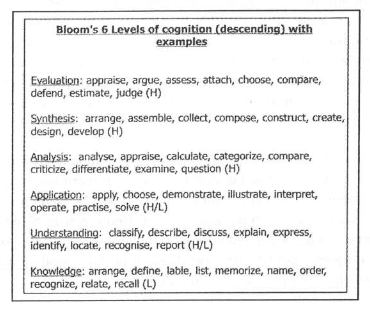
Bloom identified a hierarchy of 'thinking skills', which he basically divided between what he called 'higher order' and 'lower order'. Bloom's argument (which remains under some dispute) was that educators should strive to include in the curriculum as many 'high order' skills as possible, because only then could schools or universities be sure that a certain percentage of students could attain what he called 'complete mastery of the subject matter'.
- A rough representation of the 6-level cognitive hierarchy would be as below: The top three 'skills' are considered to be Higher Order (H), the bottom skill Lower Order (L) and the remaining a mixture (L/H). Synthesis Application Understanding Knowledge.
- Reading all of the above, it seems surprising to look back on the three pillars of Communicative Language Teaching and to discover that they were informed by three trends: Communicativeness (Activities that promote real communication). Tasks Activities that create the need for meaningful language use). Meaningfulness (If the language used in an activity is meaningful to the learner, the learning process will be more effective)
- CONCLUSION: If the students are involved, then the discussion constitutes 'real communication' (sic). And last but not least, within this process the language used both functional and topical) will automatically be relevant, unlike the language imported into the chapter by 'Headway' for the purely artificial purposes of expressing a few isolated examples of the First Conditional.
- REFERENCE: • WHY CLIL & DEFINING CLIL (2020) IEXPRO, Tuxtla Gutierrez Chiapas.
- BY RUBEN GARCIA MEDEL
- REFERENCE: • WHY CLIL & DEFINING CLIL (2020) IEXPRO, Tuxtla Gutierrez Chiapas.
- CONCLUSION: If the students are involved, then the discussion constitutes 'real communication' (sic). And last but not least, within this process the language used both functional and topical) will automatically be relevant, unlike the language imported into the chapter by 'Headway' for the purely artificial purposes of expressing a few isolated examples of the First Conditional.
- TABLE
- Reading all of the above, it seems surprising to look back on the three pillars of Communicative Language Teaching and to discover that they were informed by three trends: Communicativeness (Activities that promote real communication). Tasks Activities that create the need for meaningful language use). Meaningfulness (If the language used in an activity is meaningful to the learner, the learning process will be more effective)
- A rough representation of the 6-level cognitive hierarchy would be as below: The top three 'skills' are considered to be Higher Order (H), the bottom skill Lower Order (L) and the remaining a mixture (L/H). Synthesis Application Understanding Knowledge.
Imagens e arquivos do mapa
Informações
- Descrição
- Mapa Mental sobre WHY CLIL & DEFINING CLIL, criado por RUBEN GARCIA MEDEL em 29-11-2020.
- Criado por
- RUBEN GARCIA MEDEL
- Visualizações
- 4
- Avaliação