
Mapa mental
Chemistry KS3 Y7
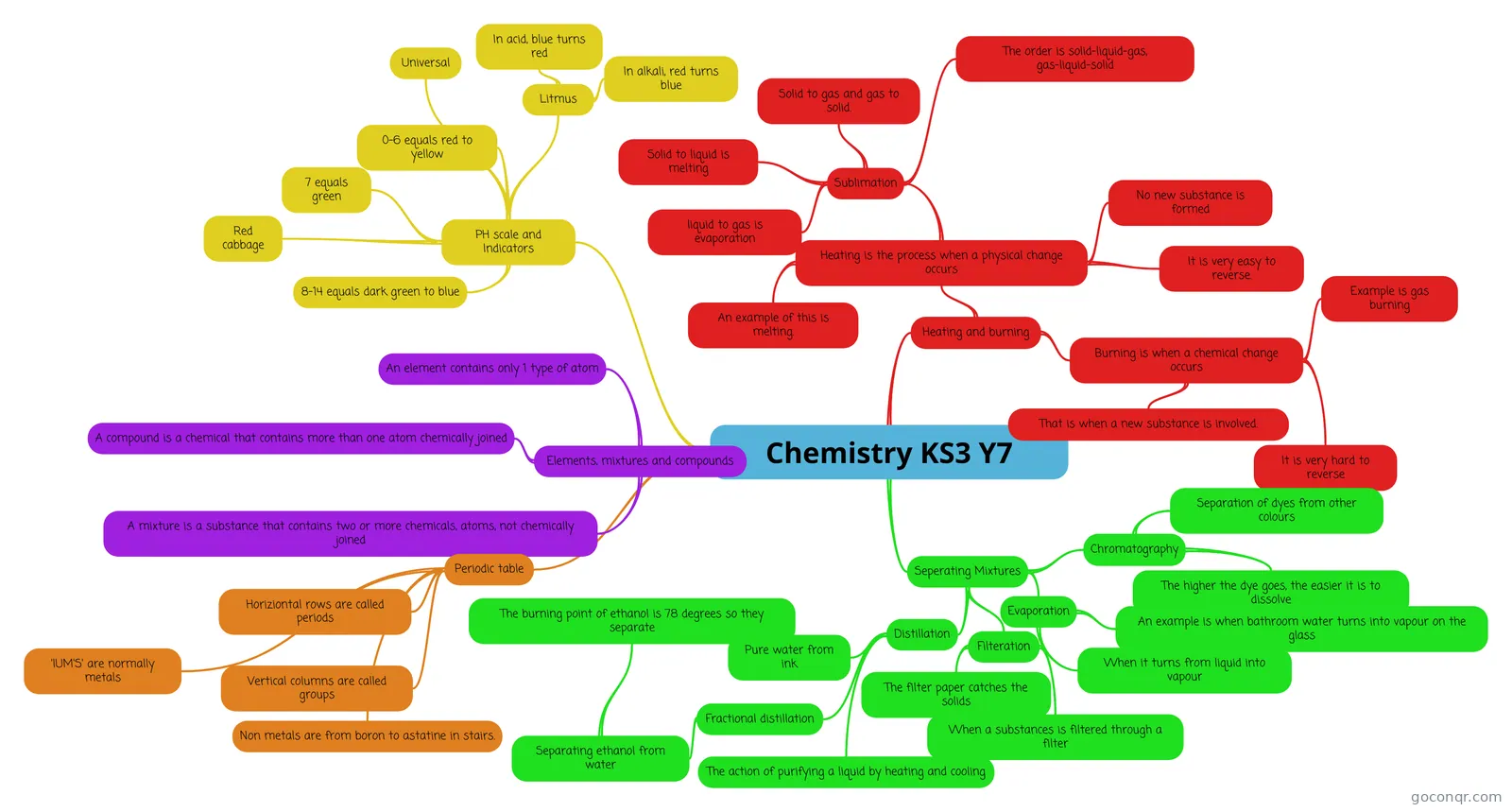
Mind map: Chemistry KS3 Y7
Conteúdo do mapa
Chemistry KS3 Y7
Seperating Mixtures
- Distillation
- The action of purifying a liquid by heating and cooling
- Fractional distillation
- Separating ethanol from water
- The burning point of ethanol is 78 degrees so they separate
- Separating ethanol from water
- Pure water from ink
- Filteration
- When a substances is filtered through a filter
- The filter paper catches the solids
- Evaporation
- When it turns from liquid into vapour
- An example is when bathroom water turns into vapour on the glass
- Chromatography
- Separation of dyes from other colours
- The higher the dye goes, the easier it is to dissolve
- Distillation
Heating and burning
- Heating is the process when a physical change occurs
- No new substance is formed
- It is very easy to reverse.
- An example of this is melting.
- Sublimation
- Solid to gas and gas to solid.
- The order is solid-liquid-gas, gas-liquid-solid
- Solid to liquid is melting
- liquid to gas is evaporation
- Burning is when a chemical change occurs
- That is when a new substance is involved.
- It is very hard to reverse
- Example is gas burning
- Heating is the process when a physical change occurs
Elements, mixtures and compounds
- An element contains only 1 type of atom
- A mixture is a substance that contains two or more chemicals, atoms, not chemically joined
- A compound is a chemical that contains more than one atom chemically joined
PH scale and Indicators
- 0-6 equals red to yellow
- 7 equals green
- 8-14 equals dark green to blue
- Red cabbage
- Litmus
- In acid, blue turns red
- In alkali, red turns blue
- Universal
Periodic table
- Horiziontal rows are called periods
- Vertical columns are called groups
- Non metals are from boron to astatine in stairs.
- 'IUM'S' are normally metals
Informações
- Descrição
- This on the end of year exam sylabus for y7
- Criado por
- Clumsy9
- Visualizações
- 131
- Tags
- Avaliação