
Mapa mental
Random access protocols
Conteúdo do mapa
Random access protocols
ALOHA
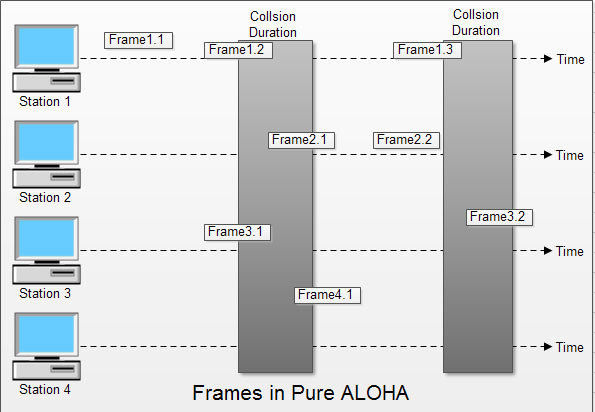
- Pure ALOHA
- Data Transmission at any time
- Vulnerable Time: 2*Frame transmission time
- Throughput: G*e^2G
- Maximum Throughput: 18.4%
- Collision Status: It does not reduce the total number of collision to half
- Maximum Throughput: 18.4%
- Throughput: G*e^2G
- -case 1:station receives an acknowledgement from the receiving station (station assumes that the transmission is successful)
- -case 2:station does not receives any acknowledgement from the receiving station (station assumes that the transmission is unsuccessful)
- Vulnerable Time: 2*Frame transmission time
- -A collision occurs if more than one frame tries to occupy the channel at the same time.
- Data Transmission at any time
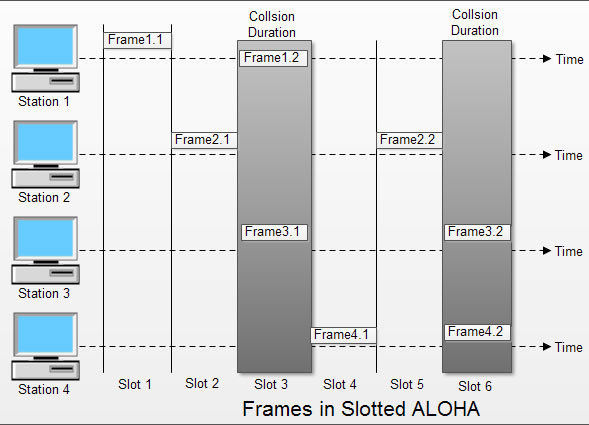
- Slotted ALOHA
- Data Transmission at the beginning of any random time slot only
- Vulnerable time: Frame transmission time
- Throughput: G*e^-G
- Maximum Throughput: 36.8%
- Collision Status: It reduces the total number of collision to half
- Maximum Throughput: 36.8%
- Throughput: G*e^-G
- If they miss the beginning of the slot , then station has to wait until the beginning of the next time slot
- Vulnerable time: Frame transmission time
- - time is divided into equal slot to a frame transmission time seconds
- -collision may occur if two or more stations try to transmit data at the beginning of the same time slot
- Data Transmission at the beginning of any random time slot only
- The earliest random access method
- is a medium access control (MAC) protocol.
- for transmission of data via a shared network channel.
- Pure ALOHA
Carrier Sense Multiple Access (CSMA)
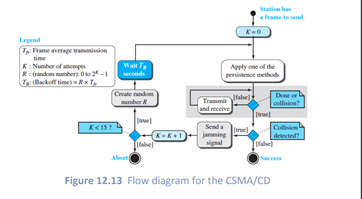
- CSMA/CD
- In this method, a station monitors the medium after it sends a frame to see if the transmission was successful.
- - If so, the station is finished. -If, however, there is a collision, the frame is sent again.
- -for detecting the collision
- -wired network
- In this method, a station monitors the medium after it sends a frame to see if the transmission was successful.
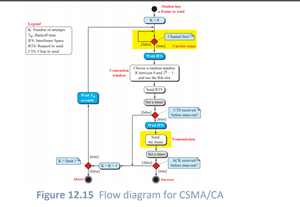
- CSMA/CA
- -collision avoidance
- through the use of CSMA/CA’s three strategies: 1. The interframe space. 2. The contention window. 3. Acknowledgments.
- -wireless network
- -collision avoidance
- based on the principle "sense before transmit" or "Listen before talk"
- To minimize the chance of collision and increase the performance
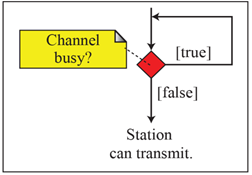
- 1-Persistent
- - When the transmitting node is ready to transmit, it senses the transmission medium for idle or busy.
- If idle, then it transmits immediately.
- If busy, then it senses the transmission medium continuously until it becomes idle, then transmits the frame unconditionally (with probability=1).
- In case of a collision, the sender waits for a random period of time and attempts the same procedure again.
- - When the transmitting node is ready to transmit, it senses the transmission medium for idle or busy.
- has the highest chance of collision
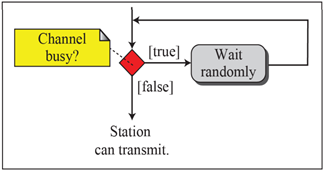
- Nonpersistent
- If the line is idle, it sends immediately
- If the line is not idle, it waits a random amount of time and then senses the line again.
- A station that has a frame to send senses the line.
- It reduces the chance of collision because it is unlikely that two or more stations will wait the same amount of time and retry to send simultaneously.
- this method reduces the efficiency of the network because the medium remains idle when there may be stations with frames to send.
- It reduces the chance of collision because it is unlikely that two or more stations will wait the same amount of time and retry to send simultaneously.
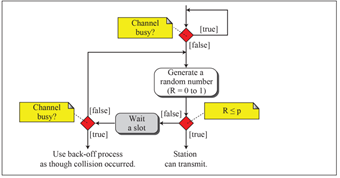
- p-Persistent
- if station line idle 1. With probability p, the station sends its frame. 2. With probability q = 1 − p, the station waits for the beginning of the next time slot and checks the line again. a. If the line is idle, it goes to step 1. b. If the line is busy, it acts as though a collision has occurred and uses the back off procedure.
- It reduces the chance of collision and improves efficiency.
- Its is used if the channel has time slots with a slot duration equal to or greater than the maximum propagation time.
- Name:Rinad Saeed Alghamdi 2190005396
- CSMA/CD
Multiple Access Protocols
Imagens e arquivos do mapa
Informações
- Descrição
- Mapa Mental sobre Random access protocols, criado por Rinad Algamdi em 04-02-2021.
- Criado por
- Rinad Algamdi · fev 2021
- Atualizado
- 6 fev 2021
- Visualizações
- 0
- Avaliação