
Mapa mental
Digestion and Absorption
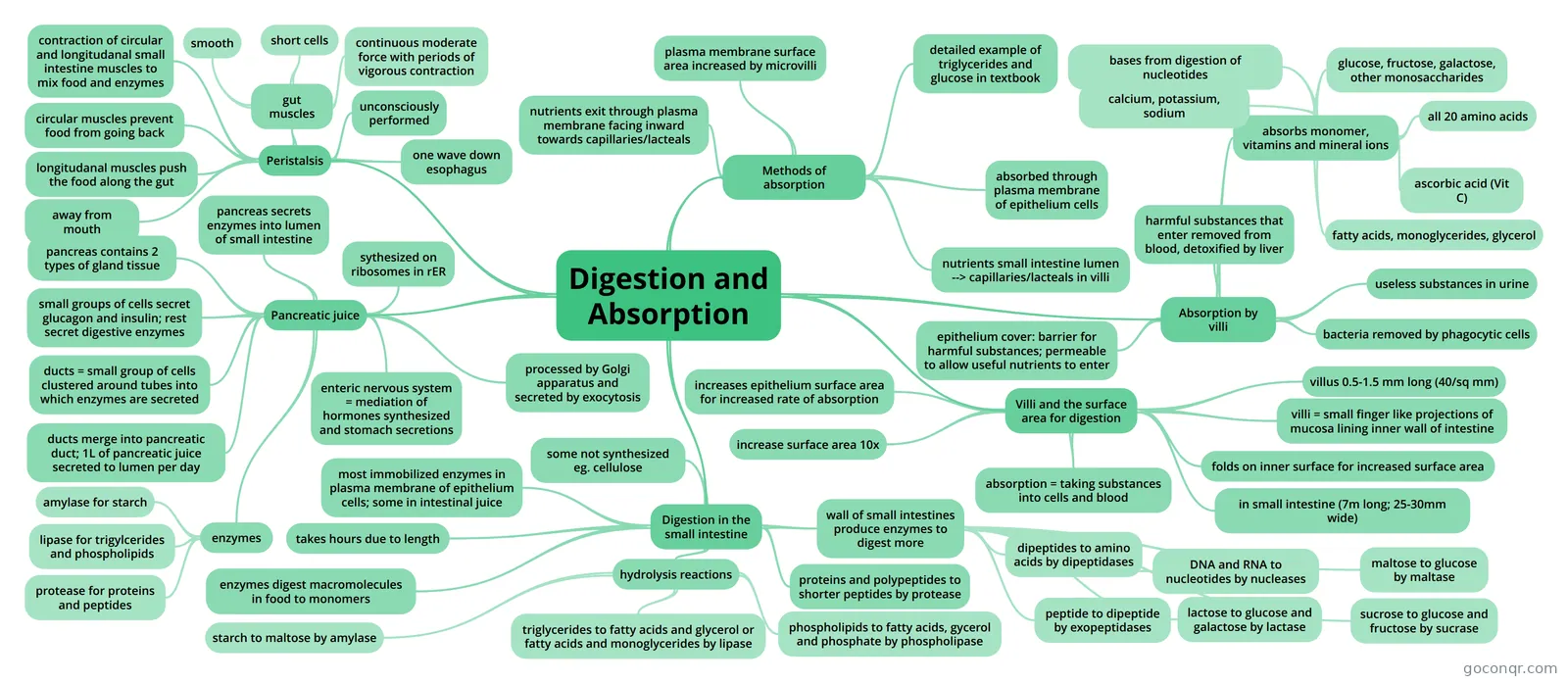
Mind map: digestion and absorption
Conteúdo do mapa
Digestion and Absorption
Peristalsis
- contraction of circular and longitudanal small intestine muscles to mix food and enzymes
- gut muscles
- smooth
- short cells
- continuous moderate force with periods of vigorous contraction
- circular muscles prevent food from going back
- longitudanal muscles push the food along the gut
- unconsciously performed
- away from mouth
- one wave down esophagus
Pancreatic juice
- pancreas secrets enzymes into lumen of small intestine
- pancreas contains 2 types of gland tissue
- small groups of cells secret glucagon and insulin; rest secret digestive enzymes
- enteric nervous system = mediation of hormones synthesized and stomach secretions
- ducts = small group of cells clustered around tubes into which enzymes are secreted
- sythesized on ribosomes in rER
- processed by Golgi apparatus and secreted by exocytosis
- ducts merge into pancreatic duct; 1L of pancreatic juice secreted to lumen per day
- enzymes
- amylase for starch
- lipase for trigylcerides and phospholipids
- protease for proteins and peptides
Digestion in the small intestine
- enzymes digest macromolecules in food to monomers
- hydrolysis reactions
- starch to maltose by amylase
- triglycerides to fatty acids and glycerol or fatty acids and monoglycerides by lipase
- phospholipids to fatty acids, gycerol and phosphate by phospholipase
- proteins and polypeptides to shorter peptides by protease
- wall of small intestines produce enzymes to digest more
- DNA and RNA to nucleotides by nucleases
- maltose to glucose by maltase
- lactose to glucose and galactose by lactase
- sucrose to glucose and fructose by sucrase
- dipeptides to amino acids by dipeptidases
- peptide to dipeptide by exopeptidases
- most immobilized enzymes in plasma membrane of epithelium cells; some in intestinal juice
- takes hours due to length
- some not synthesized eg. cellulose
Villi and the surface area for digestion
- increases epithelium surface area for increased rate of absorption
- absorption = taking substances into cells and blood
- in small intestine (7m long; 25-30mm wide)
- folds on inner surface for increased surface area
- villi = small finger like projections of mucosa lining inner wall of intestine
- villus 0.5-1.5 mm long (40/sq mm)
- increase surface area 10x
Absorption by villi
- absorbs monomer, vitamins and mineral ions
- glucose, fructose, galactose, other monosaccharides
- all 20 amino acids
- fatty acids, monoglycerides, glycerol
- bases from digestion of nucleotides
- calcium, potassium, sodium
- ascorbic acid (Vit C)
- epithelium cover: barrier for harmful substances; permeable to allow useful nutrients to enter
- harmful substances that enter removed from blood, detoxified by liver
- bacteria removed by phagocytic cells
- useless substances in urine
- absorbs monomer, vitamins and mineral ions
Methods of absorption
- nutrients small intestine lumen --> capillaries/lacteals in villi
- absorbed through plasma membrane of epithelium cells
- detailed example of triglycerides and glucose in textbook
- plasma membrane surface area increased by microvilli
- nutrients exit through plasma membrane facing inward towards capillaries/lacteals
Informações
- Descrição
- Topic 6.1 Digestion and Absorption of IB Biology Chapter 6 Human Physiology
- Criado por
- tiasabs
- Visualizações
- 1.834
- Tags
- Avaliação