
Mapa mental
ADAPTIVE FEATURES OF ORGANISMS
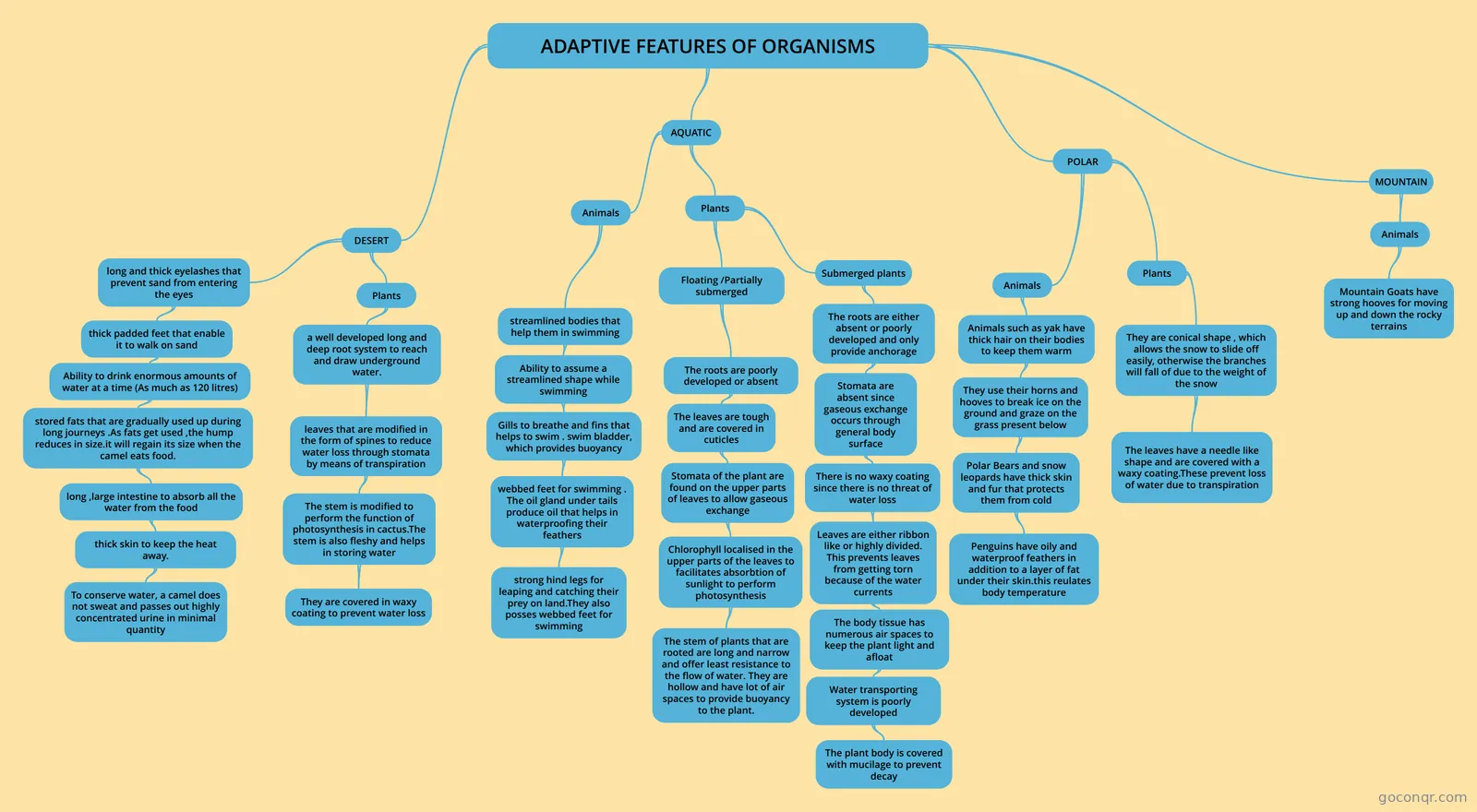
Mind map: Adaptive features of organisms
Conteúdo do mapa
ADAPTIVE FEATURES OF ORGANISMS
AQUATIC
- Animals
- streamlined bodies that help them in swimming
- Ability to assume a streamlined shape while swimming
- Gills to breathe and fins that helps to swim . swim bladder, which provides buoyancy
- webbed feet for swimming . The oil gland under tails produce oil that helps in waterproofing their feathers
- strong hind legs for leaping and catching their prey on land.They also posses webbed feet for swimming
- webbed feet for swimming . The oil gland under tails produce oil that helps in waterproofing their feathers
- Gills to breathe and fins that helps to swim . swim bladder, which provides buoyancy
- Ability to assume a streamlined shape while swimming
- streamlined bodies that help them in swimming
- Plants
- Floating /Partially submerged
- The roots are poorly developed or absent
- The leaves are tough and are covered in cuticles
- Stomata of the plant are found on the upper parts of leaves to allow gaseous exchange
- Chlorophyll localised in the upper parts of the leaves to facilitates absorbtion of sunlight to perform photosynthesis
- The stem of plants that are rooted are long and narrow and offer least resistance to the flow of water. They are hollow and have lot of air spaces to provide buoyancy to the plant.
- Chlorophyll localised in the upper parts of the leaves to facilitates absorbtion of sunlight to perform photosynthesis
- Stomata of the plant are found on the upper parts of leaves to allow gaseous exchange
- The leaves are tough and are covered in cuticles
- The roots are poorly developed or absent
- Submerged plants
- The roots are either absent or poorly developed and only provide anchorage
- Stomata are absent since gaseous exchange occurs through general body surface
- There is no waxy coating since there is no threat of water loss
- Leaves are either ribbon like or highly divided. This prevents leaves from getting torn because of the water currents
- The body tissue has numerous air spaces to keep the plant light and afloat
- Water transporting system is poorly developed
- The plant body is covered with mucilage to prevent decay
- Water transporting system is poorly developed
- The body tissue has numerous air spaces to keep the plant light and afloat
- Leaves are either ribbon like or highly divided. This prevents leaves from getting torn because of the water currents
- There is no waxy coating since there is no threat of water loss
- Stomata are absent since gaseous exchange occurs through general body surface
- The roots are either absent or poorly developed and only provide anchorage
- Floating /Partially submerged
- Animals
POLAR
- Plants
- They are conical shape , which allows the snow to slide off easily, otherwise the branches will fall of due to the weight of the snow
- The leaves have a needle like shape and are covered with a waxy coating.These prevent loss of water due to transpiration
- They are conical shape , which allows the snow to slide off easily, otherwise the branches will fall of due to the weight of the snow
- Animals
- Animals such as yak have thick hair on their bodies to keep them warm
- They use their horns and hooves to break ice on the ground and graze on the grass present below
- Polar Bears and snow leopards have thick skin and fur that protects them from cold
- Penguins have oily and waterproof feathers in addition to a layer of fat under their skin.this reulates body temperature
- Polar Bears and snow leopards have thick skin and fur that protects them from cold
- They use their horns and hooves to break ice on the ground and graze on the grass present below
- Animals such as yak have thick hair on their bodies to keep them warm
- Plants
MOUNTAIN
- Animals
- Mountain Goats have strong hooves for moving up and down the rocky terrains
- Animals
DESERT
- Plants
- a well developed long and deep root system to reach and draw underground water.
- leaves that are modified in the form of spines to reduce water loss through stomata by means of transpiration
- The stem is modified to perform the function of photosynthesis in cactus.The stem is also fleshy and helps in storing water
- They are covered in waxy coating to prevent water loss
- The stem is modified to perform the function of photosynthesis in cactus.The stem is also fleshy and helps in storing water
- leaves that are modified in the form of spines to reduce water loss through stomata by means of transpiration
- a well developed long and deep root system to reach and draw underground water.
- long and thick eyelashes that prevent sand from entering the eyes
- thick padded feet that enable it to walk on sand
- Ability to drink enormous amounts of water at a time (As much as 120 litres)
- stored fats that are gradually used up during long journeys .As fats get used ,the hump reduces in size.it will regain its size when the camel eats food.
- long ,large intestine to absorb all the water from the food
- thick skin to keep the heat away.
- To conserve water, a camel does not sweat and passes out highly concentrated urine in minimal quantity
- thick skin to keep the heat away.
- long ,large intestine to absorb all the water from the food
- stored fats that are gradually used up during long journeys .As fats get used ,the hump reduces in size.it will regain its size when the camel eats food.
- Ability to drink enormous amounts of water at a time (As much as 120 litres)
- thick padded feet that enable it to walk on sand
- Plants
Informações
- Descrição
- Mapa Mental sobre ADAPTIVE FEATURES OF ORGANISMS, criado por hari menon em 11-07-2021.
- Criado por
- hari menon
- Visualizações
- 0
- Avaliação