
Mapa mental
Philosophy
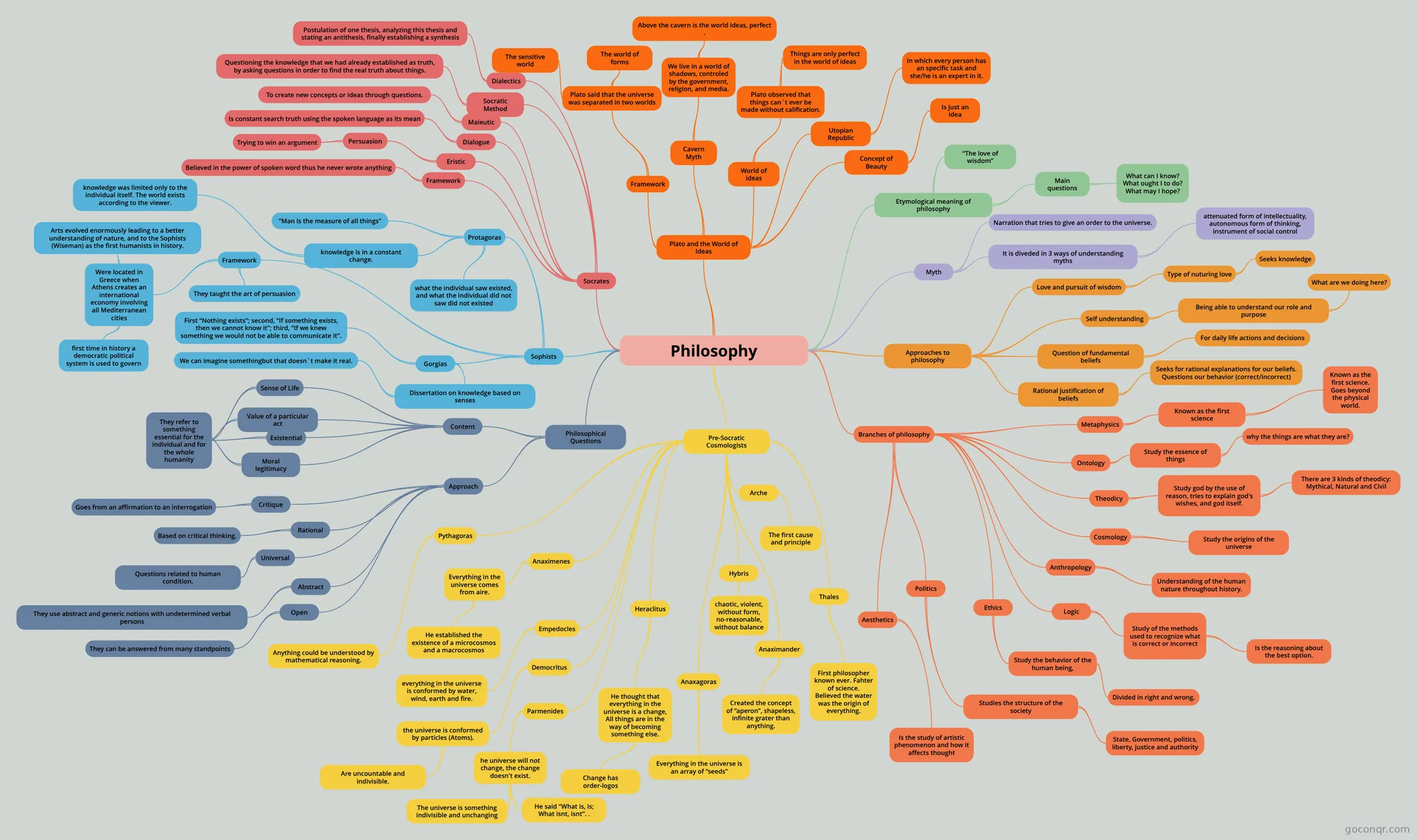
Mind map: Philosophy
Conteúdo do mapa
Philosophy
Myth
- Narration that tries to give an order to the universe.
- It is diveded in 3 ways of understanding myths
- attenuated form of intellectuality, autonomous form of thinking, instrument of social control
Etymological meaning of philosophy
- “The love of wisdom”
- Main questions
- What can I know? What ought I to do? What may I hope?
Approaches to philosophy
- Love and pursuit of wisdom
- Type of nuturing love
- Seeks knowledge
- Type of nuturing love
- Rational justification of beliefs
- Seeks for rational explanations for our beliefs. Questions our behavior (correct/incorrect)
- Question of fundamental beliefs
- For daily life actions and decisions
- Self understanding
- Being able to understand our role and purpose
- What are we doing here?
- Being able to understand our role and purpose
- Love and pursuit of wisdom
Branches of philosophy
- Metaphysics
- Known as the first science
- Known as the first science. Goes beyond the physical world.
- Known as the first science
- Ontology
- Study the essence of things
- why the things are what they are?
- Study the essence of things
- Theodicy
- Study god by the use of reason, tries to explain god's wishes, and god itself.
- There are 3 kinds of theodicy: Mythical, Natural and Civil
- Study god by the use of reason, tries to explain god's wishes, and god itself.
- Cosmology
- Study the origins of the universe
- Logic
- Study of the methods used to recognize what is correct or incorrect
- Is the reasoning about the best option.
- Study of the methods used to recognize what is correct or incorrect
- Ethics
- Study the behavior of the human being,
- Divided in right and wrong.
- Study the behavior of the human being,
- Politics
- Studies the structure of the society
- State, Government, politics, liberty, justice and authority
- Studies the structure of the society
- Aesthetics
- Is the study of artistic phenomenon and how it affects thought
- Anthropology
- Understanding of the human nature throughout history.
- Metaphysics
Pre-Socratic Cosmologists
- Pythagoras
- Anything could be understood by mathematical reasoning.
- Anaximenes
- Everything in the universe comes from aire.
- He established the existence of a microcosmos and a macrocosmos
- Everything in the universe comes from aire.
- Empedocles
- everything in the universe is conformed by water, wind, earth and fire.
- Democritus
- the universe is conformed by particles (Atoms).
- Are uncountable and indivisible.
- the universe is conformed by particles (Atoms).
- Parmenides
- he universe will not change, the change doesn't exist.
- He said “What is, is; What isnt, isnt”. .
- The universe is something indivisible and unchanging
- he universe will not change, the change doesn't exist.
- Thales
- First philosopher known ever. Fahter of science. Believed the water was the origin of everything.
- Anaximander
- Created the concept of “aperon”, shapeless, infinite grater than anything.
- Arche
- The first cause and principle
- Heraclitus
- He thought that everything in the universe is a change, All things are in the way of becoming something else.
- Change has order-logos
- He thought that everything in the universe is a change, All things are in the way of becoming something else.
- Anaxagoras
- Everything in the universe is an array of “seeds”
- Hybris
- chaotic, violent, without form, no-reasonable, without balance
- Pythagoras
Philosophical Questions
- Content
- Sense of Life
- Value of a particular act
- Existential
- They refer to something essential for the individual and for the whole humanity
- Moral legitimacy
- Sense of Life
- Approach
- Critique
- Goes from an affirmation to an interrogation
- Rational
- Based on critical thinking.
- Universal
- Questions related to human condition.
- Abstract
- They use abstract and generic notions with undetermined verbal persons
- Open
- They can be answered from many standpoints
- Critique
- Content
Sophists
- Protagoras
- “Man is the measure of all things”
- knowledge is in a constant change.
- knowledge was limited only to the individual itself. The world exists according to the viewer.
- what the individual saw existed, and what the individual did not saw did not existed
- Gorgias
- First “Nothing exists”; second, “If something exists, then we cannot know it”; third, “If we knew something we would not be able to communicate it”.
- Dissertation on knowledge based on senses
- We can imagine somethingbut that doesn´t make it real.
- Framework
- Were located in Greece when Athens creates an international economy involving all Mediterranean cities
- Arts evolved enormously leading to a better understanding of nature, and to the Sophists (Wiseman) as the first humanists in history.
- first time in history a democratic political system is used to govern
- They taught the art of persuasion
- Were located in Greece when Athens creates an international economy involving all Mediterranean cities
- Protagoras
Socrates
- Framework
- Believed in the power of spoken word thus he never wrote anything
- Eristic
- Persuasion
- Trying to win an argument
- Persuasion
- Maieutic
- To create new concepts or ideas through questions.
- Socratic Method
- Questioning the knowledge that we had already established as truth, by asking questions in order to find the real truth about things.
- Dialectics
- Postulation of one thesis, analyzing this thesis and stating an antithesis, finally establishing a synthesis
- Dialogue
- Is constant search truth using the spoken language as its mean
- Framework
Plato and the World of Ideas
- Framework
- Plato said that the universe was separated in two worlds
- The sensitive world
- The world of forms
- Plato said that the universe was separated in two worlds
- Cavern Myth
- We live in a world of shadows, controled by the government, religion, and media.
- Above the cavern is the world ideas, perfect .
- We live in a world of shadows, controled by the government, religion, and media.
- Concept of Beauty
- Is just an idea
- Utopian Republic
- In which every person has an specific task and she/he is an expert in it.
- World of ideas
- Plato observed that things can´t ever be made without calification.
- Things are only perfect in the world of ideas
- Plato observed that things can´t ever be made without calification.
- Framework
Informações
- Descrição
- Mapa Mental sobre Philosophy, criado por Fernando Ulloa em 08-09-2015.
- Criado por
- Fernando Ulloa
- Visualizações
- 52
- Avaliação