
Mapa mental
Epithelial Tissue
Conteúdo do mapa
Epithelial Tissue
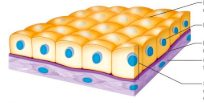
-Covers organs and body surfaces. -Lines cavities and hollow organs. -Makes up glands. -Have a free surface on outside and basement membrane on inside. -Usually lack blood vessels; nutrients diffuse from underlying connective tissue. -Cells readily divide; injuries heal rapidly. -Cells are tightly packed. -Classified according to cell shape and number of cell layers.
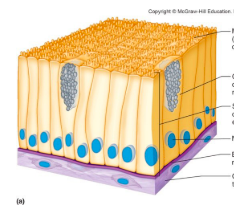
-Layers: Simple, stratified, and pseudostratified.
-Shapes: Squamous, cuboidal, and columnar.
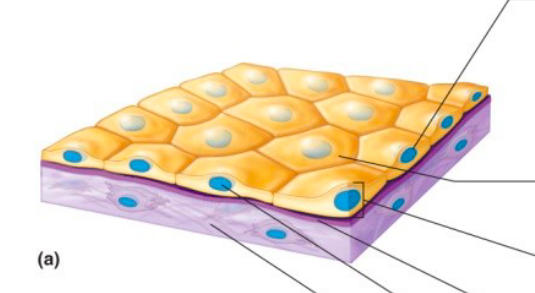
- Squamous – Flat
- -Simple squamous: -Single layer of thin, flat cells. -Substances pass easily through. -Lines blood and lymphatic vessels. -Stratified squamous: -Many cell layers; thick. -Lines oral cavity, vagina, and anal canal. -Outer layer of skin (keratinized).
- -Cuboidal – Cube
- -Simple cuboidal: -Lines kidneys tubules, thyroid follicles. -Covers ovaries. -Lines ducts of some glands. -Stratified cuboidal: 2-3 layers of cube shaped cells, lines ducts at mammary, sweat, and salivary glands and pancreas.
- -Columnar – Tall
- -Simple columnar: -Sometimes have cilia. -Sometimes have goblet cells (secrete mucus). -Pseudostratified columnar: -Single layer. -Lines respiratory passageways. -Stratified columnar: Lines part of male urethra, ducts of exocrine glands. Top layer of elongated cells
- Squamous – Flat
Nervous Tissue
- Found in brain, spinal cord, peripheral nerves.
- Main cells are neurons, which are specialized for communication, via conduction of nerve impulses
- Neurons coordinate, integrate, and regulate body functions
- Neuroglia support and nourish neurons.
- Muscle Tissue
- Muscle cells are also called muscle fibers • Contractile; can shorten and thicken • 3 types of muscle tissue: skeletal, cardiac, and smooth
- Skeletal
- Attached to bones • Striated • Voluntary • Multinucleated cells • Long cylindrical cells • Stimulated by nerve cells
- Smooth
- Non-striated • Spindle-shaped fibers • Walls of hollow organs • Walls of blood vessels • Involuntary
- Cardiac
- Only in wall of heart • Branching cells • Involuntary • Striated • Intercalated discs
Connective Tissue
- Most abundant tissue type • Cells are farther apart than epithelial cells; contain matrix between cells • Many functions: • Bind structures together • Provide support and protection • Serve as frameworks • Fill spaces • Store fat • Produce blood cells • Protect against infections • Help repair tissue damage • Extracellular matrix consists of protein fibers and ground substance; consistency varies from fluid to semisolid to solid • Most have good blood supply, and are well-nourished, but vascularity varies among tissue types • Most cells can divide
- Major Cell types
- Fibroblasts: • Most common fixed cell • Large star-shaped cell • Secrete fibers into extracellular matrix
- Macrophages (Histiocytes): • Usually attached to fibers, but can detach and wander • Conduct phagocytosis • Defend against infection
- Mast Cells: • Large, fixed cells • Release heparin to prevent blood clotting • Release histamine, which causes inflammatory response
- Fibers
- Collagen Fibers: • Thick threads of collagen, the body’s main structural protein • Great tensile strength and flexible, slightly elastic • Found in ligaments and tendons
- Elastic (Yellow) Fibers: • Composed of elastin protein; branching • Can stretch and return to original shape • Not as strong as collagen fibers • Found in vocal cords, respiratory air passages
- Elastic (Yellow) Fibers: • Composed of elastin protein; branching • Can stretch and return to original shape • Not as strong as collagen fibers • Found in vocal cords, respiratory air passages
- Categories
- Proper
- Loose
- Areolar
- •Forms thin, delicate membranes •Cells are mainly fibroblasts •Gel-like ground substance •Collagenous & elastic fibers •In subcutaneous layer •Beneath most epithelia, where it nourishes nearby epithelial cells
- Adipose
- •Adipocytes store fat •Push their nuclei to one side •Crowd out other cell types •Cushions and insulates •Beneath skin (subcutaneous layer) •Behind eyeballs •Around kidneys and heart •Spaces between muscles
- Recticular
- Composed of thin reticular fibers • Supports walls of internal organs • Walls of liver, spleen
- Areolar
- Dense
- Dense Irregular
- Randomly organized, thick, interwoven collagenous fibers •Can withstand tension exerted •from different directions •Dermis of skin •Around skeletal muscles
- Dense regular
- Closely packed collagenous fibers • Fine network of elastic fibers • Most cells are fibroblasts • Very strong, withstands pulling • Binds body parts together • Tendons, ligaments, dermis • Poor blood supply; slow to heal
- Elastic
- •Abundant yellow elastic fibers •Some collagenous fibers •Fibroblasts •Attachments between bones of spinal column •Walls of hollow organs, such as large arteries, airways •Parts of heart •Elastic quality, stretches
- Dense Irregular
- Loose
- Specialized
- Cartilage: A rigid, specialized connective tissue • Support, framework, attachments • Protection of underlying tissue • Models for developing bone • Matrix contains collagen in gel-like ground substance • Chondrocytes (cartilage cells) in lacunae (chambers), surrounded by matrix • Lacks blood supply; heals slowly • Covered by perichondrium (connective tissue), which provides some nutrients to the cartilage
- Hyaline
- Most common type • Fine collagen fibers • Ends of bones in joints • Nose, respiratory passages • Embryonic skeleton
- Elastic
- Flexible, due to elastic fibers in matrix • External ear, larynx
- Fibrocartilage
- Very tough, due to many collagenous fibers • Shock absorber • Intervertebral discs • Pads of knee and pelvic girdle
- Hyaline
- Bone
- Most rigid connective tissue • Solid matrix, composed of mineral (Ca) salts & collagen • Supports structures • Protects vital structures • Produces blood cells • Stores & releases Ca, P • Attachment sites for muscles • Forms skeleton • Contain osteocytes (bone cells) in lacunae • 2 types: compact and spongy
- Blood
- Cells suspended in fluid matrix called plasma • Red blood cells transport gases • White blood cells defend again infection • Platelets help in blood clotting • Transports substances around body
- Cartilage
- Cartilage: A rigid, specialized connective tissue • Support, framework, attachments • Protection of underlying tissue • Models for developing bone • Matrix contains collagen in gel-like ground substance • Chondrocytes (cartilage cells) in lacunae (chambers), surrounded by matrix • Lacks blood supply; heals slowly • Covered by perichondrium (connective tissue), which provides some nutrients to the cartilage
- Proper
Imagens e arquivos do mapa
Informações
- Descrição
- Mapa Mental sobre Epithelial Tissue, criado por fernanda medina em 06-11-2021.
- Criado por
- fernanda medina
- Visualizações
- 0
- Avaliação