
Overview of Basic Tissue Types
484 resources created by 432 users
This Overview of Basic Tissue Types page on GoConqr gathers community-made quizzes, mind maps, flashcards and notes on epithelial, connective, muscle and nervous tissue, with histology lab decks and wound healing flowcharts too. It's built for university students practising slide identification and tissue classification, and for teachers after ready-made material. There are over 450 resources here, including more than 40 quizzes, over 120 mind maps and more than 250 flashcards. Pick a topic, try a quiz to find your gaps, then build your own revision set.
Top Overview of Basic Tissue Types resources
-
21 cardsHistology Lab 5: Muscle Tissue What type of muscle tissue is this? What are the arrows pointing at?
-
94 questionsBody Tissues Exam 3 Oldies Questions Which of the following is/are found in the seminiferous tubules?
-
46 questionsAnatomy & Physiology Exam 1 HISTOLOGY What are the four basic tissue types found in the body?
-
20 questionsCHE - Muscle Tissue By muscle contraction the length of the I-discus is diminished whereas the A-discus is unchanged.
-
29 cardsHistology Slides PUM
-
15 cardsAnimal tissues study of tissue ?? term given by?
-
2 questionsTissues What is a TJ made of
-
54 questionsHistology- Epithelial Tissue PMU 1st Year The ciliated cells are present in the simple columnar reorbtive epithelium.
Quizzes
See all 53 quizzes-
94 questionsBody Tissues Exam 3 Oldies Questions Which of the following is/are found in the seminiferous tubules?
-
46 questionsAnatomy & Physiology Exam 1 HISTOLOGY What are the four basic tissue types found in the body?
-
20 questionsCHE - Muscle Tissue By muscle contraction the length of the I-discus is diminished whereas the A-discus is unchanged.
-
2 questionsTissues What is a TJ made of
-
54 questionsHistology- Epithelial Tissue PMU 1st Year The ciliated cells are present in the simple columnar reorbtive epithelium.
-
20 questionsHistology- Blood Tissue 1st Year PMU The increase in number of erythrocytes is called erythropenia
-
114 questionsHisto nur written exam What are the four basic tissues in our body
-
46 questionsHisto cycle 1 - epidermis, exocrine glands, adipose tissue, connective tissue, bone, cartilage Which statement regarding apical surface’s modification is correct?
Mind maps
See all 129 mind maps-
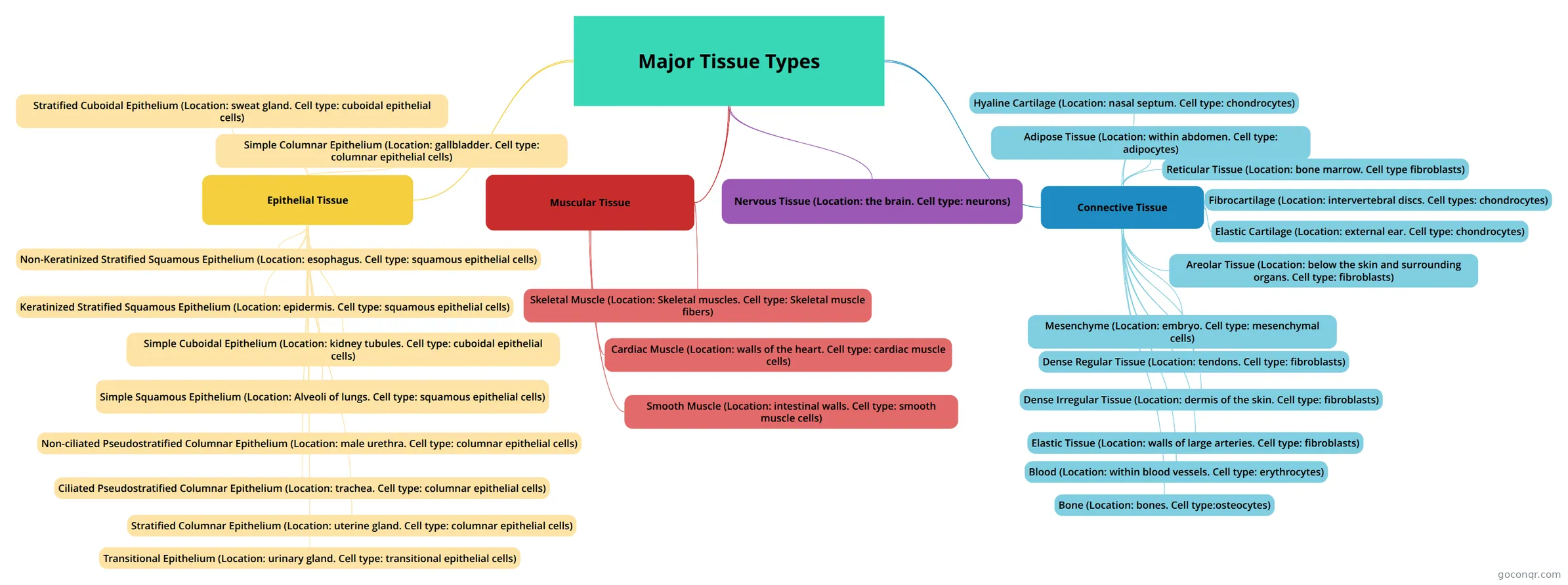 Major Tissue Types A concept map of the major types of tissues.
-
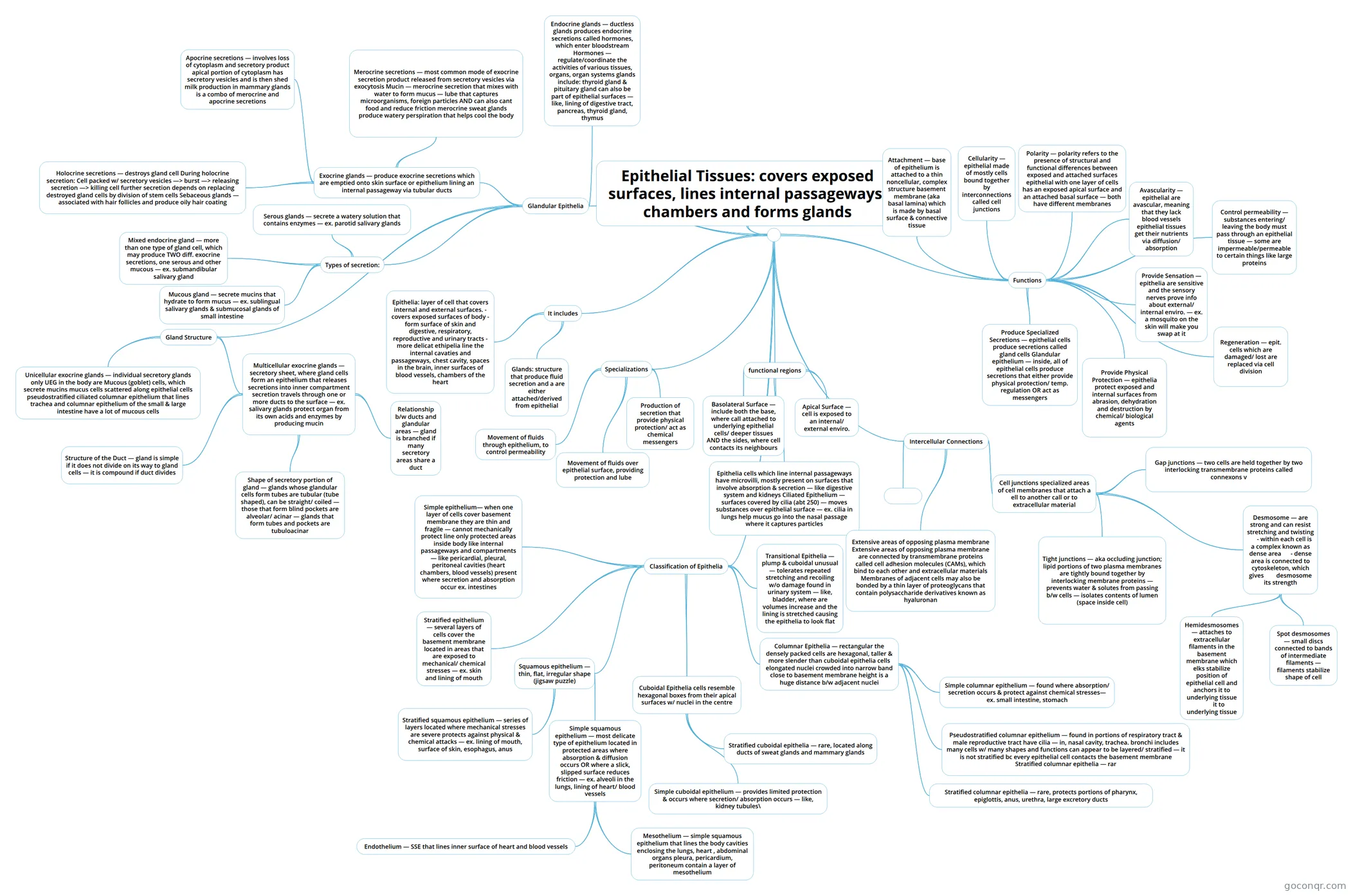 Epithelial Tissues: covers exposed surfaces, lines internal passageways, chambers and forms glands part 5 of 7 i know this one is hectic, imagine studying all this as just one part!!! please print to be abl...
-
Tissues
-
Tissues: Connective Tissue
-
Tissue Types In The Body
-
The Epithelial Tissue
-
Connective Tissue
-
Epithelia
Flashcards
See all 281 flashcards-
21 cardsHistology Lab 5: Muscle Tissue What type of muscle tissue is this? What are the arrows pointing at?
-
29 cardsHistology Slides PUM
-
15 cardsAnimal tissues study of tissue ?? term given by?
-
30 cardsHistology 3rd Col Practical
-
139 cardsCells and Tissue Types Epithelial Tissue Description
-
62 cardsTh3L03 Tissue organisation and epithelia Epithelia exist as what
-
26 cardsHistology of Cartilage & Bone Describe the structure & function of cartilage.
-
29 cardsPrimary Tissue Types
Flowcharts
Notes
See all 14 notes-
Cell and Tissue Exam Questions - Dee 2013: Section B 2. List the three (3) modes of secretion found in exocrine glands. Give a brief description of each mode of secretion and name a representative exocrine gland for each mode of secretion.Apocrine secret...
-
Connective Tissue Connective Tissue/supporting tissue: Basic tissue structure of mesodermal origin which provides structural support as well as metabolic support for other tissues and organs throughout the body. There are three types o...
-
Connective Tissue Connects, supports, binds or separates other tissues or organs Provide structural support (fibrous CT, cartilage and bone) Provide metbolic support (adipose CT & blood) 2 main divisions: Fibrous CT = proper CT Special...
-
Untitled Histology Notes test Histology The study of Tissues Tissues are groups of cells working together We have over 200 different types of cells What is a Tissue? Collection of cells and cell products and...
-
Topic 2a: tissues Tissues: group of similar cells that perform a specialized function, building blocks of organs epithelial connective muscle nervous Epithelial tissue: found on the surface of any part of the body in contact...
-
Lecture 2 Four Tissue Classifications Four tissue types: Epithelium Connective Tissue Muscle tissue Nervous tissue Epithelial Tissue
-
Connective Tissues 111. Connective Tissues A. General Characteristics: most abundant tissue in the body, gives support to the body and it's organs and binds/attaches tissues and body structures together. B. Structural Makeup and Functio...
-
Histology Basic tissue 4 primary tissues: Epithelial
Slides
Topics in Overview of Basic Tissue Types
More Histology and embryology topics
About Overview of Basic Tissue Types
GoConqr OriginalWhat this page covers
This page brings together the four basic tissue types: epithelial, connective, muscle and nervous. The resources were made by GoConqr users and come as quizzes, mind maps, flashcards, notes, slide sets and flowcharts. Almost all of them are pitched at university level.
Where to start
Begin with the big picture. The mind maps Tissue Types In The Body and Major Tissue Types lay out the four groups and their subtypes, such as simple squamous, simple cuboidal, pseudostratified columnar and transitional epithelium. The flashcard deck Primary Tissue Types works well alongside them.
Next, go deeper one tissue at a time:
- Epithelium: try the mind maps on classification and specialisations, then the quiz Histology- Epithelial Tissue PMU 1st Year.
- Connective tissue: the notes on connective tissue describe it as supporting tissue of mesodermal origin, and the deck Histology of Cartilage & Bone follows on.
- Muscle and nervous tissue: the quiz CHE - Muscle Tissue covers the I-disc, A-disc and sarcomere, and Cell Biology: Nervous Tissue is a flashcard deck for the nervous side.
Using quizzes and maps together
Read a mind map first, then close it and take a quiz on the same tissue. Questions you miss show you which branch to revisit. The quiz Tissues tests tight junctions, including occludins and claudins, which is a good check after the epithelium maps.
For slide work, the flashcard deck Histology Slides PUM labels sections such as simple squamous epithelium and pseudostratified ciliated epithelium in H&E. The deck Histology Lab 5: Muscle Tissue asks what type of tissue is shown and what the arrows indicate, which is useful practice for identification.
Where it fits
This unit sits in the Basic Tissues strand of Histology and embryology. The wound healing flowcharts show how tissues repair, and the long-answer deck is useful for written practice. Teachers can pick out maps, slide sets and quizzes to use as they are.
Choose one tissue, open a mind map, and see how much of it you can recall before checking the quiz.
Frequently asked questions
Which resource should I open first?
Start with a overview mind map such as Tissue Types In The Body or Major Tissue Types. They show the four basic tissue types and their subtypes on one screen. Then move to the flashcard deck Primary Tissue Types, and finish with a quiz on the tissue you found hardest.
What do the mind maps cover?
The mind maps cover epithelial tissue, including its classification and specialisations, as well as connective tissue, muscle and nervous tissue. Some give a broad overview of all tissue types, while others focus on a single group. There are over 120 mind maps on the page, so you can choose the level of detail you need.
Are the resources free to use?
Yes. Every resource listed here is free to open, study and take, with no account needed. They were made by GoConqr users, not by GoConqr itself. If you create a free account, your quiz scores are saved and you can make your own quizzes, mind maps, flashcards and notes.
Is there anything for practising slide identification?
Yes. The flashcard decks Histology Slides PUM and Histology Lab 5: Muscle Tissue are built around images and ask you to name tissues and what the arrows point to. The quiz Lecture 1 photomicrographs and the quiz Histology Slides give further practice.
Who are these resources for?
They are mainly for university students learning to classify and recognise tissues, and for teachers who want ready-made quizzes, maps and slide sets. Nearly all the resources on the page are at university level, so they suit degree-level histology and anatomy courses.
What if I cannot find the topic I need?
Try a nearby resource first, since many tissue topics overlap. For example, notes on blood or cartilage appear under connective tissue. You can also build your own mind map, flashcards or quiz for the missing topic, and a free account lets you save them.