
Mapa mental
Competitive Markets
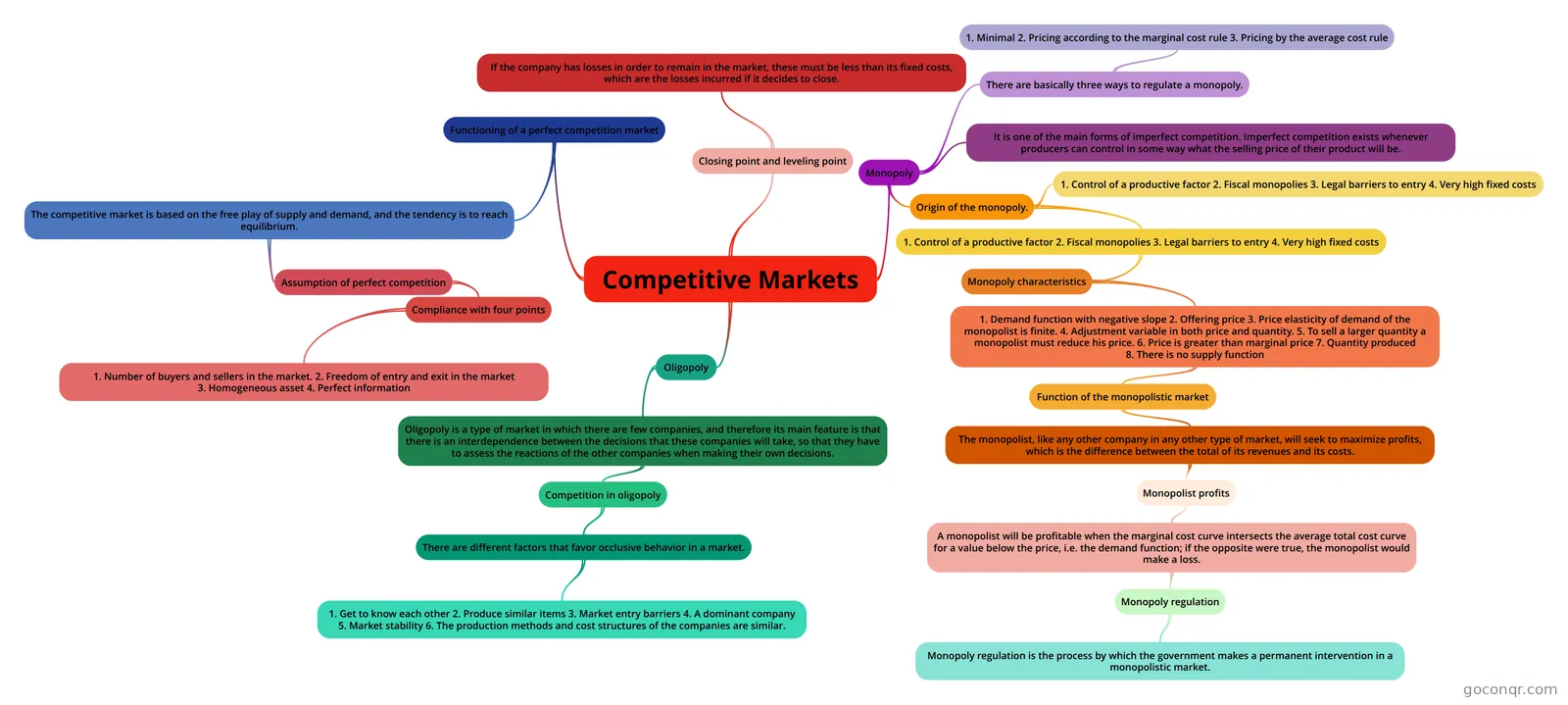
Mind map: Competitive markets
Conteúdo do mapa
Competitive Markets
Functioning of a perfect competition market
- The competitive market is based on the free play of supply and demand, and the tendency is to reach equilibrium.
- Assumption of perfect competition
- Compliance with four points
- 1. Number of buyers and sellers in the market. 2. Freedom of entry and exit in the market 3. Homogeneous asset 4. Perfect information
- Compliance with four points
- Assumption of perfect competition
- The competitive market is based on the free play of supply and demand, and the tendency is to reach equilibrium.
Closing point and leveling point
- If the company has losses in order to remain in the market, these must be less than its fixed costs, which are the losses incurred if it decides to close.
Monopoly
- It is one of the main forms of imperfect competition. Imperfect competition exists whenever producers can control in some way what the selling price of their product will be.
- Origin of the monopoly.
- 1. Control of a productive factor 2. Fiscal monopolies 3. Legal barriers to entry 4. Very high fixed costs
- 1. Control of a productive factor 2. Fiscal monopolies 3. Legal barriers to entry 4. Very high fixed costs
- Monopoly characteristics
- 1. Demand function with negative slope 2. Offering price 3. Price elasticity of demand of the monopolist is finite. 4. Adjustment variable in both price and quantity. 5. To sell a larger quantity a monopolist must reduce his price. 6. Price is greater than marginal price 7. Quantity produced 8. There is no supply function
- Function of the monopolistic market
- The monopolist, like any other company in any other type of market, will seek to maximize profits, which is the difference between the total of its revenues and its costs.
- Monopolist profits
- A monopolist will be profitable when the marginal cost curve intersects the average total cost curve for a value below the price, i.e. the demand function; if the opposite were true, the monopolist would make a loss.
- Monopoly regulation
- Monopoly regulation is the process by which the government makes a permanent intervention in a monopolistic market.
- Monopoly regulation
- A monopolist will be profitable when the marginal cost curve intersects the average total cost curve for a value below the price, i.e. the demand function; if the opposite were true, the monopolist would make a loss.
- Monopolist profits
- The monopolist, like any other company in any other type of market, will seek to maximize profits, which is the difference between the total of its revenues and its costs.
- Function of the monopolistic market
- 1. Demand function with negative slope 2. Offering price 3. Price elasticity of demand of the monopolist is finite. 4. Adjustment variable in both price and quantity. 5. To sell a larger quantity a monopolist must reduce his price. 6. Price is greater than marginal price 7. Quantity produced 8. There is no supply function
- Monopoly characteristics
- There are basically three ways to regulate a monopoly.
- 1. Minimal 2. Pricing according to the marginal cost rule 3. Pricing by the average cost rule
Oligopoly
- Oligopoly is a type of market in which there are few companies, and therefore its main feature is that there is an interdependence between the decisions that these companies will take, so that they have to assess the reactions of the other companies when making their own decisions.
- Competition in oligopoly
- There are different factors that favor occlusive behavior in a market.
- 1. Get to know each other 2. Produce similar items 3. Market entry barriers 4. A dominant company 5. Market stability 6. The production methods and cost structures of the companies are similar.
- There are different factors that favor occlusive behavior in a market.
- Competition in oligopoly
- Oligopoly is a type of market in which there are few companies, and therefore its main feature is that there is an interdependence between the decisions that these companies will take, so that they have to assess the reactions of the other companies when making their own decisions.
Informações
- Descrição
- Contaduría Mapa Mental sobre Competitive Markets, criado por Jairo Muñoz em 08-03-2022.
- Criado por
- Jairo Muñoz
- Visualizações
- 2
- Avaliação