
Mapa mental
Paris Anthology: Analysis
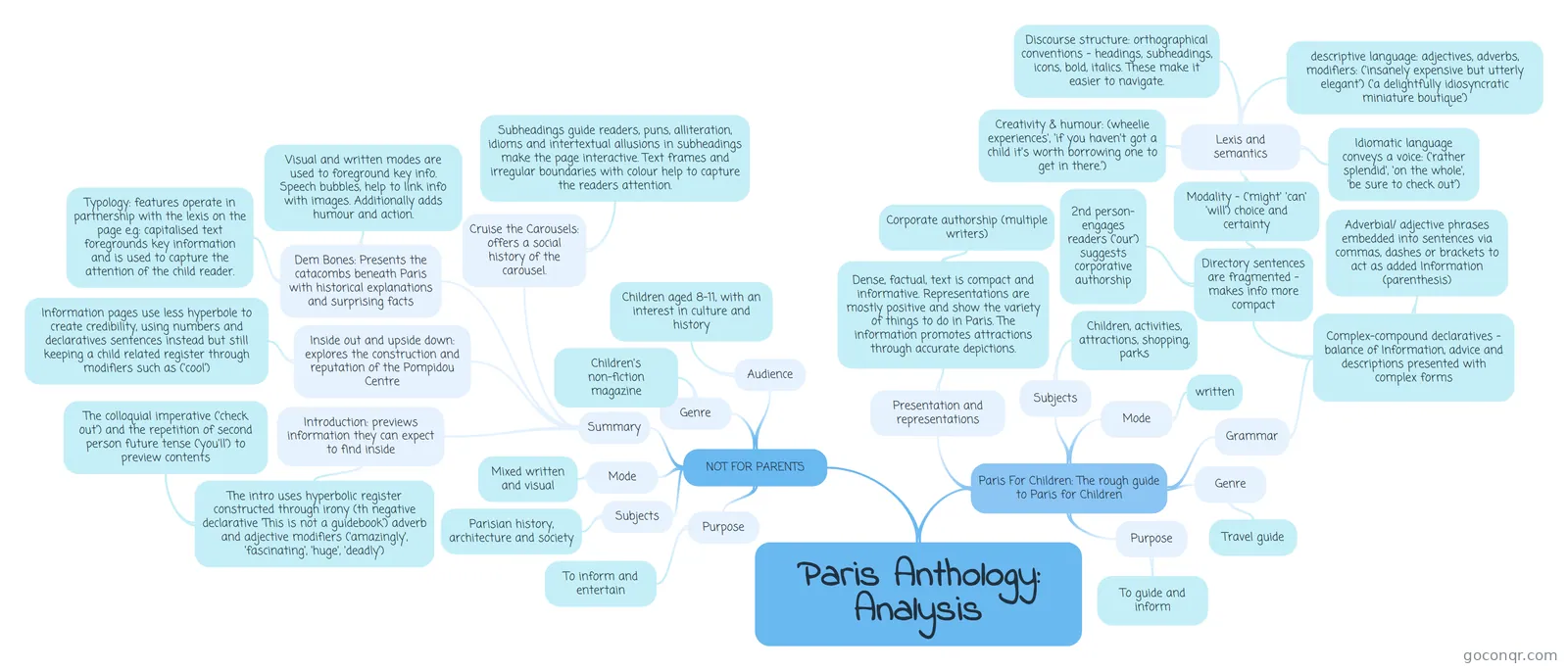
Mind map: Paris Anthology analysis
Conteúdo do mapa
Paris Anthology: Analysis
Paris For Children: The rough guide to Paris for Children
- Grammar
- Complex-compound declaratives - balance of Information, advice and descriptions presented with complex forms
- Directory sentences are fragmented - makes info more compact
- 2nd person- engages readers ('our') suggests corporative authorship
- Modality - ('might' 'can' 'will') choice and certainty
- Lexis and semantics
- Creativity & humour: (wheelie experiences', 'if you haven't got a child it's worth borrowing one to get in there.')
- descriptive language: adjectives, adverbs, modifiers: ('insanely expensive but utterly elegant') ('a delightfully idiosyncratic miniature boutique')
- Idiomatic language conveys a voice: ('rather splendid', 'on the whole', 'be sure to check out')
- Discourse structure: orthographical conventions - headings, subheadings, icons, bold, italics. These make it easier to navigate.
- Lexis and semantics
- Adverbial/ adjective phrases embedded into sentences via commas, dashes or brackets to act as added Information (parenthesis)
- Directory sentences are fragmented - makes info more compact
- Complex-compound declaratives - balance of Information, advice and descriptions presented with complex forms
- Presentation and representations
- Dense, factual, text is compact and informative. Representations are mostly positive and show the variety of things to do in Paris. The information promotes attractions through accurate depictions.
- Corporate authorship (multiple writers)
- Dense, factual, text is compact and informative. Representations are mostly positive and show the variety of things to do in Paris. The information promotes attractions through accurate depictions.
- Subjects
- Children, activities, attractions, shopping, parks
- Purpose
- To guide and inform
- Genre
- Travel guide
- Mode
- written
- Grammar
NOT FOR PARENTS
- Mode
- Mixed written and visual
- Genre
- Children's non-fiction magazine
- Purpose
- To inform and entertain
- Audience
- Children aged 8-11, with an interest in culture and history
- Subjects
- Parisian history, architecture and society
- Summary
- Introduction: previews information they can expect to find inside
- The intro uses hyperbolic register constructed through irony (th negative declarative 'This is not a guidebook') adverb and adjective modifiers ('amazingly', 'fascinating', 'huge', 'deadly')
- The colloquial imperative ('check out') and the repetition of second person future tense ('you'll') to preview contents
- The intro uses hyperbolic register constructed through irony (th negative declarative 'This is not a guidebook') adverb and adjective modifiers ('amazingly', 'fascinating', 'huge', 'deadly')
- Inside out and upside down: explores the construction and reputation of the Pompidou Centre
- Information pages use less hyperbole to create credibility, using numbers and declaratives sentences instead but still keeping a child related register through modifiers such as ('cool')
- Dem Bones: Presents the catacombs beneath Paris with historical explanations and surprising facts
- Typology: features operate in partnership with the lexis on the page e.g: capitalised text foregrounds key information and is used to capture the attention of the child reader.
- Visual and written modes are used to foreground key info. Speech bubbles, help to link info with images. Additionally adds humour and action.
- Cruise the Carousels: offers a social history of the carousel.
- Subheadings guide readers, puns, alliteration, idioms and intertextual allusions in subheadings make the page interactive. Text frames and irregular boundaries with colour help to capture the readers attention.
- Introduction: previews information they can expect to find inside
- Mode
Informações
- Descrição
- An analysis mind map of the texts in the advanced information for the 2022 A Level AQA paper for English language and literature. Will be updated further.
- Criado por
- Alice Baker
- Visualizações
- 1.585
- Tags
- Avaliação