
Mapa mental
Mass Storage
Conteúdo do mapa
Mass Storage
Types
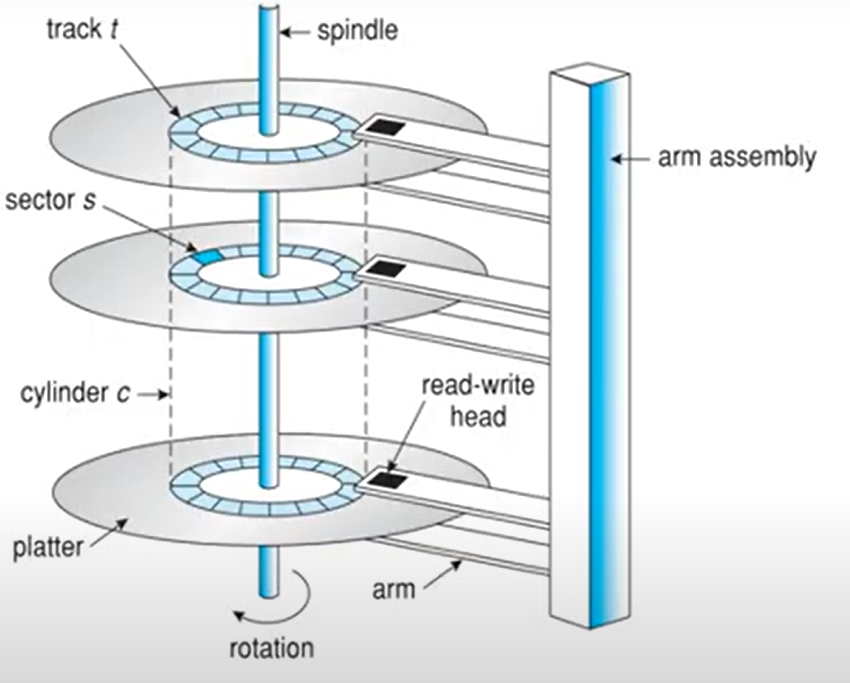
- Hard Disk Drive (HDD)
- Important measures
- Transfer Rate
- Rate that data flow between drive and computer
- Positioning time (random access time)
- Seek time
- Time to move disk arm to the desired cylinder
- Rotational Latency
- Time for the desired sector to rotate under the disk header.
- Latency = 60/RPM
- Avg of latency = Latency/2
- Seek time plus rotational latency
- Seek time
- Access Latency (Average Access Time) = Avg seek time + Avg latency
- Avg I/O time = Avg Access Time + Amount to transfer/transfer rate + Controller overhead
- Transfer Rate
- Illustration
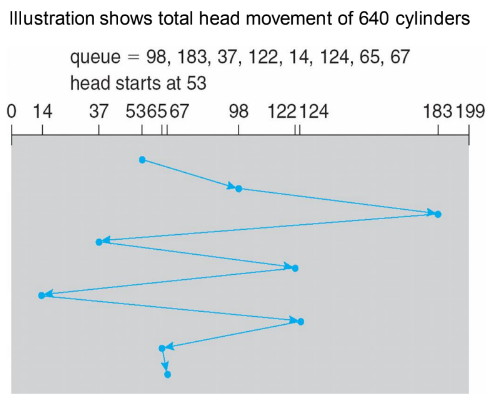
- HDD scheduling
- It means scheduling the disks I/O requests (OS maintains a queue of requests). The goal of HDD scheduling is to minimize seek time (that is proportional to seek distance).
- Sources of disk I/O requests
- OS
- System processes
- User processes
- Scheduling queue management
- Algorithms
- First-come First-served (FCFS)
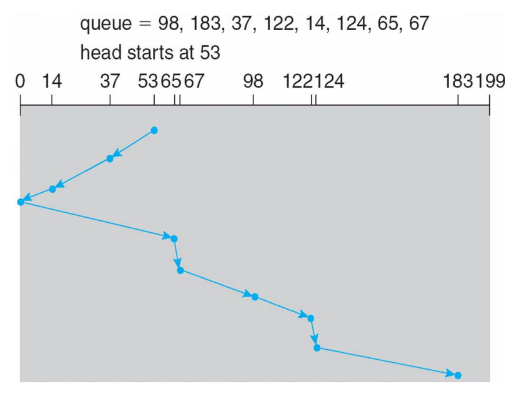
- SCAN
- Arm goes to one end of the disk and then moves to the other end.
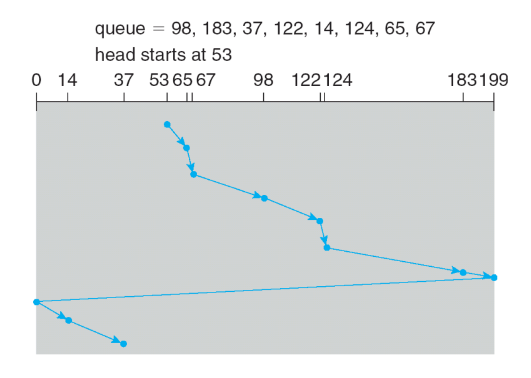
- C-SCAN
- Arm goes to one end and it returns to the beginning when it reaches that end continuing the movement as a cycle.
- More uniform wait time than SCAN.
- In the past, OS was responsible for that management. Modern devices have controllers built into the storage device.
- Ex.: Implementation in Linux. Uses 2 queues for reading (1 C-SCAN and 1 FCFS) and 2 for writing operations (1 C-SCAN and 1 FCFS). It also implement an aging mechanism to avoid starvation.
- Algorithms
- Disk bandwidth
- Total number of bytes transferred divided by the total time between the first request and the completion of the last service.
- Important measures
- Nonvolatile Memory (NVM)
- Disk-drive like
- Solid-state Disk (SSD)
- Other forms
- USB drives
- Main storage in smartphone
- Characteristics
- More reliable than HDD
- More expensive per MB than HDD
- May have shorter lifespan
- Much faster than HDD
- No moving parts
- Limited number of writes (Ex. ~100000)
- Measure: drive writes per day (DWPD)
- Ex. 1TB NAND drive with 5 DWPD is expected to have 5 TB per day written with warrantee period without failing.
- It is necessary to spread write operations uniformily among the cells to avoid consuming all the possible writes of a specific cell.
- Measure: drive writes per day (DWPD)
- Disk-drive like
- Hard Disk Drive (HDD)
Volatile memory as mass storage
- Volatile memory used as high speed temporary storage
- Ex.: Linux /tmp usually is located in RAM, not in secondary memory
Magnetic Tape
- Characteristics
- Cheap
- High capacity
- Slow reading process
- Sequential reading/writing
- Usually used for backup
- Requires special devices for reading/writing
- Characteristics
Disk Attachment
- Host-attached storage accessed through I/O ports talking to I/O busses
- BUSSES
- Advanced Technology Attachment (ATA)
- Serial ATA (SATA)
- Parallel ATA (PATA)
- eSATA
- Serial Attached SCSI (SAS)
- Universal Serial Bus (USB)
- Fibre Channel (FC)
- NVM express (NVMe)
- Connected directly to PCI bus
Disk Structure
- Disk drives are addressed as large 1-dimensional arrays of logical blocks. Each logical block is the smallest unit of data that can be transferred. The array is mapped into sectors.
- Ex.: sector 0 is the first sector of the first track of the outermost cylinder. Mapping proceeds in that track and in the rest of the tracks in that cylinder. After that cylinder, it proceeds to other cylinders, from outermost to innermot.
- Disk drives are addressed as large 1-dimensional arrays of logical blocks. Each logical block is the smallest unit of data that can be transferred. The array is mapped into sectors.
Error detection and correction
- Mechanisms to detect and, sometimes, correct bit errors. May be applied in memory, networking, storage.
- Types of errors
- Soft errors
- Correctable
- Hard errors
- Detectable but not correctable
- Soft errors
- Examples ot techniques
- Parity bit
- Cyclic redundancy check (CRC)
- Error Correction Code (ECC)
- It contributes to the controller overhead
- Very important for HDDs
Storage device management
- Low-level formatting (physical formatting)
- Dividing a disk into sectors that a disk controller can read and write. Each sector can hold header, data, and error correction code.
- Ex. usually blocks 512 B
- Dividing a disk into sectors that a disk controller can read and write. Each sector can hold header, data, and error correction code.
- Using disk to hold files
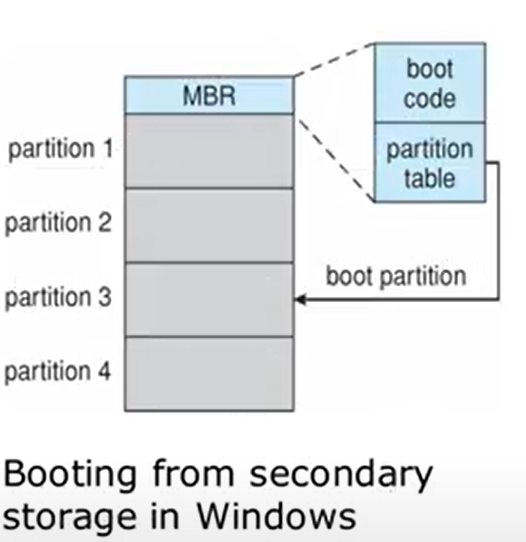
- Partition
- Divide the disk into one or more groups of cylinder.
- Root Partition
- Contains the OS. It is mounted at boot time.
- Consistency checked during mount time.
- Logical Formatting
- For efficiency, group blocks into clusters
- Partition
- Low-level formatting (physical formatting)
Storage Attachment
- Ways to access storage
- Host-attached storage
- Access through local I/O ports. May use one of the following technologies: USB, firewire, fibre channel (FC), etc
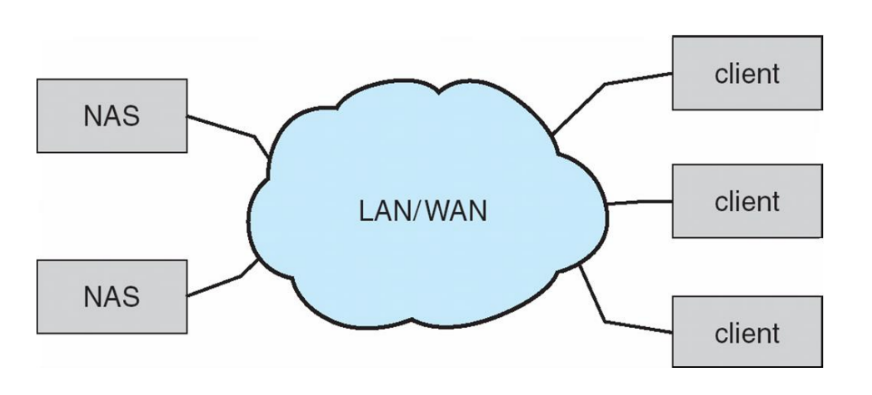
- Network-attached storage (NAS)
- Storage made available over a network. Implemented via remote procedure calls (RPCs) between host and storage. It is presented as a file system.
- Common protocols
- Network File System (NFS)
- Common Internet File System (CIFS)
- Illustration
- Cloud storage
- Similar to NAS, but uses Internet or WAN to access the storage. It is API based
- Host-attached storage
- Ways to access storage
Storage Array
- Attach disks or array of disks.
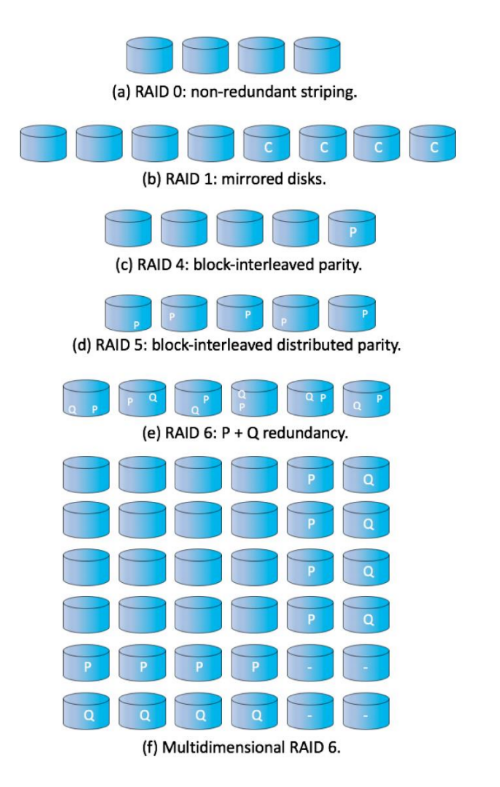
- Redundant Array of Inexpensive/Independent Disks (RAID)
- Increase mean time to failure
- Multiple disks provide reliability via redundancy
- NVRAM to improve write performance
- Disk striping
- A group of disks used as one storage unit
- Redundancy level
Imagens e arquivos do mapa

Informações
- Descrição
- Superior Operating Systems Mapa Mental sobre Mass Storage, criado por Artur Assis em 17-06-2022.
- Criado por
- Artur Assis
- Visualizações
- 0
- Avaliação