
Mapa mental
Activity 1. Consumer behaviour
Conteúdo do mapa
Activity 1. Consumer behaviour
WHY PEOPLE BUY
- People buy to satisfy a want or desire, to solve a problem, or to satisfy an impulse
- Buyers have personal goals and aspirations
- People buy to satisfy a want or desire, to solve a problem, or to satisfy an impulse
TYPES OF CUSTOMERS
- MANUFACTURERS
- OEM Purchasers
- Buyers for original equipment manufacturers (OEMs)
- Purchase goods (components, subassemblies, raw and processed materials) to use in making their products
- Example: Dell
- Most OEM products are bought in large quantities on an annual contract
- Purchase goods (components, subassemblies, raw and processed materials) to use in making their products
- Buyers for original equipment manufacturers (OEMs)
- End Users
- End-user buying situations include the purchase of capital equipment; maintenance, repair, and overhaul (MRO) supplies; and services.
- Capital equipment: mainframe computers and machine tools that the producer uses for a number of years.
- MRO supplies include paper towels and replacement parts for machinery
- Services include Internet and telephone connections, employment agencies, consultants, and transportation.
- MRO supplies include paper towels and replacement parts for machinery
- Capital equipment: mainframe computers and machine tools that the producer uses for a number of years.
- Manufacturers buy goods and services to support their own production and operation
- End-user buying situations include the purchase of capital equipment; maintenance, repair, and overhaul (MRO) supplies; and services.
- OEM Purchasers
- RESELLERS
- Resellers buy finished products or services with the intention to resell them to businesses and consumers
- Three elements
- Profit margin, turnover and effort
- Resellers want to maximize their return on investment (ROI), which is a function of profit margin, or how much they make on each sale; turnover (TO), or how quickly a product will sell; and how much effort it takes to sell the product.
- Profit margin, turnover and effort
- Three elements
- Resellers buy finished products or services with the intention to resell them to businesses and consumers
- GOVERNMENT AGENCIES
- Government buyers develop detailed specifications for a product
- Unique procurement procedures and rules
- Government buyers develop detailed specifications for a product
- INSTITUTIONS
- Group consists of public and private institutions such as churches, hospitals, and colleges
- Purchasing rules and procedures that are as complex and rigid
- Group consists of public and private institutions such as churches, hospitals, and colleges
- CONSUMERS
- Consumers purchase products and services for use by themselves or by their families
- MANUFACTURERS
HOW DO ORGANIZATIONS MAKE BUYING DECISIONS?
- STEPS IN THE BUYING PROCESS
- Recognizing a Need or a Problem (Step 1)
- A problem exists
- Defining the Type of Product Needed (Step 2)
- General approach to solve the problem
- Developing Product Specifications (Step 3)
- Specifications for the product needed to solve the problem are prepared
- Potential suppliers use these specifications to develop proposals. The buyers use them to evaluate the proposal
- Specifications for the product needed to solve the problem are prepared
- Searching for Qualified Suppliers (Step 4)
- Looking for potential suppliers
- Acquiring and Analyzing Proposals (Step 5)
- Qualified suppliers are asked to submit proposals.
- Evaluating Proposals and Selecting a Supplier (Step 6)
- Customer evaluates the proposals
- Placing an Order and Receiving the Product (Step 7)
- The order goes to the supplier, who acknowledges receipt and commits to a delivery date
- Evaluating Product Performance (Step 8)
- Formal or informal assessment made by people involved in the buying process
- Buying Processes Vary
- Recognizing a Need or a Problem (Step 1)
- CREEPING COMMITMENT
- A customer becomes increasingly committed to a particular course of action while going through the steps in the buying process.
- Customer’s point of view is a series of steps that results in a purchase
- A customer becomes increasingly committed to a particular course of action while going through the steps in the buying process.
- STEPS IN THE BUYING PROCESS
WHO MAKES THE BUYING DECISION?
- USERS
- Do not make the ultimate purchase decision. They have considerable influence in the early and late steps of the buying process
- INITIATORS
- Person who starts the buying process
- INFLUENCERS
- People inside or outside the organization who directly or indirectly provide information during the buying process
- GATEKEEPERS
- Gatekeepers control the flow of information and may limit the alternatives considered
- Purchasing agents, also called buyers or supply chain managers
- Gatekeepers control the flow of information and may limit the alternatives considered
- DECIDERS
- Make the final choice
- Senior executives
- Make the final choice
- USERS
TYPES OF ORGANIZATIONAL BUYING DECISIONS
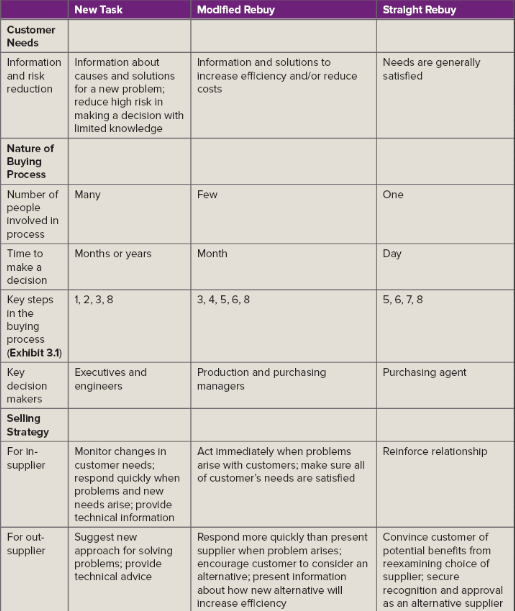
- NEW TASKS
- When a customer purchases a product or service for the first time, a new-task situation occurs
- STRAIGHT REBUYS
- The customer buys the same product from the same source it used when the need arose previously
- MODIFIED REBUYS
- In a modified rebuy situation, the customer has purchased the product or a similar product in the past but is interested in obtaining new information
- Unsatisfactority, a new product becomes available, or the buying needs change
- In a modified rebuy situation, the customer has purchased the product or a similar product in the past but is interested in obtaining new information
- NEW TASKS
ORGANIZATIONAL BUYING AND SELLING
- COMPLEXITY OF THE ORGANIZATIONAL BUYING PROCESS
- Extensive evaluations and negotiations over time
- Number of people involved and Purchasing agents
- Salespeople must be able to deal effectively with a wide range of people working for their customer and their company
- Extensive evaluations and negotiations over time
- DERIVED VERSUS DIRECT DEMAND
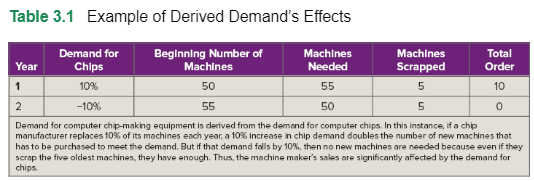
- Derived demand
- OEMs and resellers
- Purchases made by these customers ultimately depend on the demand for their products
- Derived demand
- COMPLEXITY OF THE ORGANIZATIONAL BUYING PROCESS
SUPPLIER EVALUATION AND CHOICE
- ORGANIZATIONAL NEEDS AND CRITERIA
- Economic Criteria
- Objective of businesses is to make a profit
- Life-cycle costing, also referred to as the total cost of ownership, is a method for determining the cost of equipment or supplies over their useful lives.
- Objective of businesses is to make a profit
- Quality Criteria
- Quality and reliability of their products are as important to their customers as price
- Quality criteria can include such objective measures as the number of defects per thousand products, the amount of time a machine operates before needing service, or the number of items a system can process in a given period of time
- Salespeople need to know what organizational buyers are looking for
- Quality and reliability of their products are as important to their customers as price
- Service Criteria
- Products that are low cost, that perform reliably, and that are aesthetically pleasing
- Service-level agreements (SLAs) are standards for minimum service delivery for specific objective measures of how the vendor will perform services
- Value analysis is an example of a program in which suppliers and customers work together to reduce costs and still provide the required level of performance
- Salespeople can use value analysis to get customers to consider a new product
- Products that are low cost, that perform reliably, and that are aesthetically pleasing
- Economic Criteria
- INDIVIDUAL NEEDS OF BUYING CENTER MEMBERS
- Types of Needs
- Personal goals and aspirations
- Salespeople can influence members of the buying center by developing strategies to satisfy individual needs.
- Personal goals and aspirations
- Risk Reduction
- Buyers first assess the potential for risk and then develop a risk-reduction strategy
- To reduce risk, buying center members may collect additional information, develop a loyalty to present suppliers, or spread the risk by placing orders with several vendors
- Sales Technology illustrates the importance of the Internet for word-of-mouth information, as well as company-created information
- Another way to reduce uncertainty and risk is to display vendor loyalty to suppliers that is, to continue buying from suppliers that proved satisfactory in the past
- Lost for good; for all the out-suppliers, this account can be considered lost for good because the in-supplier has cemented this relationship for a long time
- Types of vendor loyalty
- Behavioral loyaltyis a form of vendor loyalty where a buyer will make the same purchases over and over, so long as the vendor doesn’t make any major mistakes.
- Attitudinal loyalty is different; the buyer has a strong emotional attachment to the vendor, the vendor’s product, or even the salesperson, which then translates into sales as opportunities arise.
- To reduce risk, buying center members may collect additional information, develop a loyalty to present suppliers, or spread the risk by placing orders with several vendors
- Buyers first assess the potential for risk and then develop a risk-reduction strategy
- Types of Needs
- ORGANIZATIONAL NEEDS AND CRITERIA
SUPPLY CHAIN MANAGEMENT AND PROFESSIONAL PURCHASING
- SUPPLY CHAIN MANAGEMENT
- SCM has become more than just logistics; it is now a strategy of managing inventory while containing costs.
- SCM includes logistics systems, such as just-in-time inventory control, as well as supplier evaluation processes, such as supplier relationship management systems
- The just-in-time (JIT) inventory control system is an example of a logistics SCM system used by a producer to minimize its inventory
- These JIT inventory systems are referred to as quick-response (QR) systems or efficient consumer response (ECR) systems in a consumer product distribution channel.
- Automatic replenishment (AR) is a form of JIT where the supplier manages inventory levels for the customer
- Efficient consumer response systems use automatic replenishment technology through electronic data interchange (EDI)
- Supplier relationship management (SRM) is a strategy by which organizational buyers evaluate the relative importance of suppliers and use that information to determine with whom they want to develop partnerships
- Efficient consumer response systems use automatic replenishment technology through electronic data interchange (EDI)
- SCM has become more than just logistics; it is now a strategy of managing inventory while containing costs.
- SUPPLY CHAIN MANAGEMENT
MULTIATTRIBUTE MODEL OF PRODUCT EVALUATION AND CHOICE
- PERFORMANCE EVALUATION OF CHARACTERISTICS
- The final decision depends on the relationship between the performance evaluations and the company’s needs
- he buying center members must consider the degree to which they are willing to sacrifice poor performance on one attribute for superior performance on another
- The final decision depends on the relationship between the performance evaluations and the company’s needs
- IMPORTANCE WEIGHTS
- OVERALL EVALUATION
- VALUE OFFERED
- SUPPLIER SELECTION
- IMPLICATIONS FOR SALESPEOPLE
- PERFORMANCE EVALUATION OF CHARACTERISTICS
SELLING YOURSELF
- Recognize that there is a buying center
- Who is the gatekeeper, who is the decider, and who are influencers?
- You need to understand the process by which the decision is made
- Take some time to understand who is involved in the decision, what criteria they will use, and what process they will use to reach a decision
- You need to understand the process by which the decision is made
- Who is the gatekeeper, who is the decider, and who are influencers?
- Recognize that there is a buying center
Imagens e arquivos do mapa
Informações
- Descrição
- Mapa Mental sobre Activity 1. Consumer behaviour, criado por Nicole Patiño em 09-08-2022.
- Criado por
- Nicole Patiño
- Visualizações
- 0
- Avaliação