
Mapa mental
Phonetic Rules
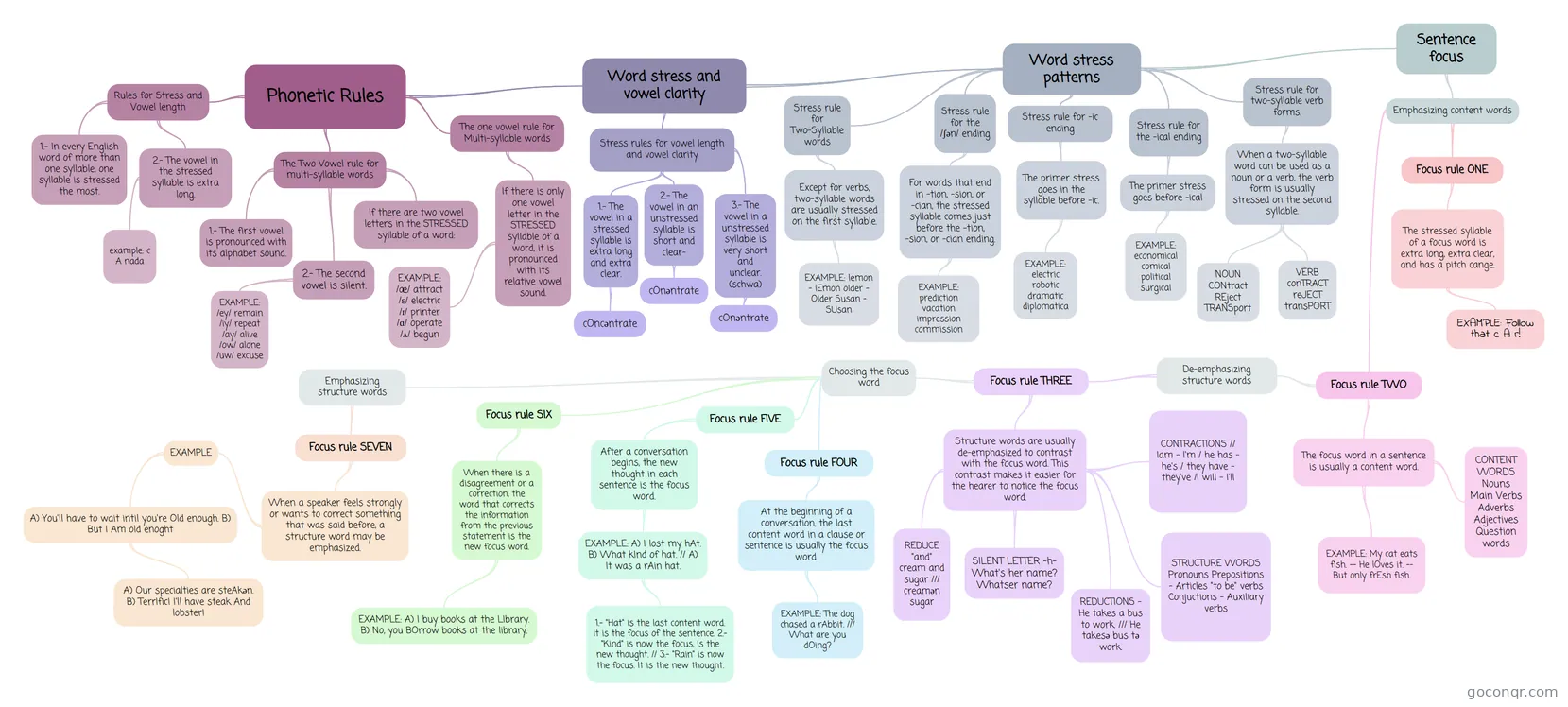
Mind map: Phonetic rules
Conteúdo do mapa
Phonetic Rules
Rules for Stress and Vowel length
- 1.- In every English word of more than one syllable, one syllable is stressed the most.
- 2.- The vowel in the stressed syllable is extra long.
- example: c A nada
The Two Vowel rule for multi-syllable words
- If there are two vowel letters in the STRESSED syllable of a word:
- 1.- The first vowel is pronounced with its alphabet sound.
- 2.- The second vowel is silent.
- EXAMPLE: /ey/ remain /iy/ repeat /ay/ alive /ow/ alone /uw/ excuse
The one vowel rule for Multi-syllable words
- If there is only one vowel letter in the STRESSED syllable of a word, it is pronounced with its relative vowel sound.
- EXAMPLE: /æ/ attract /ɛ/ electric /ɪ/ printer /ɑ/ operate /ʌ/ begun
- If there is only one vowel letter in the STRESSED syllable of a word, it is pronounced with its relative vowel sound.
Word stress and vowel clarity
- Stress rules for vowel length and vowel clarity
- 1.- The vowel in a stressed syllable is extra long and extra clear.
- cOncəntrate
- 2.- The vowel in an unstressed syllable is short and clear-
- cOnəntrate
- 3.- The vowel in a unstressed syllable is very short and unclear. (schwa)
- cOnəntrate
- 1.- The vowel in a stressed syllable is extra long and extra clear.
- Word stress patterns
- Stress rule for Two-Syllable words
- Except for verbs, two-syllable words are usually stressed on the first syllable.
- EXAMPLE: lemon - lEmon older - Older Susan - SUsan
- Except for verbs, two-syllable words are usually stressed on the first syllable.
- Stress rule for the /ʃən/ ending
- For words that end in -tion, -sion, or -cian, the stressed syllable comes just before the -tion, -sion, or -cian ending.
- EXAMPLE: prediction vacation impression commission
- For words that end in -tion, -sion, or -cian, the stressed syllable comes just before the -tion, -sion, or -cian ending.
- Stress rule for -ic ending
- The primer stress goes in the syllable before -ic.
- EXAMPLE: electric robotic dramatic diplomatica
- The primer stress goes in the syllable before -ic.
- Stress rule for the -ical ending
- The primer stress goes before -ical
- EXAMPLE: economical comical political surgical
- The primer stress goes before -ical
- Stress rule for two-syllable verb forms.
- When a two-syllable word can be used as a noun or a verb, the verb form is usually stressed on the second syllable.
- NOUN CONtract REject TRANSport
- VERB conTRACT reJECT transPORT
- When a two-syllable word can be used as a noun or a verb, the verb form is usually stressed on the second syllable.
- Sentence focus
- Emphasizing content words
- Focus rule ONE
- The stressed syllable of a focus word is extra long, extra clear, and has a pitch cange.
- EXAMPLE: Follow that c A r!
- The stressed syllable of a focus word is extra long, extra clear, and has a pitch cange.
- Focus rule TWO
- The focus word in a sentence is usually a content word.
- CONTENT WORDS Nouns Main Verbs Adverbs Adjectives Question words
- EXAMPLE: My cat eats fIsh. -- He lOves it. -- But only frEsh fish.
- De-emphasizing structure words
- Focus rule THREE
- Structure words are usually de-emphasized to contrast with the focus word. This contrast makes it easier for the hearer to notice the focus word.
- STRUCTURE WORDS Pronouns Prepositions - Articles "to be" verbs Conjuctions - Auxiliary verbs
- CONTRACTIONS // Iam - I'm / he has - he's / they have - they've /I will - I'll
- REDUCTIONS - He takes a bus to work. /// He takesə bus tə work.
- REDUCE "and" cream and sugar /// creamən sugar
- SILENT LETTER -h- What's her name? Whatser name?
- Choosing the focus word
- Focus rule FOUR
- At the beginning of a conversation, the last content word in a clause or sentence is usually the focus word.
- EXAMPLE: The dog chased a rAbbit. /// What are you dOing?
- At the beginning of a conversation, the last content word in a clause or sentence is usually the focus word.
- Focus rule FIVE
- After a conversation begins, the new thought in each sentence is the focus word.
- EXAMPLE: A) I lost my hAt. B) What kInd of hat. // A) It was a rAin hat.
- 1.- "Hat" is the last content word. It is the focus of the sentence. 2.- "Kind" is now the focus, is the new thought. // 3.- "Rain" is now the focus. It is the new thought.
- EXAMPLE: A) I lost my hAt. B) What kInd of hat. // A) It was a rAin hat.
- After a conversation begins, the new thought in each sentence is the focus word.
- Focus rule SIX
- When there is a disagreement or a correction, the word that corrects the information from the previous statement is the new focus word.
- EXAMPLE: A) I buy books at the LIbrary. B) No, you BOrrow books at the library.
- When there is a disagreement or a correction, the word that corrects the information from the previous statement is the new focus word.
- Emphasizing structure words
- Focus rule SEVEN
- When a speaker feels strongly or wants to correct something that was said before, a structure word may be emphasized.
- EXAMPLE
- A) You'll have to wait intil you're Old enough. B) But I Am old enoght
- A) Our specialties are steAkən. B) TerrIfic! I'll have steak And lobster!
- A) You'll have to wait intil you're Old enough. B) But I Am old enoght
- EXAMPLE
- When a speaker feels strongly or wants to correct something that was said before, a structure word may be emphasized.
- Focus rule SEVEN
- Focus rule FOUR
- Structure words are usually de-emphasized to contrast with the focus word. This contrast makes it easier for the hearer to notice the focus word.
- Focus rule THREE
- The focus word in a sentence is usually a content word.
- Focus rule ONE
- Emphasizing content words
- Stress rule for Two-Syllable words
- Stress rules for vowel length and vowel clarity
Informações
- Descrição
- Mapa Mental sobre Phonetic Rules, criado por Cecilia Garza em 22-10-2015.
- Criado por
- Cecilia Garza
- Visualizações
- 0
- Avaliação