
Mapa mental
9.Tracing
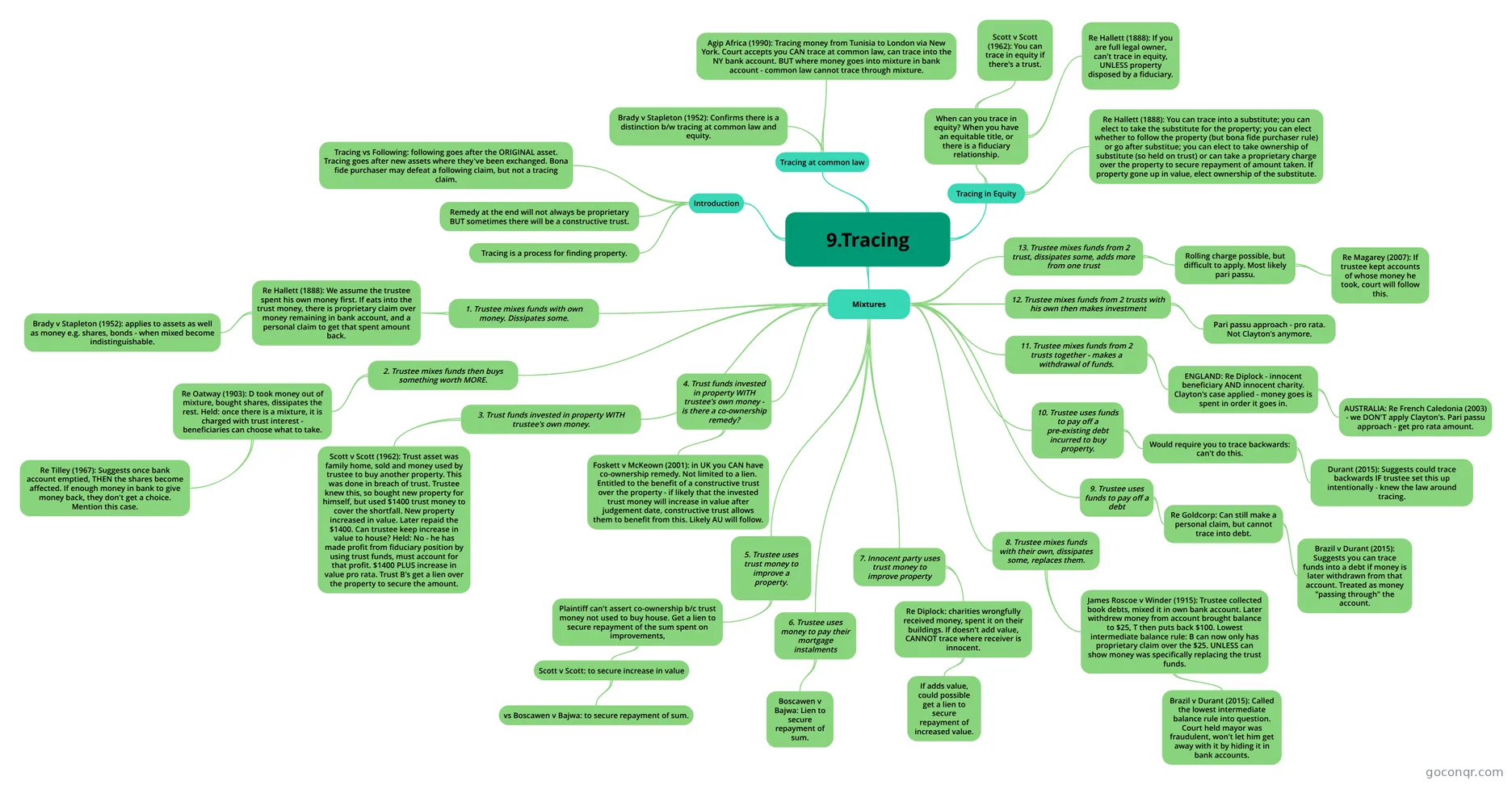
Mind map: Tracing in equity and common law
Conteúdo do mapa
9.Tracing
Introduction
- Tracing is a process for finding property.
- Remedy at the end will not always be proprietary BUT sometimes there will be a constructive trust.
- Tracing vs Following: following goes after the ORIGINAL asset. Tracing goes after new assets where they've been exchanged. Bona fide purchaser may defeat a following claim, but not a tracing claim.
Tracing at common law
- Brady v Stapleton (1952): Confirms there is a distinction b/w tracing at common law and equity.
- Agip Africa (1990): Tracing money from Tunisia to London via New York. Court accepts you CAN trace at common law, can trace into the NY bank account. BUT where money goes into mixture in bank account - common law cannot trace through mixture.
Tracing in Equity
- When can you trace in equity? When you have an equitable title, or there is a fiduciary relationship.
- Scott v Scott (1962): You can trace in equity if there's a trust.
- Re Hallett (1888): If you are full legal owner, can't trace in equity, UNLESS property disposed by a fiduciary.
- Re Hallett (1888): You can trace into a substitute; you can elect to take the substitute for the property; you can elect whether to follow the property (but bona fide purchaser rule) or go after substitue; you can elect to take ownership of substitute (so held on trust) or can take a proprietary charge over the property to secure repayment of amount taken. If property gone up in value, elect ownership of the substitute.
- When can you trace in equity? When you have an equitable title, or there is a fiduciary relationship.
Mixtures
- 1. Trustee mixes funds with own money. Dissipates some.
- Re Hallett (1888): We assume the trustee spent his own money first. If eats into the trust money, there is proprietary claim over money remaining in bank account, and a personal claim to get that spent amount back.
- Brady v Stapleton (1952): applies to assets as well as money e.g. shares, bonds - when mixed become indistinguishable.
- Re Hallett (1888): We assume the trustee spent his own money first. If eats into the trust money, there is proprietary claim over money remaining in bank account, and a personal claim to get that spent amount back.
- 2. Trustee mixes funds then buys something worth MORE.
- Re Oatway (1903): D took money out of mixture, bought shares, dissipates the rest. Held: once there is a mixture, it is charged with trust interest - beneficiaries can choose what to take.
- Re Tilley (1967): Suggests once bank account emptied, THEN the shares become affected. If enough money in bank to give money back, they don't get a choice. Mention this case.
- Re Oatway (1903): D took money out of mixture, bought shares, dissipates the rest. Held: once there is a mixture, it is charged with trust interest - beneficiaries can choose what to take.
- 3. Trust funds invested in property WITH trustee's own money.
- Scott v Scott (1962): Trust asset was family home, sold and money used by trustee to buy another property. This was done in breach of trust. Trustee knew this, so bought new property for himself, but used $1400 trust money to cover the shortfall. New property increased in value. Later repaid the $1400. Can trustee keep increase in value to house? Held: No - he has made profit from fiduciary position by using trust funds, must account for that profit. $1400 PLUS increase in value pro rata. Trust B's get a lien over the property to secure the amount.
- 4. Trust funds invested in property WITH trustee's own money - is there a co-ownership remedy?
- Foskett v McKeown (2001): in UK you CAN have co-ownership remedy. Not limited to a lien. Entitled to the benefit of a constructive trust over the property - if likely that the invested trust money will increase in value after judgement date, constructive trust allows them to benefit from this. Likely AU will follow.
- 5. Trustee uses trust money to improve a property.
- Plaintiff can't assert co-ownership b/c trust money not used to buy house. Get a lien to secure repayment of the sum spent on improvements,
- Scott v Scott: to secure increase in value
- vs Boscawen v Bajwa: to secure repayment of sum.
- Scott v Scott: to secure increase in value
- Plaintiff can't assert co-ownership b/c trust money not used to buy house. Get a lien to secure repayment of the sum spent on improvements,
- 6. Trustee uses money to pay their mortgage instalments
- Boscawen v Bajwa: Lien to secure repayment of sum.
- 7. Innocent party uses trust money to improve property
- Re Diplock: charities wrongfully received money, spent it on their buildings. If doesn't add value, CANNOT trace where receiver is innocent.
- If adds value, could possible get a lien to secure repayment of increased value.
- Re Diplock: charities wrongfully received money, spent it on their buildings. If doesn't add value, CANNOT trace where receiver is innocent.
- 8. Trustee mixes funds with their own, dissipates some, replaces them.
- James Roscoe v Winder (1915): Trustee collected book debts, mixed it in own bank account. Later withdrew money from account brought balance to $25, T then puts back $100. Lowest intermediate balance rule: B can now only has proprietary claim over the $25. UNLESS can show money was specifically replacing the trust funds.
- Brazil v Durant (2015): Called the lowest intermediate balance rule into question. Court held mayor was fraudulent, won't let him get away with it by hiding it in bank accounts.
- James Roscoe v Winder (1915): Trustee collected book debts, mixed it in own bank account. Later withdrew money from account brought balance to $25, T then puts back $100. Lowest intermediate balance rule: B can now only has proprietary claim over the $25. UNLESS can show money was specifically replacing the trust funds.
- 9. Trustee uses funds to pay off a debt
- Re Goldcorp: Can still make a personal claim, but cannot trace into debt.
- Brazil v Durant (2015): Suggests you can trace funds into a debt if money is later withdrawn from that account. Treated as money "passing through" the account.
- Re Goldcorp: Can still make a personal claim, but cannot trace into debt.
- 10. Trustee uses funds to pay off a pre-existing debt incurred to buy property.
- Would require you to trace backwards: can't do this.
- Durant (2015): Suggests could trace backwards IF trustee set this up intentionally - knew the law around tracing.
- Would require you to trace backwards: can't do this.
- 11. Trustee mixes funds from 2 trusts together - makes a withdrawal of funds.
- ENGLAND: Re Diplock - innocent beneficiary AND innocent charity. Clayton's case applied - money goes is spent in order it goes in.
- AUSTRALIA: Re French Caledonia (2003) - we DON'T apply Clayton's. Pari passu approach - get pro rata amount.
- ENGLAND: Re Diplock - innocent beneficiary AND innocent charity. Clayton's case applied - money goes is spent in order it goes in.
- 12. Trustee mixes funds from 2 trusts with his own then makes investment
- Pari passu approach - pro rata. Not Clayton's anymore.
- 13. Trustee mixes funds from 2 trust, dissipates some, adds more from one trust
- Rolling charge possible, but difficult to apply. Most likely pari passu.
- Re Magarey (2007): If trustee kept accounts of whose money he took, court will follow this.
- Rolling charge possible, but difficult to apply. Most likely pari passu.
- 1. Trustee mixes funds with own money. Dissipates some.
Informações
- Descrição
- Universität EQUITY Mapa Mental sobre 9.Tracing, criado por georgiafeltis em 07-11-2015.
- Criado por
- georgiafeltis
- Visualizações
- 3
- Avaliação