
Mapa mental
The Protists
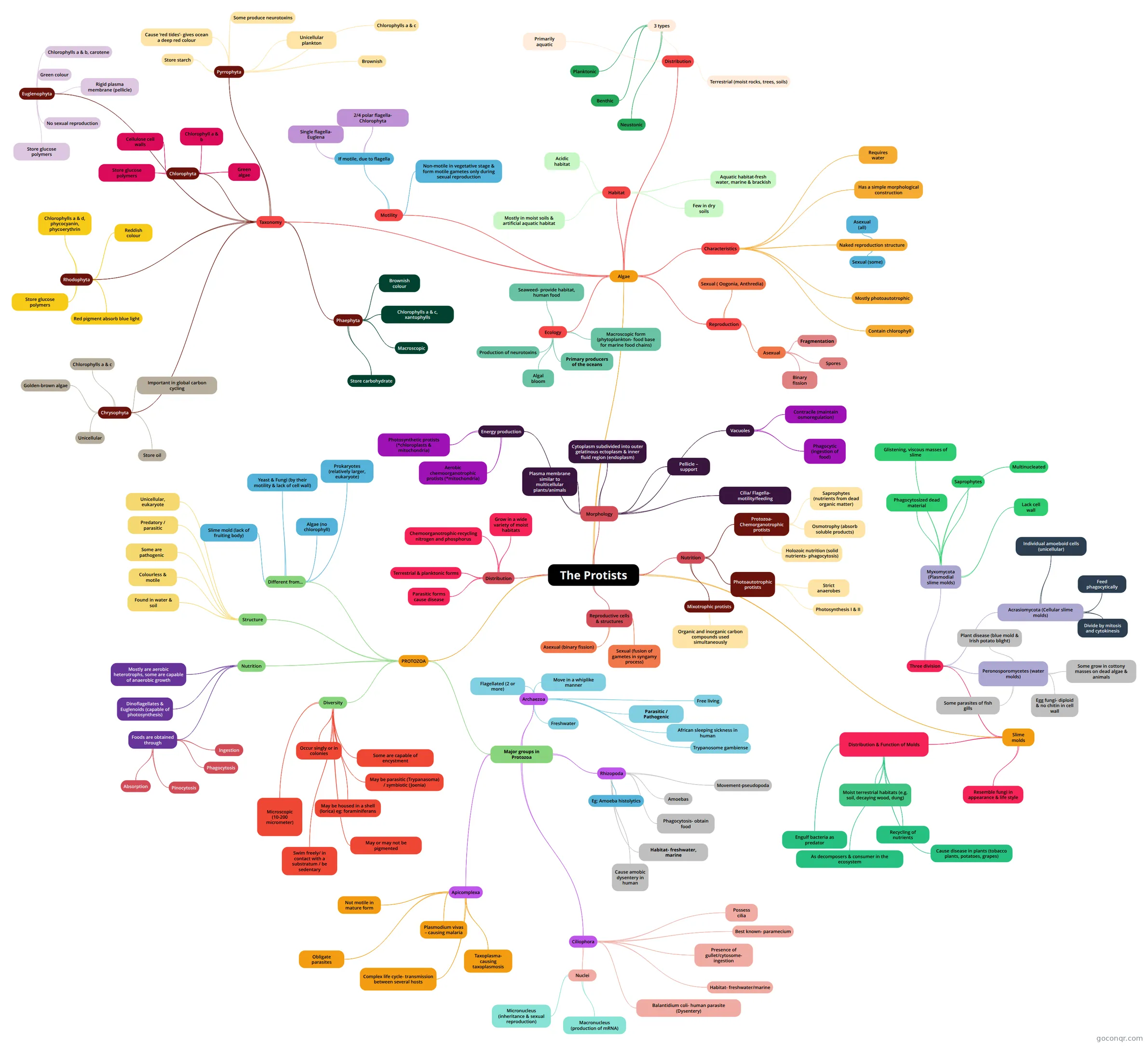
Mind map: The protists
Conteúdo do mapa
The Protists
Distribution
- Chemoorganotrophic-recycling nitrogen and phosphorus
- Terrestrial & planktonic forms
- Parasitic forms cause disease
- Grow in a wide variety of moist habitats
Morphology
- Pellicle – support
- Cytoplasm subdivided into outer gelatinous ectoplasm & inner fluid region (endoplasm)
- Plasma membrane similar to multicellular plants/animals
- Vacuoles
- Contracile (maintain osmoregulation)
- Phagocytic (ingestion of food)
- Energy production
- Photosynthetic protists (*chloroplasts & mitochondria)
- Aerobic chemoorganotrophic protists (*mitochondria)
- Cilia/ Flagella- motility/feeding
Nutrition
- Protozoa- Chemorganotrophic protists
- Saprophytes (nutrients from dead organic matter)
- Osmotrophy (absorb soluble products)
- Holozoic nutrition (solid nutrients- phagocytosis)
- Photoautotrophic protists
- Strict anaerobes
- Photosynthesis I & II
- Mixotrophic protists
- Organic and inorganic carbon compounds used simultaneously
- Protozoa- Chemorganotrophic protists
Reproductive cells & structures
- Asexual (binary fission)
- Sexual (fusion of gametes in syngamy process)
PROTOZOA
- Different from…
- Slime mold (lack of fruiting body)
- Yeast & Fungi (by their motility & lack of cell wall)
- Prokaryotes (relatively larger, eukaryote)
- Algae (no chlorophyll)
- Structure
- Unicellular, eukaryote
- Predatory / parasitic
- Some are pathogenic
- Colourless & motile
- Found in water & soil
- Nutrition
- Dinoflagellates & Euglenoids (capable of photosynthesis)
- Foods are obtained through
- Ingestion
- Phagocytosis
- Pinocytosis
- Absorption
- Mostly are aerobic heterotrophs, some are capable of anaerobic growth
- Diversity
- Microscopic (10-200 micrometer)
- Occur singly or in colonies
- Some are capable of encystment
- May be housed in a shell (lorica) eg: foraminiferans
- May be parasitic (Trypanasoma) / symbiotic (Joenia)
- May or may not be pigmented
- Swim freely/ in contact with a substratum / be sedentary
- Major groups in Protozoa
- Archaezoa
- Free living
- Parasitic / Pathogenic
- Trypanosome gambiense
- Flagellated (2 or more)
- Freshwater
- Move in a whiplike manner
- African sleeping sickness in human
- Rhizopoda
- Amoebas
- Phagocytosis- obtain food
- Movement-pseudopoda
- Cause amobic dysentery in human
- Eg: Amoeba histolytics
- Habitat- freshwater, marine
- Ciliophora
- Possess cilia
- Presence of gullet/cytosome- ingestion
- Balantidium coli- human parasite (Dysentery)
- Habitat- freshwater/marine
- Best known- paramecium
- Nuclei
- Micronucleus (inheritance & sexual reproduction)
- Macronucleus (production of mRNA)
- Apicomplexa
- Not motile in mature form
- Obligate parasites
- Complex life cycle- transmission between several hosts
- Plasmodium vivas – causing malaria
- Taxoplasma- causing taxoplasmosis
- Archaezoa
- Different from…
Algae
- Characteristics
- Naked reproduction structure
- Asexual (all)
- Sexual (some)
- Mostly photoautotrophic
- Contain chlorophyll
- Has a simple morphological construction
- Requires water
- Naked reproduction structure
- Habitat
- Aquatic habitat-fresh water, marine & brackish
- Few in dry soils
- Acidic habitat
- Mostly in moist soils & artificial aquatic habitat
- Motility
- If motile, due to flagella
- Single flagella- Euglena
- 2/4 polar flagella- Chlorophyta
- Non-motile in vegetative stage & form motile gametes only during sexual reproduction
- If motile, due to flagella
- Distribution
- Terrestrial (moist rocks, trees, soils)
- Primarily aquatic
- 3 types
- Benthic
- Planktonic
- Neustonic
- Reproduction
- Sexual ( Oogonia, Anthredia)
- Asexual
- Fragmentation
- Spores
- Binary fission
- Ecology
- Seaweed- provide habitat, human food
- Macroscopic form (phytoplankton- food base for marine food chains)
- Primary producers of the oceans
- Production of neurotoxins
- Algal bloom
- Taxonomy
- Rhodophyta
- Reddish colour
- Chlorophylls a & d, phycocyanin, phycoerythrin
- Red pigment absorb blue light
- Store glucose polymers
- Chrysophyta
- Important in global carbon cycling
- Store oil
- Chlorophylls a & c
- Unicellular
- Golden-brown algae
- Phaephyta
- Brownish colour
- Chlorophylls a & c, xantophylls
- Macroscopic
- Store carbohydrate
- Chlorophyta
- Chlorophyll a & b
- Cellulose cell walls
- Store glucose polymers
- Green algae
- Pyrrophyta
- Unicellular plankton
- Brownish
- Store starch
- Cause ‘red tides’- gives ocean a deep red colour
- Some produce neurotoxins
- Chlorophylls a & c
- Euglenophyta
- Green colour
- Chlorophylls a & b, carotene
- Store glucose polymers
- Rigid plasma membrane (pellicle)
- No sexual reproduction
- Rhodophyta
- Characteristics
Slime molds
- Resemble fungi in appearance & life style
- Three division
- Acrasiomycota (Cellular slime molds)
- Individual amoeboid cells (unicellular)
- Feed phagocytically
- Divide by mitosis and cytokinesis
- Myxomycota (Plasmodial slime molds)
- Phagocytosized dead material
- Saprophytes
- Multinucleated
- Lack cell wall
- Glistening, viscous masses of slime
- Peronosporomycetes (water molds)
- Some grow in cottony masses on dead algae & animals
- Some parasites of fish gills
- Plant disease (blue mold & Irish potato blight)
- Egg fungi- diploid & no chitin in cell wall
- Acrasiomycota (Cellular slime molds)
- Distribution & Function of Molds
- Engulf bacteria as predator
- As decomposers & consumer in the ecosystem
- Recycling of nutrients
- Cause disease in plants (tobacco plants, potatoes, grapes)
- Moist terrestrial habitats (e.g. soil, decaying wood, dung)