
Mapa mental
Understanding Second Language Acquisition (Rod Ellis, 1985)
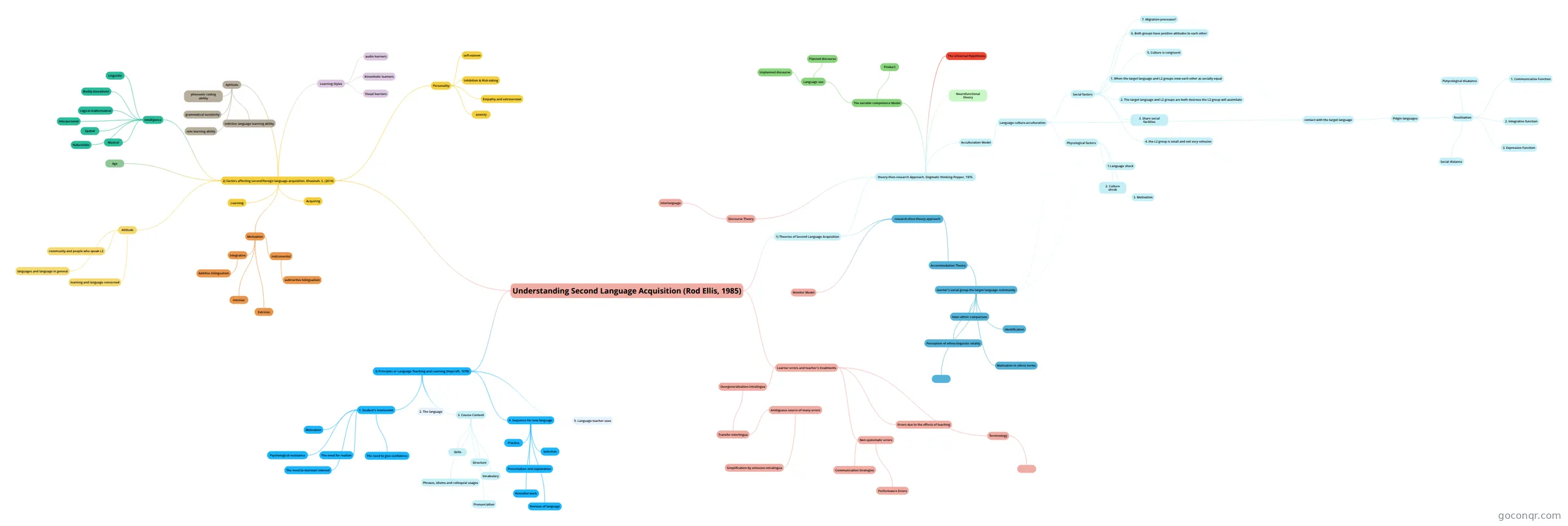
Mind map: Second Language Acquisition Rod Ellis 1985
Conteúdo do mapa
Understanding Second Language Acquisition (Rod Ellis, 1985)
1) Theories of Second Language Acquisition
- Explanation-Description-learner develops the linguistic categories he does. What-How-When-Why, Theory-then-research Approach
- theory-then-research Approach. Dogmatic thinking-Popper, 1976.
- 1. Develop an explicit theory 2. Testable prediction from theory 3. Conduct research to test prediction 4. Modify (abandon) the theory 5. Test a new prediction
- Acculturation Model
- Brown (1980). becoming adapted to a new culture. Language-culture John Schumannn (1978) Nativization Model: degree of learners acculturatization.
- Language-culture-acculturation
- social-psycological distance
- Social factors
- 1. When the target language and L2 groups view each other as socially equal
- 2. The target language and L2 groups are both desirous the L2 group will assimilate
- 3. Share social facilities
- 4. the L2 group is small and not very cohesive
- 5. Culture is congruent
- 6. Both groups have positive attitudes to each other
- 7. Migration processes?
- Phycological factors
- 1.Language shock
- 2. Culture shcok
- 3. Motivation
- contact with the target language
- Pidgin languages
- fossilization
- Social distance
- Pshycological disatance
- 1. Communicative Function
- 2. Integrative function
- 3. Expressive Function
- fossilization
- Pidgin languages
- Discourse Theory
- the development of communication
- Interlanguage
- The variable competence Model
- Ellis (`984)
- Language use
- the way the language is learnt is a reflection of the way it is used lingustic knowedge and use of it
- Unplanned discourse
- Planned discourse
- Product
- The Universal Hypothesis
- Target language-first language Language faculty chomsky 1965 Interlanguage
- Neurofunctional theory
- Lamendella (`977) Language funtion and neural anatomy
- research-then-theory approach
- 1. Select a phenonon for invetigation 2. Measure its characteristics. 3. Collect data and look for systematic patterns 4. Formalize significant patterns as rules describing natural events.
- Accommodation Theory
- Howard Giles. Intergroup used of language in multilingual communities. Canadian context. Intergroup uses of language-ethnic communication.
- learner's social group-the target language community
- identity
- Motivation in ethnic terms
- Identification
- Inter-ethnic comparison
- Perception of ethno-linguistic vitality
- Monitor Model
- Krashen (1982)
2) Factors affecting second/foreign language acquisition. Khasinah, S. (2014)
- Learning
- learning is a conscious study through formal instruction such as language classroom learning.
- Acquiring
- Second Language Acquisition: is subconscious study through which a person acquires L2 or addi- tional languages.
- Motivation
- Integrative
- People and culture
- Additive bilingualism
- no harm to the mother tongue
- Instrumental
- functional and useful-job, tests, foreign news paper
- subtractive bilingualism
- mother tongue is replaced by the target language.
- Intrinsic
- no apparent reward
- Extrinsic
- Integrative
- Attitude
- beliefs about the target language culture, their own culture, and teachers and learning tasks.
- community and people who speak L2
- learning and language concerned
- languages and language in general
- Age
- younger age is better at language acquisition, but adults are better at learning lan- guage rules and systems.
- Intelligence
- general ability to master academic skills (Ellis, 1985). Lunguistic-mathematical abilities. Learners with high IQ achieve better resuts on language tests. Garner (1983) Frames of mind.
- Linguistic
- Logical-mathematical
- Spatial
- Musical
- Bodily-kinesthetic
- Interpersonal
- Naturalistic
- Aptitude
- specific ability a learner has for learning a second language (Ellis, 1986)
- phonemic coding ability
- grammatical sensitivity
- indictive language learning ability
- rote learning ability
- Learning Styles
- cognitive style. It is said that if teachers match their teaching methods to the students’ learning styles, the students will be more successful and more interested in the language.
- audio learners
- Kinesthetic learners
- Visual learners
- Personality
- set of features that chracterize an individual. Affective states. Introvert and extroverts, self-esteem, inhibition, risk-taking, anxiety and empathy (Ellis, 1986)
- self-esteem
- People develop their sense of self-esteem as a result of the information they receive about them- selves from others
- Inhibition & Risk-taking
- The higher self-esteem the lower walls of inhibition and greater success in learning a foreign language.
- anxiety
- feelings of uneasiness, frustration, self-doubt and worry (Brown, 1994)
- Empathy and extroversion
- the willingness and capacity to identify with others” (Stern, 1993) Native-like pronunciation.
- Learning
3) Principles or Language Teaching and Learning (Haycraft, 1978)
- 1. Student's involvemnt
- Motivation
- Psychological resistance
- The need for realism
- The need to give confidence
- The need to maintain interest
- 2. The language
- 3. Course Content
- Skills
- Structure
- Vocabulary
- Phrases, idioms and colloquial usages
- Pronunciation
- 4. Sequence for new language
- Selection
- Presentation and explanation
- Practice
- Remedial work
- Revision of language
- 5. Language teacher uses
- mother tongue use of aids
- 1. Student's involvemnt
Learner errors and teacher's treatments
- Child's speech is not a faulty version of adult's. Errors are not signs of learning failure Developing system-data of language. (Intralingual-interlingual)
- Overgeneralisation-intralingua
- Knowledge about the second language
- Transfer-Interlingua
- Mother tongue-begginers
- Ambiguous source of many errors
- Simplification by omission-intralingua
- Non-systematic errors
- Communication Strategies
- Performance Errors
- Errors due to the effects of teaching
- Terminology
- 1. Transitional Competence: systems of rules that the learner has developed 2. Idiosyncratic dialect: 3. Approximative System: botjh mother tongue and knowledge of second language.
Informações
- Descrição
- Mapa Mental sobre Understanding Second Language Acquisition (Rod Ellis, 1985), criado por Camilo Andres Acevedo Gerena em 02-03-2026.
- Criado por
- Camilo Andres Acevedo Gerena
- Visualizações
- 0
- Avaliação
Mais sobre Theories of Second Language Acquisition