
Mapa mental
Geography-U2T2 Consuming Resources
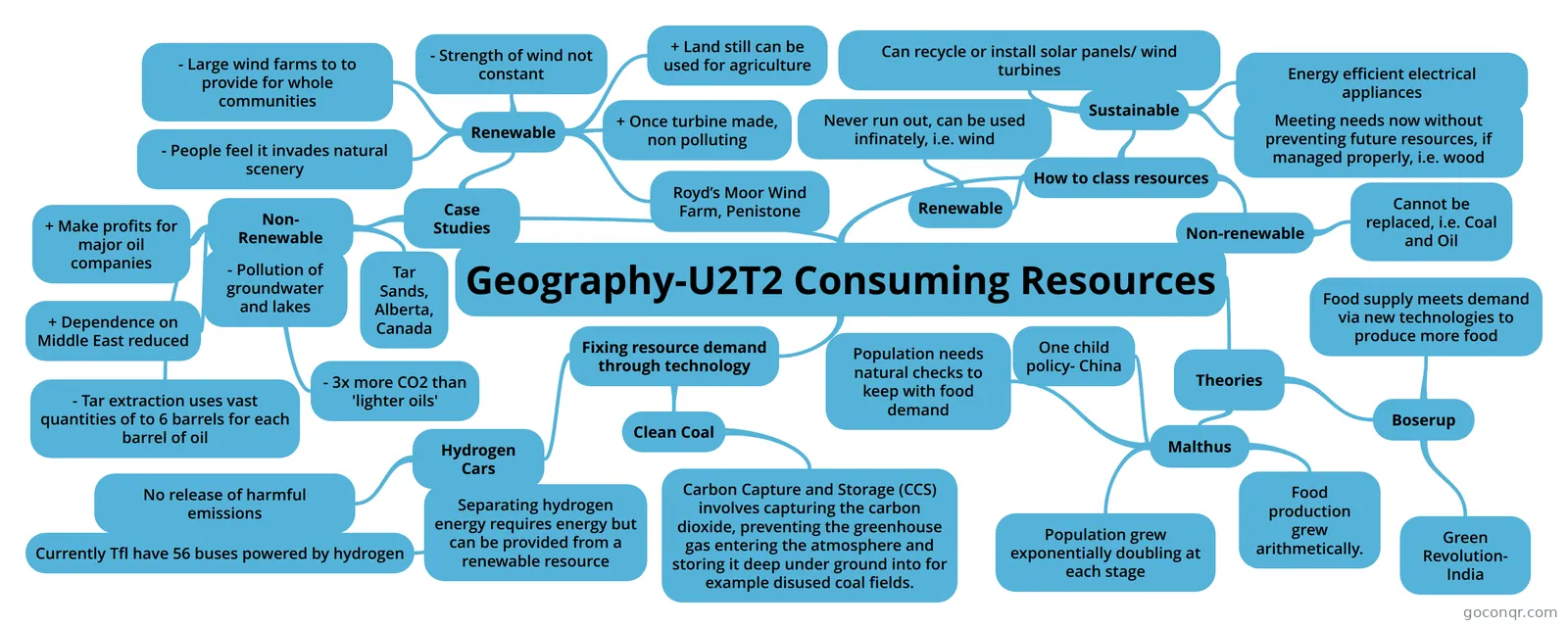
Mind map: geography consuming resources
Conteúdo do mapa
Geography-U2T2 Consuming Resources
Theories
- Malthus
- Population grew exponentially doubling at each stage
- Food production grew arithmetically.
- Population needs natural checks to keep with food demand
- One child policy- China
- Boserup
- Food supply meets demand via new technologies to produce more food
- Green Revolution- India
- Malthus
Fixing resource demand through technology
- Hydrogen Cars
- No release of harmful emissions
- Currently Tfl have 56 buses powered by hydrogen
- Separating hydrogen energy requires energy but can be provided from a renewable resource
- Clean Coal
- Carbon Capture and Storage (CCS) involves capturing the carbon dioxide, preventing the greenhouse gas entering the atmosphere and storing it deep under ground into for example disused coal fields.
- Hydrogen Cars
How to class resources
- Non-renewable
- Cannot be replaced, i.e. Coal and Oil
- Renewable
- Never run out, can be used infinately, i.e. wind
- Sustainable
- Meeting needs now without preventing future resources, if managed properly, i.e. wood
- Can recycle or install solar panels/ wind turbines
- Energy efficient electrical appliances
- Non-renewable
Case Studies
- Renewable
- Royd’s Moor Wind Farm, Penistone
- + Once turbine made, non polluting
- + Land still can be used for agriculture
- - Strength of wind not constant
- - Large wind farms to to provide for whole communities
- - People feel it invades natural scenery
- Non- Renewable
- Tar Sands, Alberta, Canada
- + Make profits for major oil companies
- + Dependence on Middle East reduced
- - 3x more CO2 than 'lighter oils'
- - Tar extraction uses vast quantities of to 6 barrels for each barrel of oil
- - Pollution of groundwater and lakes
- Renewable
Informações
- Descrição
- Mind Map of Consuming resources
- Criado por
- Edmund Lau
- Visualizações
- 78
- Tags
- Avaliação