
Mapa mental
Philosophy Overview
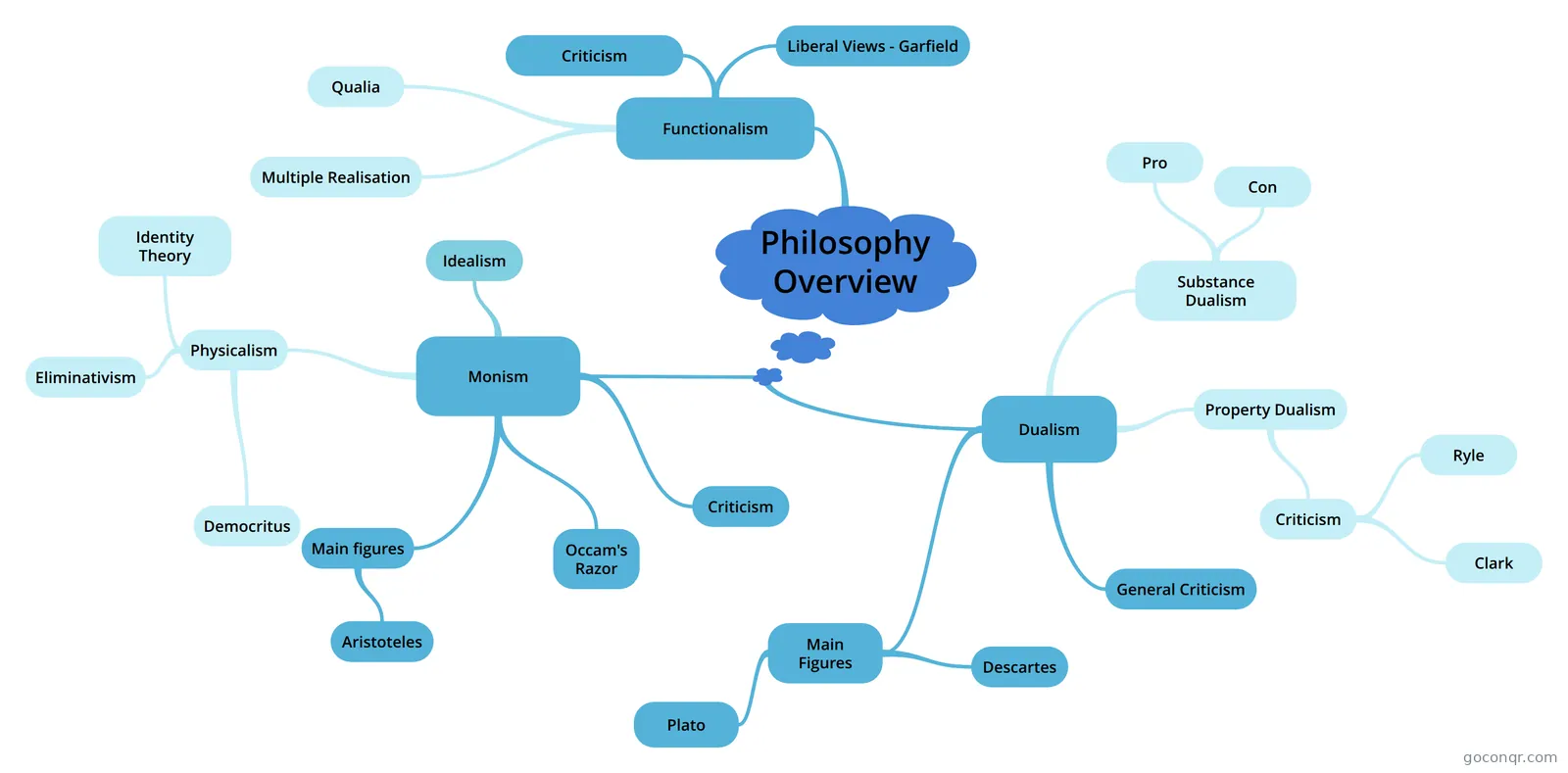
Mind map: Philosophy Overview: Monism, Dualism, Functionalism
Conteúdo do mapa
Philosophy Overview
Monism
- only one kind of state or substance in the universe. PRO Deficit studies that look at behavior following brain damage show that when particular parts of the brain are damaged, very specific types of deficits follow. Area's where the so called Mental phenomena take place.
- Criticism
- Critics acknowledge that the world is physical but indicate that there is no physical explanation for many phenomena. In these cases, they believe, it is better to explain using mental terms. Multiple realization as an criticism towards identity theory: Any given mental state, such as pain, can be instantiated or realized differently in different creatures. (Humans c-fiber, squid in d-fiber)
- Main figures
- Aristoteles
- Defined the Mind-Body Problem, as the difference between form and matter.
- Aristoteles
- Idealism
- The universe is mental Cannot be falsified - the brain in the vat argument
- Physicalism
- universe is composed of a single substance (physical). The operations of the mind are simply operations of the brain. Most research in this book supports the idea of the brain as the mechanism of mind.
- Democritus
- Democritus believed all things were composed of atoms. The attributes and behaviors of the atoms, can explain the differences between things.
- Identity Theory
- Part of physicalism is identity theory - the mind is the brain. Brain is like mind the same way salt is the same sodium chloride.
- Eliminativism
- Rejects all form of mental states descriptions as "feeling good". They don't believe in mental states and only physical brain states are acknowledged as existing.
- Occam's Razor
- All things being equal, the simplest explanation is usually the correct one.
Dualism
- One believes that both mental and physical substances are possible.
- Main Figures
- Although Plato was first to mention it, Descartes is known for his detailed description
- Plato
- Plato believed, that the mind and the body exist in two separate worlds. Mind exist in an ideal world of forms and is immaterial, non extended and eternal. Body resides in a world that is material, extended and perishable. A circle in the ideal world of forms are perfect In the real world they will always have some small imperfection Teacher of Aristoteles
- Descartes
- Was the first to define relationship between soul and body in detail. Believed the mind in control of the body but not vice versa. Mind controlled the body through the pineal gland. (Maybe because it only exists once in the brain) Agrees with the folk view that our thoughts control our actions. Known for " I think therefore I am"
- Substance Dualism
- Mind and body are of completely different substances (mental and physical substances) Physical substances are atoms, molecules and cells, unclear what mental substances might be.
- Pro
- Minds can do X. No physical object can do X. Therefore mind are not physical objects. X can be language, reason and consciousness for example.
- Con
- Some forms that we thought to be exclusively human (X) can now be replicated in machine form. (AI capable of pattern recognition, language comprehension and production and even artistic creativity) Friedenberg, 2008 If mind and body are two different substances, then they should not be able to casually interact. Biology can give account of mental states. If we can explain these completely in terms of neurons, action potentials and synapses, then there is no need to even provide a non-physical account
- Property Dualism
- The mind and the body can be of the same stuff but have different properties. By properties, we mean characteristics or features. Analogy to a golf and a tennis ball. Both made of atoms but differ in their properties.
- Criticism
- Damage in a certain brain region causes forms of mental disruption. fe Broca's area = language
- Ryle
- Mind is not any particular component of the brain but, rather, all the parts working together as a coordinated, organized whole. University analogy
- Clark
- Dualism is uninformative It tells us what the mind is rather what it isn't. As a theory, inelegant, because it postulates two worlds that must be coordinated. (Disagreeing Occam's razor)
- General Criticism
Functionalism
- Functionalist believe that mental states are equivalent to the functioning or operation of physical states. It may be different material substrates can give rise to mental states. The number of possible computational states always exceeds the number of possible physical states. Psychological states (such as beliefs) are defined more by their relations to other such states, to inputs from the environment, and to behaviors than by their relations to physical states. Functionalismimplies that mental states might not be reduced to any particular physicalstate. Difference in functionalism in psychology andphilosophy. Philosophy:conception stresses multiple realizabilityPsychology:conception stresses the functions themselves
- Multiple Realisation
- Multiple realization (also in identity theory in monism) If two people have the same thought, the process could be significantly different.
- Criticism
- Critics have argued that, although it is possible that minds can exist in the absence of brains, this does not make it plausible. No empirical evidence to support claim. The failure to identify mind with a physical kind can itself be considered reason to do away with the concept of mind - rather than give it special status as a functional kind.
- Qualia
- are individual instances of subjective, conscious experience
- Liberal Views - Garfield
- Mathematically the number of beliefs concerning politics is infinite. The number of possible states the brain can achieve is finite. A computational level of description, thus, becomes richer and more diverse way of describing the mind and should be the preferred level.
Informações
- Descrição
- A Mind Map - Overview Philosophical Approach with Notes
- Criado por
- Tjarde-Savhannah Schulz
- Visualizações
- 26
- Avaliação