
Philosophy of Mind
213 resources created by 154 users
This Philosophy of Mind page on GoConqr gathers community-made mind maps, flashcards, quizzes, notes and flowcharts, from substance dualism and behaviourism to functionalism, personhood and the problem of other minds. It's built for university students and professional candidates, school students, and teachers after ready-made material, all practising how to set out and weigh arguments. There are over 200 resources here, including more than 10 quizzes and over 100 mind maps, pitched at university and A-level stages. Pick a topic, try a quiz, then build your own.
Top Philosophy of Mind resources
-
41 cardsThe Mind-Body Problem and Physicalism What is the argument of the cogito?
-
Mind map Behaviourism
-
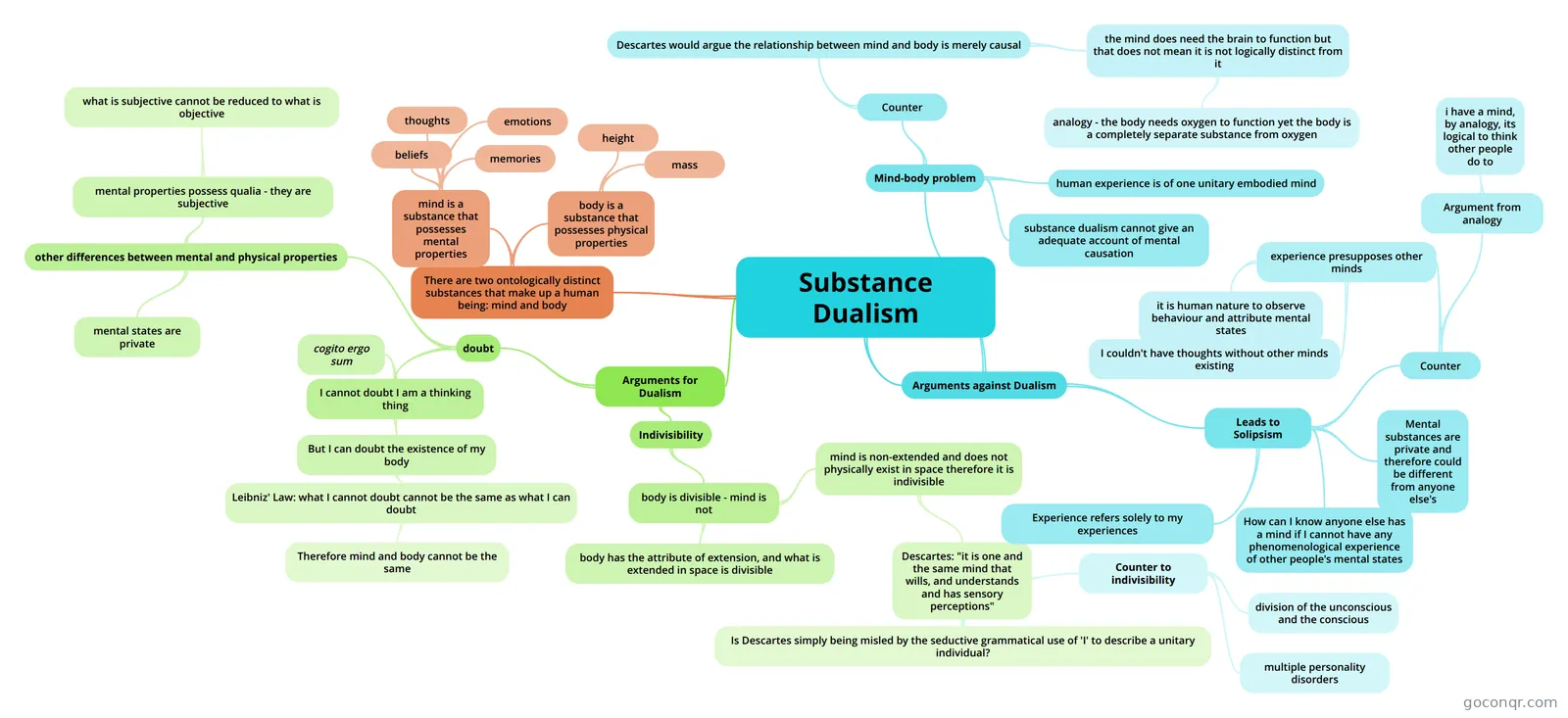 Mind map Substance Dualism
-
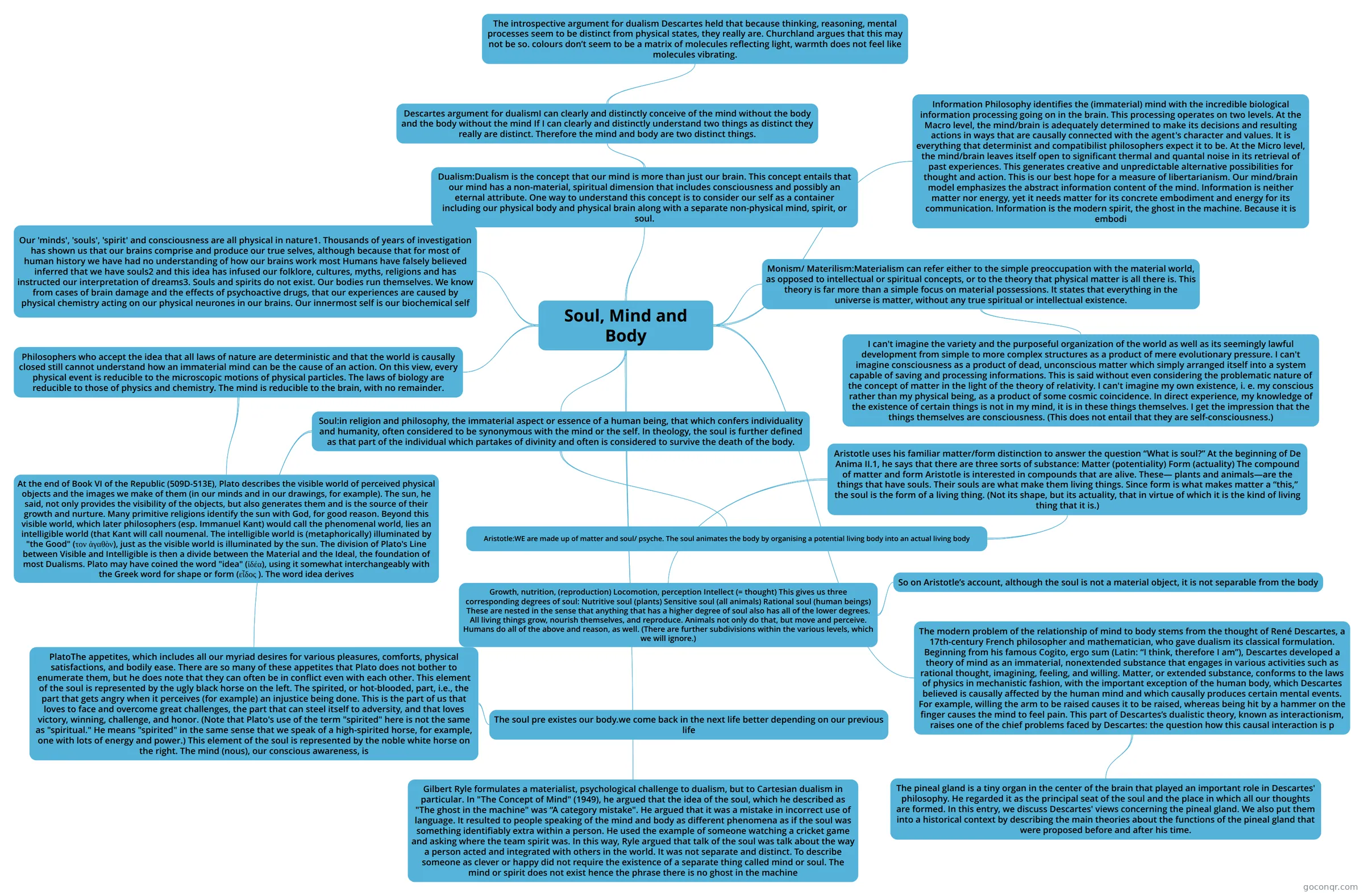 Mind map Soul, Mind and Body Mindmap homies enjoy
-
 Mind map Characteristics of Personhood
-
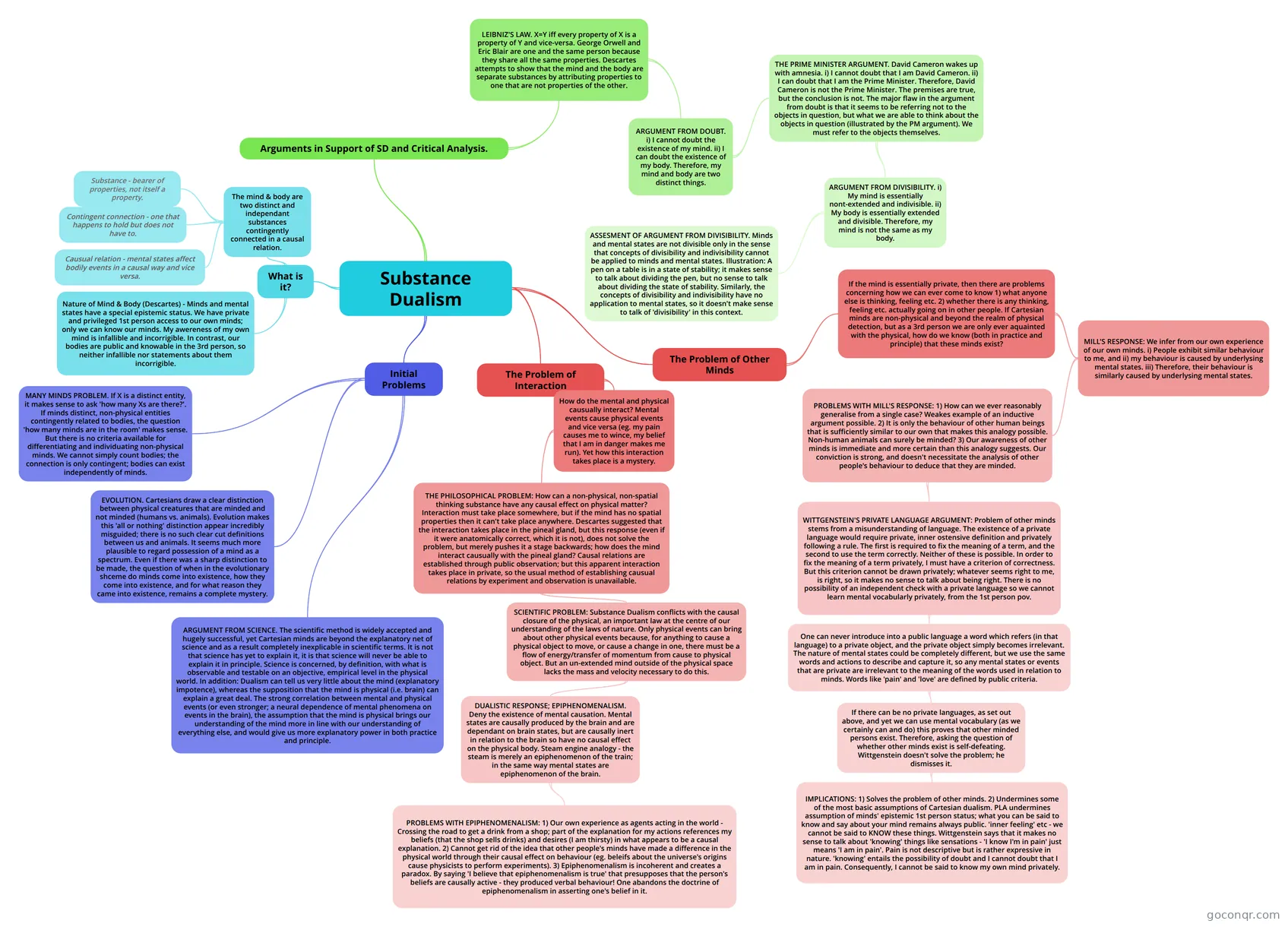 Mind map Substance Dualism Revision Prompts
-
23 cardsDeterminism, Free Will, and Moral Responsibility According to Ayer, why should we contrast freedom with constraint rather than with causality?
-
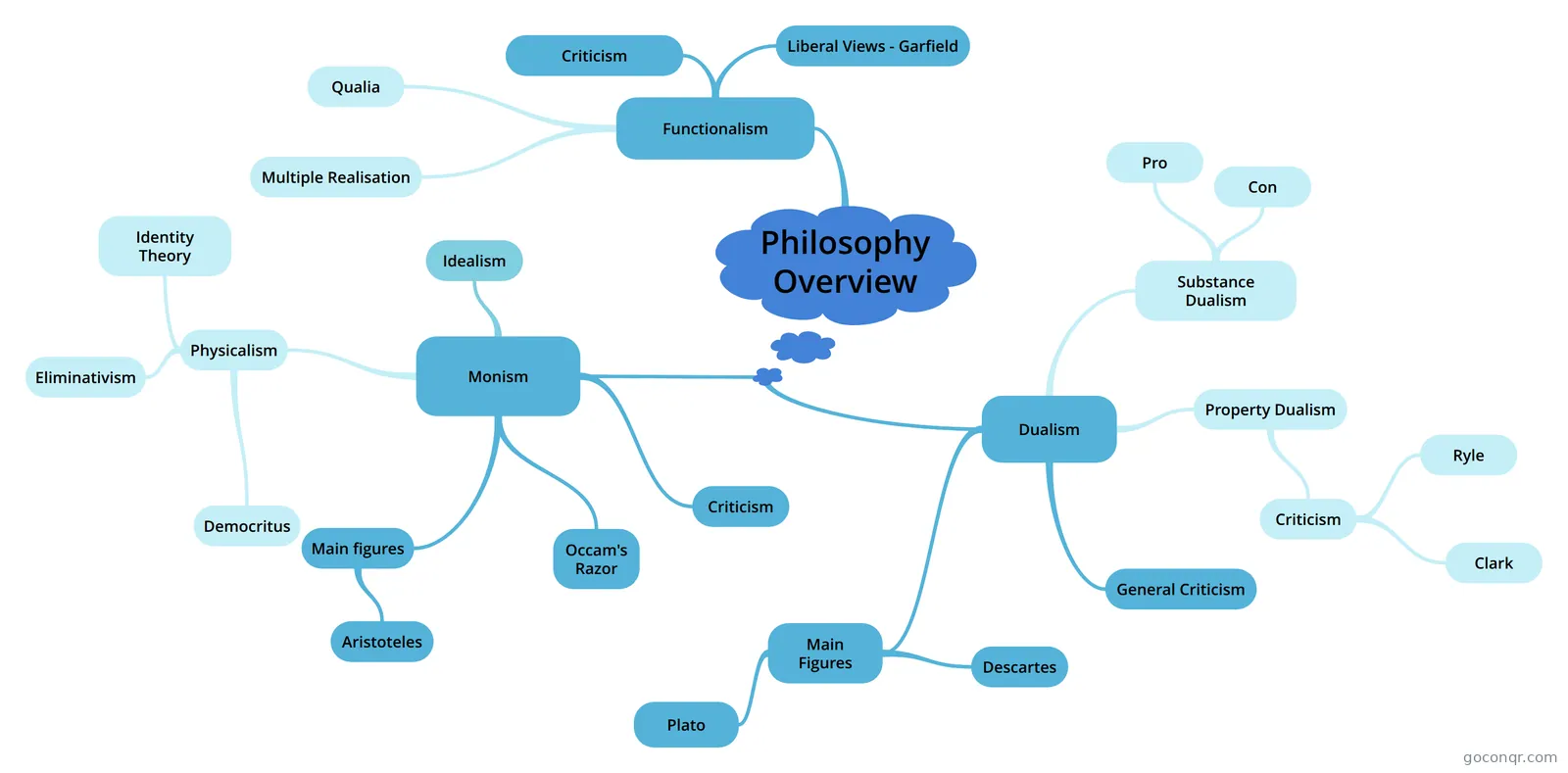 Mind map Philosophy Overview A Mind Map - Overview Philosophical Approach with Notes
Quizzes
See all 12 quizzesMind maps
See all 114 mind maps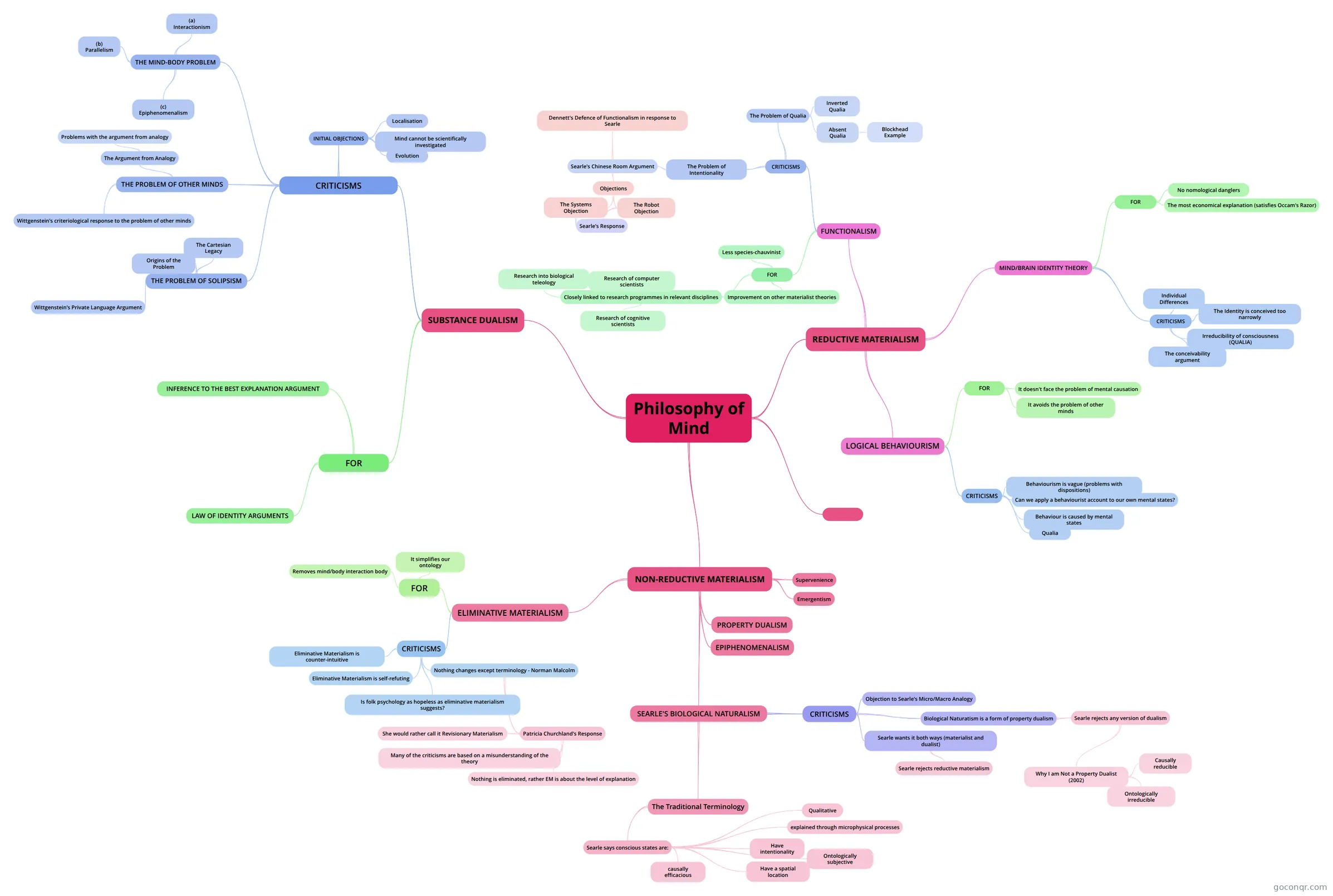
Flashcards
See all 54 flashcards-
41 cardsThe Mind-Body Problem and Physicalism What is the argument of the cogito?
-
23 cardsDeterminism, Free Will, and Moral Responsibility According to Ayer, why should we contrast freedom with constraint rather than with causality?
-
24 cardsAmy - The Mind & Brain 24 Questions (True or False, Fill in the Blanks, & Vocab/Terminology included)
-
14 cardsSelf, death and the afterlife Plato 'the body is a source of endless trouble' The Republic 400 BC
-
14 cardsChange and Causation Flash cards to help learn the change and causation theories of different philosopher's.
-
17 cardsDescartes theory of mind and body essay plan Which meditation did Descartes explain the mind and body dualism?
-
16 cardsPhilosophical Concepts Flash cards to help study opposing philosophical views.
-
15 cardsPersonhood Thought Experiments
Notes
See all 18 notes-
Armstrong David Armstrong Background: Physicalism is the view by “We can give a complete account of man in purely physico-chemical terms” The mind is not something behind the behaviour of the body, merely a part of that behavio...
-
The Body and Soul Descartes: Dualism Rene Descartes was dualist philosopher credited with the famous quote, "I think, therefore I am." (Cognito ergo sum in Latin.) As a dualist, he argued that the mind and body are two different substa...
-
Physicalism Mind/Brain Identity Theories Designed to overcome the issues of causation with Cartesian Dualism - how the metaphysical can affect the physical (mental states having affect on the body) and similarly how the physical can affect the metaphysical (...
-
Substance Dualism Dualism maintains that human beings are composed of two components:the non-physical mind/soulthe physical body The person, the subject of experience and states of mind generally, is identical to the soul, not the body...
-
Behaviourism Logical Behaviourism The reduction of mental properties to physical or behavioural properties Removes the Cartesian dualism of mind and body To talk of thoughts is to misuse the word thought. 'Thoughts...
-
DESCARTES' MIND-BODY DUALISM DESCARTES – Substance Dualism Descartes denies that he is a body. There are two kinds of substances; minds (thinking things) and bodies (extended things). Bodies are things in space that take up space; they have a sha...
-
Questions and Argurments Is it correct to group (thoughts, feelings, senses) all as a mental-state? Functionalism define minds state in terms of what they do. And functionalism are considered as Physicalism philosophers who refused the idea o...
-
Problems of philosophy of mind SolipsismSolipsism plagues theories of the mind because they are all necessarily inductiveThis is because one only has access to one's own mind Arguments for other minds Solipsism
Slides
Topics in Philosophy of Mind
More Philosophy topics
About Philosophy of Mind
GoConqr OriginalWhat this unit covers
The page is built around the mind-body problem. Many of the resources look at dualism, and the mind map on Substance Dualism sets out the claim that a human being is made of two distinct substances, mind and body, linked by a causal relation. Other items cover Descartes, Plato's dualist view, the soul, and the issue of causal interaction, with notes on how a dualist might answer it.
The physicalist side
Against dualism, you will find maps and notes on Behaviourism, Logical Behaviourism, Identity Theory and Functionalism. The Logical Behaviourism map explains that mental states are analysed in terms of behaviour rather than reduced to physical properties. The notes on non-reductive theories of mind bring in biological naturalism and John Searle's view that the ontologically subjective cannot be reduced to the objective. There is also a flashcard deck on eliminative materialism.
Wider questions
The unit also reaches into personhood, personal identity and thought. The map on Characteristics of Personhood lists reason, self-awareness, language and being social, along with degrees of personhood. The Language of Thought Hypothesis map covers its arguments and objections, and there are resources on the problem of other minds and on Locke on personal identity.
Where to start
- Begin with the Mind and Body introduction flashcards, then the Mind and Body Introduction Quiz.
- Read the Substance Dualism mind map, then take the Dualism Quiz.
- Move to Behaviourism and Functionalism to compare the physicalist options.
- Finish with the personhood and other-minds maps.
Using maps and quizzes together
Read a map to see how an argument is built, then take a quiz to check what stuck. Where you miss a point, go back to the map or the notes. Some resources mention A-level Philosophy and A-level Religious Studies, so school students can spot material close to their course, while the larger share suits university study.
This unit sits in the Knowledge, Mind and Reality strand of Philosophy. Choose one resource that matches your topic and work through it today.
Frequently asked questions
Which resource should I open first?
Start with the flashcards titled Mind and Body introduction, then take the Mind and Body Introduction Quiz. They give you the basic vocabulary before you move on to the mind maps on dualism, behaviourism and functionalism.
What do the mind maps cover?
There are over 100 mind maps. They cover substance dualism, behaviourism, logical behaviourism, identity theory, functionalism, the soul, personhood, personal identity, the problem of other minds and the Language of Thought Hypothesis.
Are the resources free to use?
Yes. Every resource on this page is free to open, study and take, with no account needed. They were made by GoConqr users, not by GoConqr itself, so styles and depth vary from one resource to the next.
Which levels and exams do these suit?
Most of the material is aimed at university students, with a smaller share for school students. Some resources mention A-level Philosophy and A-level Religious Studies. Teachers can use the maps, notes and quizzes as ready-made starting points.
Can I make my own versions?
Yes. A free account saves your quiz scores and lets you make your own quizzes, mind maps, flashcards and notes, so you can adapt a listed resource to your own course.
What if my topic seems to be missing?
Look at related titles first. Free will and determinism, self, death and the afterlife, and consciousness are all listed. If your topic is still absent, build a short map or deck of your own.