
Mapa mental
Oligopolies
Conteúdo do mapa
Oligopolies
Definition = A market structure in which a few firms dominate the market
Examples of oligopolies :
Definition = Occurs when a few firms dominate a market
- Duopoly = when two firms dominate a market
Examples of oligopoly: Newspaper industry, supermarkets, airlines
Behaviour
- Actions of one of them can have a significant effect on behaviour of others
- Firms are interdependent
- Behaviour depends on what a firm thinks others are going to do
- Firms are interdependent
- There is not one price and output outcome
- Actions of one of them can have a significant effect on behaviour of others
Competition and collusion
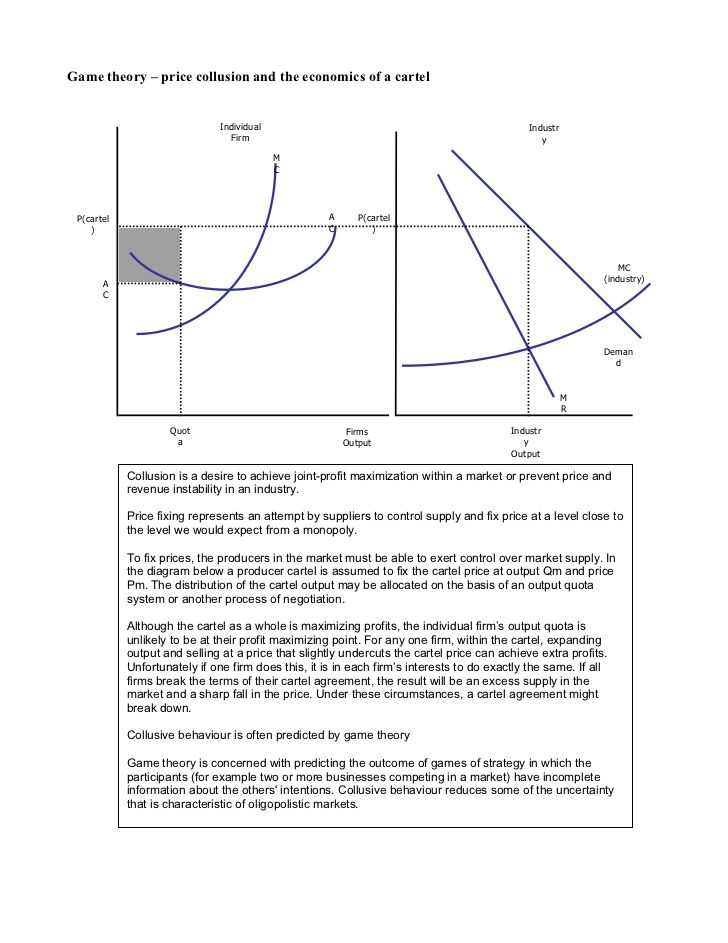
- Oligopoly firms can collude with eachother to maximise combined profits
- Collusion = When firms work together and act like a profit maximising monopolist
- The industry fixes a profit maximising price and output for the industry
- Maximises the industry's profits
- But - incentive for individual producers to cut their price and exceed quotas to increase their own profits at the expense of the industry
- Cartels tend to break down because there is an incentive to cheat
- There needs to be an effective policing mechanism
- Ensure firms are not producing too much or undercutting agreed price
- Collusion is made more likely if....
- 1) There are only a few firms (easier to check each other and share information)
- 2) Effective communication and monitoring system to identify cheating
- 3) Stable cost and demand conditions so quotas are easy to allocate, measure and easy to administer
- 4) similar producion costs so similar profits can be made
- The industry fixes a profit maximising price and output for the industry
- Collusion = When firms work together and act like a profit maximising monopolist
- Oligopoly firms can compete to take business away from rivals and make more profit independently
- Tacit collusion = When firms collude without any formal agreement being reached or even without any communication between them
- Oligopoly firms can collude with eachother to maximise combined profits
Kinked demand curve
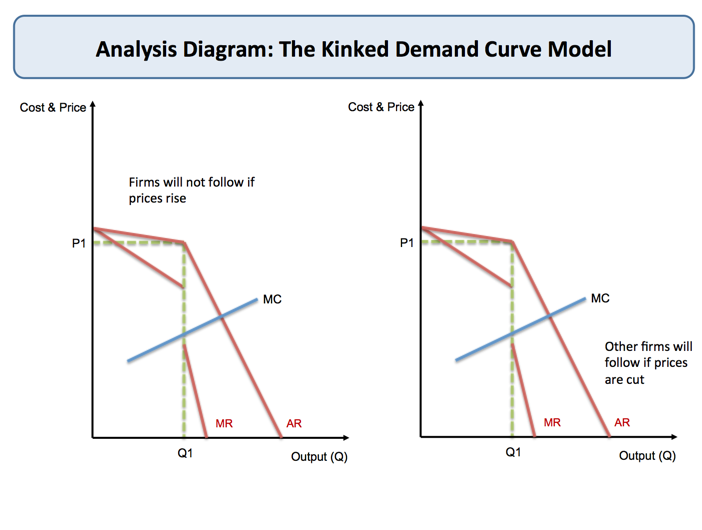
- If a firm increases its price, other firms do not follow and so price is elastic
- Demand falls
- If a firm decreases price, the other firms do follow so demand is price inelastic
- Revenue falls
- This model explains price rigidity in oligopoly
- Prices do not change very much and firms tend to compete via non-price competition
- Examples of non-price competition 1) Advertising 2) Sales promotion
- Any change in price leads to a fall in revenue
- The kinked demand causes discontinuity in the MR curve
- Changes in MC do not change the profit maximising price and output
- Prices are likely to be fixed despite cost changes
- Changes in MC do not change the profit maximising price and output
- Prices do not change very much and firms tend to compete via non-price competition
- If a firm increases its price, other firms do not follow and so price is elastic
Game theory
- Definition = The decision a firm makes in oligopoly depends on its assumptions about other firms. Firms try to calculate the best course of action depending on how others behave. Economists build models of this behaviour known as game theory
- Nash equilibrium = Occurs in game theory when no firm can improve its position given the strategy of the other firms; equilibrium because no firm has an incentive to change
- Actual outcome in game theory depends on whether firms can trust each other
- Definition = The decision a firm makes in oligopoly depends on its assumptions about other firms. Firms try to calculate the best course of action depending on how others behave. Economists build models of this behaviour known as game theory
Pricing and non-pricing strategies
- Pricing
- Cost-plus pricing
- Firms add % profit on to their costs
- Positive = straightforward to implement and often used by retailers
- Negative = ignores demand conditions
- Predatory pricing
- Firms deliberately undercut competitors to force them out of the market
- negative = anti-competitive
- Limit pricing
- Selecting highest price possible without encouraging entry
- Extra supply drives price down to a level new firms cannot surrive at - scared to enter
- Price wars
- Firms undercut each other
- Aim to gain sales from competition
- Happens with overcapacity in markets e.g. cars and PCs
- Price leadership
- Firms follow the pricing decision of one firm
- Price leader is dominant and other firms do not want to challenge
- Decision to follow may be clearly agreed
- or occur due to tacit collusion
- Cost-plus pricing
- Non-price competition (firms look for other means to compete rather than by using price changes which can be easily followed)
- Advertising
- negatives = can mislead / create barriers to entry (higher costs to entry
- Branding
- well known brand name
- Brand loyalty
- Sales promotions
- Buy one get one free
- Competitions
- Distribution
- Controlling distribution to retail outlets e.g. in confectionary, cigarettes, cleaning products, jeans
- High spending on promotional campaigns
- Product differentiation
- unique selling proposition
- e.g. locally made, natural ingredients, 24 hour service
- unique selling proposition
- Advertising
- Pricing
Imagens e arquivos do mapa
Informações
- Descrição
- Mapa Mental sobre Oligopolies, criado por callum_j.smith em 31-01-2016.
- Criado por
- callum_j.smith
- Visualizações
- 0
- Avaliação