
Mapa mental
Learning
Conteúdo do mapa
Learning
Classical Conditioning
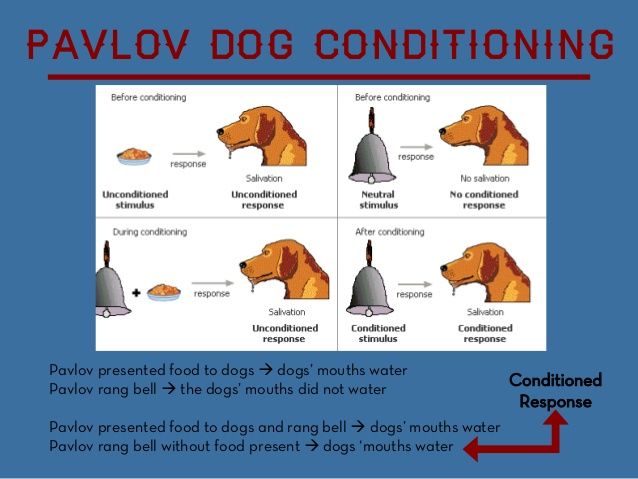
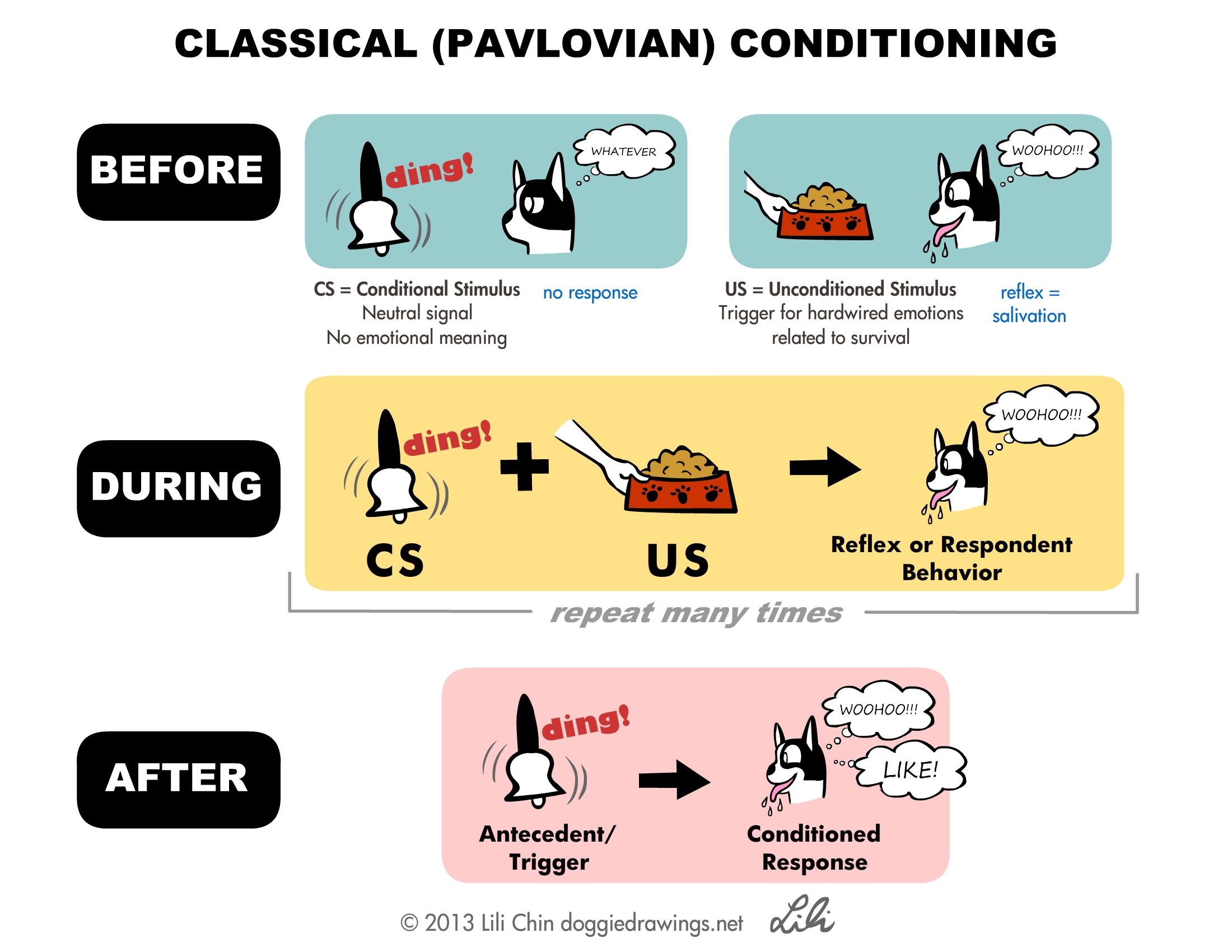
- • Initially developed by Ivan Pavlov • Classical Conditioning refers to a type of learning in which a stimulus gets the capacity to evoke a response that was originally evoked by a physically natural stimulus • Also called Pavlovian conditioning. Pavlov helped turn psychology in the direction of the scientific approach.
- Phobias
- • Phobias: irrational fears of specific objects or situations. Example: someone gets dizzy while in a high place and so high places become associated with instability and fear and other high places produce the same fear.
- Terminology of Classical Conditioning
- Unconditioned stimulus (US): A stimulus that automatically leads to an observable response prior to any training (natural reflexive response). Example: Food Unconditioned response (UR) The observable response that is produced automatically, prior to training, on presentation of US. Example: Salivation Conditioned stimulus (CS): Neutral stimulus that is paired with the US during classical conditioning E.g. Bell Conditioned response (CR): The acquired response produced by the conditioned stimulus in anticipation of the US. E.g. Dog salivates (CR) when hearing the feeder’s footsteps (CS) Trial - a presentation of a stimulus or pair of stimuli
- Evaluative Conditioning
- Evaluative conditioning: refers to changes in the liking of a stimulus that results from pairing the stimulus with other positive or negative or negative stimuli.
- Conditioning and Physiological Responses
- Ader and Cohen showed that classical conditioning can lead to immunosuppression – a decrease in the production of antibodies. They injected animals with a drug (US) that chemically causes immune suppression and also gave them an unusual tasting drink (CS). Later they gave the animals only the drink and when they measured antibody production, it decreased. The drug was paired with the drink which then caused immune suppression without the drug even being administered. Drug tolerance may also be partly due to classical conditioning. Normally, the brain responds to drug use (US) by compensating with an opposite response (UR). Drug paraphernalia or situations (CR) can become classically conditioned to elicit the compensatory response (CR) even prior to using the drug. This may be part of the reason a user needs more and more to get the same effect. If an addict shoots up in an unfamiliar setting (no compensatory CR), the user may experience a stronger unconditioned effect and overdose. Also, seeing reminders of drugs can elicit the conditioned compensatory response and induce cravings.
- Basic Processes in Classical Conditioning
- Acquisition – acquiring (learning) the new behaviour Usually something novel, unusual or very intense that results in classical conditioning. Timing is another factor. Stimulus contiguity – how close the stimuli are together. E.g. the CS (bell) and the UCS (food) Extinction: Presenting a CS repeatedly, after conditioning, without the US, resulting in no response. E.g. Food no longer follows a bell, so dog gradually stops salivating in response to the bell Spontaneous Recovery: Recovery of an extinguished CR after a period of nonexposure to the CS - Often the CR isn’t as strong as it once was Renewal Effect: If a response is extinguished in a different environment from where it was acquired, it will reappear once the animal or person is returned to the original environment. Stimulus Discrimination: Responding differently to a new stimulus than one responds to established CS ϖ When stimuli share properties, for example, two tones of a similar pitch, people often need to learn to discriminate Higher Order Conditioning • After a conditioned stimulus reliably elicits a response, this conditioned stimulus can be paired with another stimuli which also elicits the same response. If Pavlov had put on a red light each time he rang the bell, the dogs would begin to salivate to the red light even though the red light was never paired with the meat.
- Stimulus Generalization
- Stimulus generalization: Responding to a new stimulus in a way similar to the response produced by an established CS In this case, a similar stimulus leads to a similar CR • Things that look, sound, or feel similar often share significant properties • Example: Little Albert was initially not afraid of a white rat presented to him by John Watson. A loud noise is paired with the white rat and the baby becomes afraid of it. Then Little Albert is shown other furry items rabbit, Santa Claus beard, fur coat and is afraid of other similar objects. We say this was generalized to the similar objects. • if you had a bad experience in the dentist’s chair, the sound of a neighbour’s high-speed drill may make you feel uncomfortable • People with panic disorder may overgeneralize
- Images
Operant Conditioning
- Operant Conditioning is a form of learning in which responses come to be controlled by their consequences of their own voluntary actions • Example: Learning that studying leads to a good exam grade
- Law of Effect (Thorndike)
- • If a response in a particular situation is followed by a satisfying consequence, it will be strengthened; if followed by an unsatisfying consequence, it will be weakened
- Reinforcement
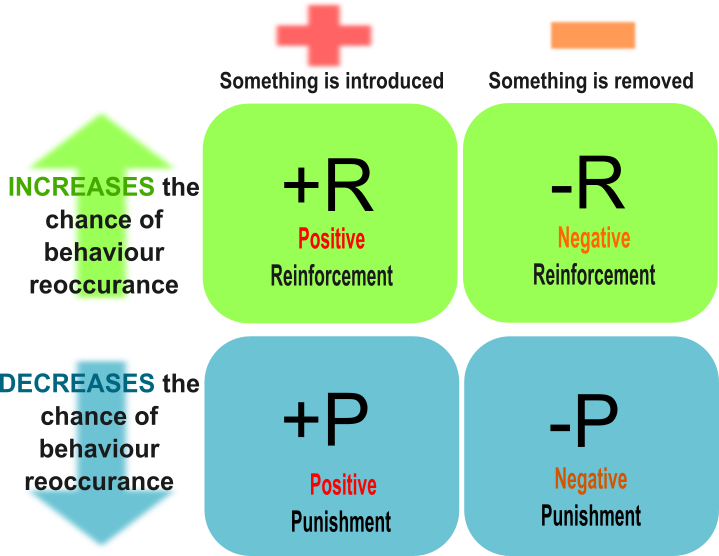
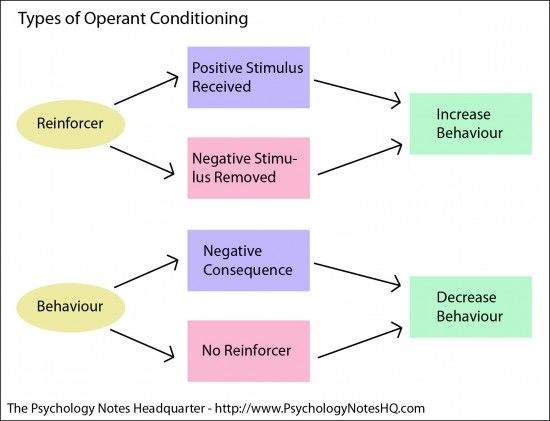
- Reinforcement occurs when an event following a response increases a person or animal’s tendency to make that response. E.g. you put your money in a pop machine and get a pop (reinforcer) so you do it again the next time you want a pop.
- Acquisition
- Acquisition in operant conditioning: acquisition also refers to the initial stage of learning a new response. Some responses are more complex and require a process called shaping. Shaping occurs when rewards are given for behavior that is closer and closer to the desired end result.
- Extinction
- Extinction: Response is no longer followed by a reinforcer. When the reinforcer is withdrawn, the animal or person often increases the behavior. Then the behavior decreases gradually. E.g. The rat believes that pressing a lever dispenses food so presses more in case it will continue. Children will do the same thing if a parent is used to buying a child candies in a store to get them to stop crying. If the parent absolutely refuses, the child will cry harder until they see that the parent definitely will not reinforce them. Resistance to extinction: sometimes you want resistance (e.g. positive behaviours) Schedules of reinforcement affect this.
- Primary Reinforcers & Secondary or Conditioned Reinforcers
- Primary reinforcers – events that are inherently reinforcing because they satisfy biological needs. For humans, food, water, warmth, sex, affection involving bodily contact. Secondary or conditioned, reinforcers – associated with primary reinforcers and so acquire reinforcing qualities. E.g. money, good grades, attention.
- Schedules of Reinforcement & Glossary Words
- Rules that an experimenter uses to determine when particular responses will be reinforced • Strongly affects speed and strength of training ϖ Continuous: Every response followed rapidly by reinforcement E.g. Salesperson paid for each sale ϖ All of the following schedules are Intermittent or Partial Reinforcement: Reinforcement delivered only some of the time. They can be: 1) Ratio 2) Interval GLOSSARY Ratio = number of responses e.g. number of lever presses Interval = time on the clock e.g. number of minutes Fixed = always the same e.g. every 10 lever presses/minutes Variable = changes (around an average amount) e.g. an average of every 10 lever presses or minutes
- Ratio Schedules
- 1. Ratio Schedules a) Fixed-Ratio Schedules ϖ Number of responses required for reinforcement stays the same • Example: Salesperson paid for every 10 sales • Tend to produce steady, consistent rates of responding, but might stop for a period after reinforcement • Extinction when reinforcement no longer given b) Variable-Ratio Schedules A certain number of responses required for reinforcement, but this number changes ϖ Example: Salesperson paid after some number of sales, but doesn’t know how many ϖ Extinction takes much longer Variable Ratio schedules (associated with VLT machines) have the most rapid and steady responding and the highest resistance to extinction
- Interval Schedules
- 2. Interval Schedules a) Fixed-interval: Reinforcement delivered for first response after a fixed allotment of time ϖ Example: Salesperson paid for first sale in each week, but not others until next week begins • Tend to produce low rates of responding and a “Scalloping” pattern b) Variable-interval: ϖ Allotted time before a response will yield reinforcement changes • Example: Salesperson paid for first sale on randomly chosen day
- Positive and Negative Reinforcement
- Response consequences that increase likelihood of responding in a similar way • Positive Reinforcement: ϖ Increase in responding is due to giving something good or rewarding E.g. If you study hard, you get a good mark so you study hard again. • Negative Reinforcement: ϖ Increased responding is due to removing something bad (aversive) ϖ E.g you have a headache and take an aspirin and the headache goes away. So whenever you have a headache again, you take an aspirin ϖ The terms positive and negative simply refer to whether response increases because of the presentation of something (positive) or because of the removal of something (negative) As it applies to reinforcement Positive = something good is given Negative = something bad is removed
- Negative Reinforcement and Avoidance of Behavior
- Escape Response- learning a response to end or decrease an aversive stimulus E.g. shuttle box - two rooms - one where the floor gives the rat a shock and another where it can escape to E.g. turning on a fan when it is really hot in the room. Avoidance Response - acquiring a response that prevents some aversive stimulus from even occurring at all. Rat gets a signal (typically a light) that the shock is coming and it learns to run before the shock comes on. - turning on the fan before it gets really hot in the room. - Begins with classical conditioned fear to shock and is maintained with operant conditioning due to the removal of the fear (neg. reinforcement) Punishment: Consequences that Weaken Responses Punishment : Consequences that decrease the likelihood of responding in a similar way again • Example: Time out – fun removed for misbehaviour, driver loses licence. Side Effects of Physical Punishment of Children Supreme Court of Canada ruled that a parent can legally spank their child (“reasonable corrective force”) only for children between ages 2 and 12 and never on the head or with objects. Physical Punishment is associated with poor quality parent-child relationships, elevated aggression, delinquency and behavioural problems in children. It increases the likelihood of child abuse. In adulthood, people may experience increased aggression criminal behavior, mental health problems, and child abuse. Evidence is correlational so does not indicate causation. Also research often does not distinguish between infrequent, moderate, corporal punishment and harsh punishment more often.
- B.F. Skinner
- B.F. Skinner took the a perspective on human and animal behaviour that emphasizes explaining behaviour in terms of environmental events and that minimized the use of internal explanations, like thoughts, beliefs, and intentions
- Image
- Image
Observational Learning
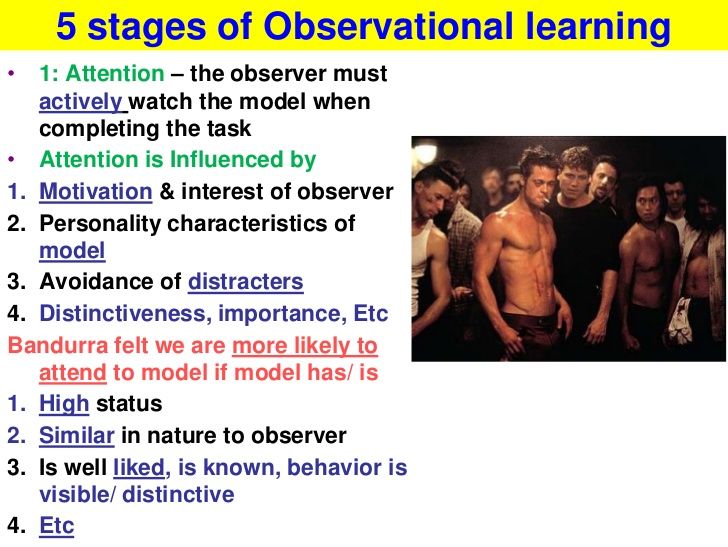
- Learning that occurs as a result of observing the experiences of others • Also called social learning or modelling ϖ Observational learning occurs in many species, including chimpanzees, rhesus monkeys and some birds ϖ Natural tendency to imitate behaviour of significant others • Example: Children imitate parents, teachers ϖ Strongest when: • Model is viewed positively • Model is rewarded for the modeled behaviour ϖ Bandura: Researcher who studied effects of viewing adult aggressive behaviour on children • Study involved film of adult hitting “Bobo” doll • Children acted out what they observed • Adult was either praised or punished - more likely to follow if adult praised for aggression. Observational Learning: Practical Applications Particularly relevant to children Modeling techniques such as films have been used to reduce fears, promote positive behaviour ϖ Television may however, produce modeling of negative behaviour (aggression, stereotyping)
- Observational Learning and Mirror Neurons
- One line of research that explains how observational learning works biologically, is the role of mirror neurons. Mirror neurons are neurons that are activated by performing an action or by seeing another monkey or person perform the same action. Italian researchers working with monkeys watch as neurons were activated when the monkeys made certain hand movements. Surprisingly, the same neurons were also activated when they observed the experimenter make the same hand movement. This has also been found to occur in humans.
- Observational Learning and Media Violence
- Excessive Television watching has been linked to obesity, lower academic performance Canadian Pediatric Society recommends children watch no more than 2 hours of television per day TV, movie and video game violence is linked to physical and verbal aggression and aggressive thoughts and emotions in children and adults and can make people less sensitive to the pain of others. Longitudinal studies have shown that exposure media violence in childhood predicts aggressiveness in adolescence and adulthood.
- Observational Learning: Practical Applications
- Observational Learning: Practical Applications Particularly relevant to children Modeling techniques such as films have been used to reduce fears, promote positive behaviour ϖ Television may however, produce modeling of negative behaviour (aggression, stereotyping)
- Image
- Image
Imagens e arquivos do mapa

Informações
- Descrição
- Mapa Mental sobre Learning, criado por Britany Marie Al em 18-03-2016.
- Criado por
- Britany Marie Al
- Visualizações
- 1
- Avaliação