
Mapa mental
SCN1A Na channel and Epilepsy
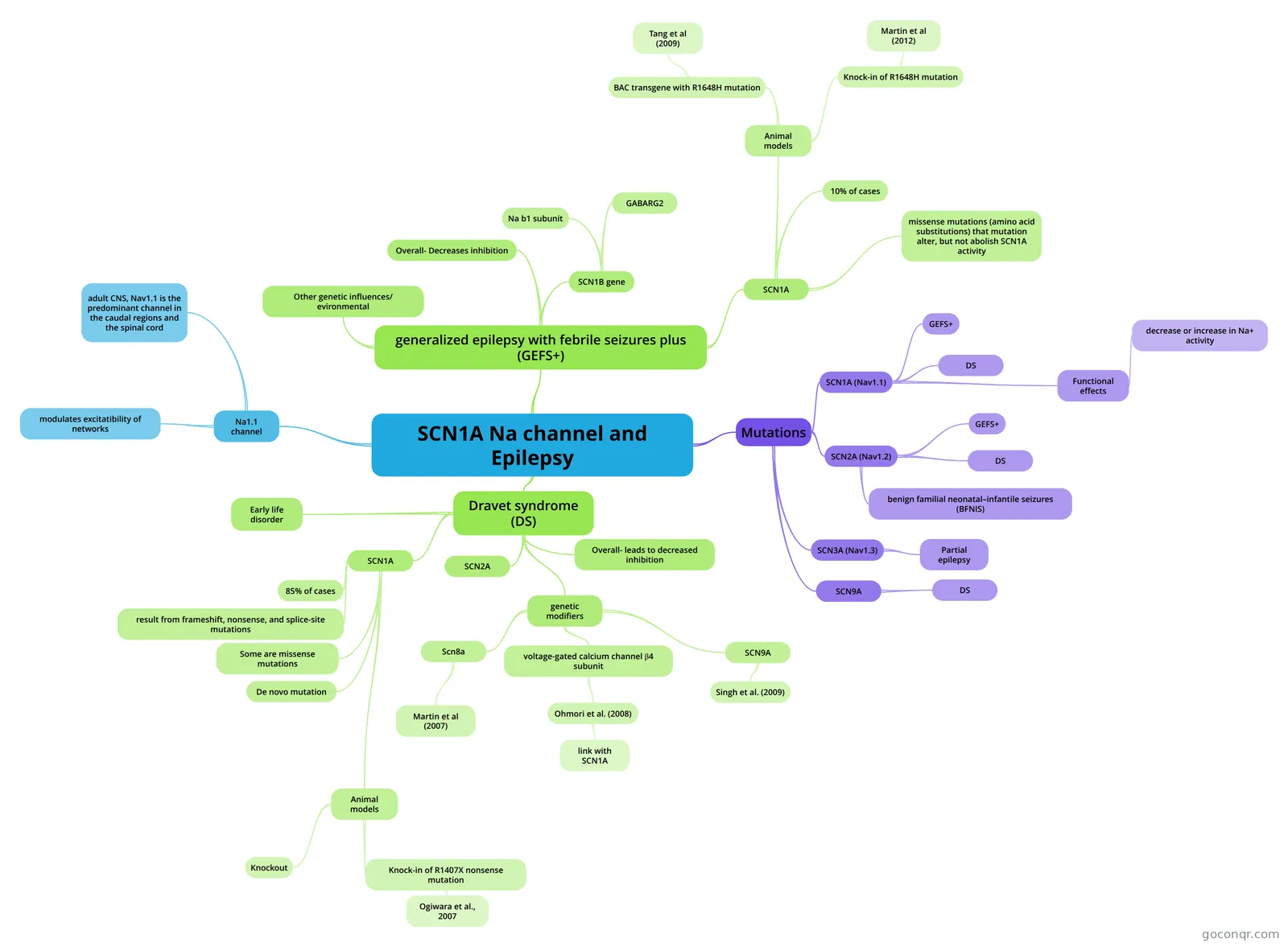
Mind map: SCN1A Na channel and epilepsy
Conteúdo do mapa
SCN1A Na channel and Epilepsy
generalized epilepsy with febrile seizures plus (GEFS+)
- mutations alter channel activity
- patients with GEFS+ demonstrate febrile seizures that persist beyond 6 years of age and are associated with generalized or partial epilepsies, such as absence epilepsy, myoclonic seizures, atonic seizures, and myoclonic–astatic epilepsy (Scheffer & Berkovic, 1997; Singh et al., 1999). Affected individuals within GEFS+ families often display a wide variety of epilepsy subtypes, with markedly different ages of onset and severity, suggesting the action of genetic and/or environmental modifiers.
- Overall- Decreases inhibition
- SCN1B gene
- encoding the sodium channel β1 subunit and two GABAA receptor genes: GABRG2 encoding the γ2 subunit
- Na b1 subunit
- GABARG2
- SCN1A
- 10% of cases
- missense mutations (amino acid substitutions) that mutation alter, but not abolish SCN1A activity
- Animal models
- BAC transgene with R1648H mutation
- Increased seizure susceptibility to kainic acid Decreased sodium current density in inhibitory bipolar neurons Delayed recovery from inactivation and increased use-dependent inactivation of mutant sodium channels in inhibitory bipolar neuronsHyperpolarizing shift in the voltage dependence of inactivation of mutant sodium channels in excitatory pyramidal neurons
- Tang et al (2009)
- Knock-in of R1648H mutation
- Spontaneous seizures and death between P16 and P26 in homozygous mice Infrequent spontaneous seizures, reduced seizure thresholds, and accelerated propagation of febrile seizures in heterozygous mice Slower recovery from inactivation, greater use-dependent inactivation, reduced sodium current density, and decreased action potential firing in bipolar inhibitory neurons
- Martin et al (2012)
- BAC transgene with R1648H mutation
- Other genetic influences/ evironmental
- often display a wide range of seizure types and severities, suggesting that additional environmental or genetic factors likely influence clinical presentation
Dravet syndrome (DS)
- severe myoclonic epilepsy of infancy >>Most of the mutations that cause DS result in loss of function
- SCN1A
- main cause
- 85% of cases
- result from frameshift, nonsense, and splice-site mutations
- Several of these mutations occur very early in the sequence of SCN1A, strongly suggesting that expression of the mutant allele is reduced or that a nonfunctional protein product is generated from the mutant allele, demonstrating haploinsufficiency of SCN1A
- Some are missense mutations
- also abolish channel function, possibly by altering the properties of the channel, trafficking or subcellular localization, or interactions with other molecules
- De novo mutation
- An alteration in a gene that is present for the first time in one family member as a result of a mutation in a germ cell
- Animal models
- Knockout
- Spontaneous seizures, febrile seizures, ataxia, and death at P15 in homozygous mice Spontaneous seizures, febrile seizures, and impaired coordination in heterozygous mice Decreased sodium current density in inhibitory interneurons and cerebellar Purkinje neurons, but not in excitatory pyramidal neuronsDecreased action potential firing in inhibitory interneuronsUpregulation of Nav1.3 in hippocampal interneurons
- Knock-in of R1407X nonsense mutation
- Spontaneous seizures, unstable gait, and death by P20 in homozygous mice Spontaneous seizures in heterozygous mice Spike amplitude decrements in parvalbumin-positive interneurons from heterozygous mice Nav1.1 was clustered at the axon initial segments of parvalbumin-positive interneurons
- Ogiwara et al., 2007
- Knockout
- SCN2A
- some cases
- Early life disorder
- DS is a catastrophic early life epilepsy disorder in which the seizures are usually refractory to treatment and are associated with intellectual disability
- characterized by febrile hemiclonic seizures or generalized status epilepticus starting at approximately 6 months of age, with other seizure types including partial, absence, atonic, and myoclonic seizures occurring after 1 year.
- genetic modifiers
- SCN9A
- might be a genetic modifier
- Singh et al. (2009)
- six DS patients who harbored missense or splice-site mutations in SCN1Awere also found to carry SCN9A variants. This raises the possibility that alterations in SCN9A may exacerbate the impact of otherwise less deleterious SCN1A mutations on neuronal excitability.
- Scn8a
- Martin et al (2007)
- mice with mutations in Scn8a display elevated thresholds to chemically induced seizures when compared with wild-type littermates
- in the presence of an Scn8a mutation, normal seizure thresholds and life spans were restored in heterozygous Scn1aknockout mice, which serve as a model of DS
- Martin et al (2007)
- voltage-gated calcium channel β4 subunit
- Ohmori et al. (2008)
- In DS-positive patients screening- The amino acid substitution R468Q in CACNB4
- link with SCN1A
- Increased calcium currents were seen when R468Q mutant channels were examined in BHK cells. Therefore, this mutation may result in increased neurotransmitter release from excitatory cells, which when combined with reduced inhibition as a result of the SCN1A mutation, may cause a more severe clinical presentation
- Ohmori et al. (2008)
- SCN9A
- Overall- leads to decreased inhibition
Mutations
- SCN1A (Nav1.1)
- GEFS+
- DS
- Functional effects
- decrease or increase in Na+ activity
- SCN2A (Nav1.2)
- GEFS+
- DS
- benign familial neonatal–infantile seizures (BFNIS)
- SCN3A (Nav1.3)
- Partial epilepsy
- SCN9A
- DS
- SCN1A (Nav1.1)
Na1.1 channel
- adult CNS, Nav1.1 is the predominant channel in the caudal regions and the spinal cord
- modulates excitatibility of networks
- Nav1.1 is clustered at the axon initial segments of parvalbumin-positive basket cells, which project their terminal axonal arbors around the soma and proximal dendrites of excitatory neurons, it may play an important role in modulating excitability of the network.
Informações
- Descrição
- Neurological and Psychiatric disorders Mapa Mental sobre SCN1A Na channel and Epilepsy, criado por Cher Bachar em 26-04-2013.
- Criado por
- Cher Bachar
- Visualizações
- 150
- Tags
- Avaliação