
Mapa mental
CVD treatments
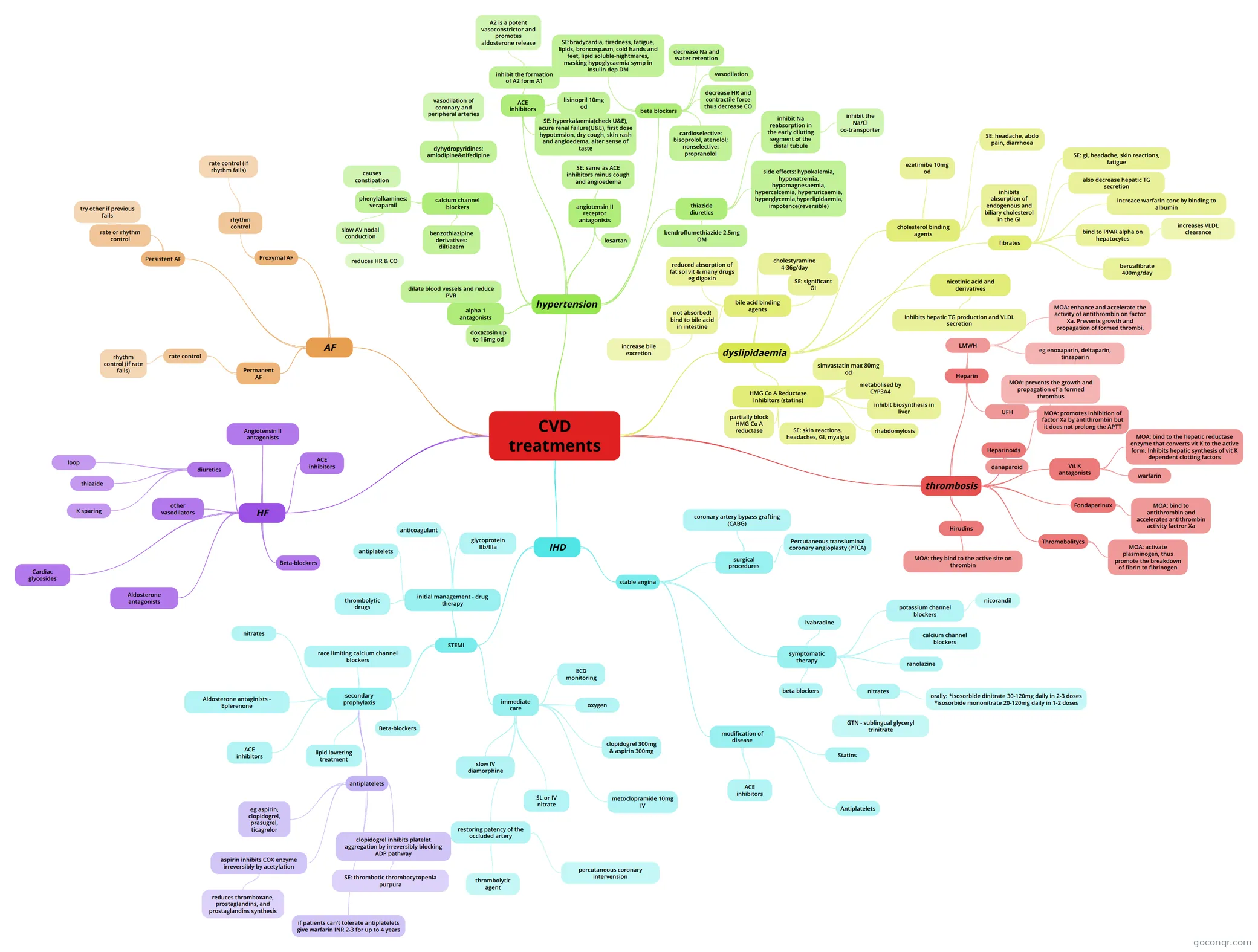
Mind map: CVD treatments
Conteúdo do mapa
CVD treatments
hypertension
- thiazide diuretics
- bendroflumethiazide 2.5mg OM
- inhibit Na reabsorption in the early diluting segment of the distal tubule
- inhibit the Na/Cl co-transporter
- side effects: hypokalemia, hyponatremia, hypomagnesaemia, hypercalcemia, hyperuricaemia, hyperglycemia,hyperlipidaemia, impotence(reversible)
- beta blockers
- cardioselective: bisoprolol, atenolol; nonselective: propranolol
- decrease HR and contractile force thus decrease CO
- vasodilation
- decrease Na and water retention
- SE:bradycardia, tiredness, fatigue, lipids, broncospasm, cold hands and feet, lipid soluble-nightmares, masking hypoglycaemia symp in insulin dep DM
- ACE inhibitors
- lisinopril 10mg od
- inhibit the formation of A2 form A1
- A2 is a potent vasoconstrictor and promotes aldosterone release
- SE: hyperkalaemia(check U&E), acure renal failure(U&E), first dose hypotension, dry cough, skin rash and angioedema, alter sense of taste
- angiotensin II receptor antagonists
- losartan
- SE: same as ACE inhibitors minus cough and angioedema
- calcium channel blockers
- dyhydropyridines: amlodipine&nifedipine
- vasodilation of coronary and peripheral arteries
- phenylalkamines: verapamil
- slow AV nodal conduction
- reduces HR & CO
- causes constipation
- slow AV nodal conduction
- benzothiazipine derivatives: diltiazem
- dyhydropyridines: amlodipine&nifedipine
- alpha 1 antagonists
- doxazosin up to 16mg od
- dilate blood vessels and reduce PVR
- thiazide diuretics
dyslipidaemia
- HMG Co A Reductase Inhibitors (statins)
- simvastatin max 80mg od
- partially block HMG Co A reductase
- inhibit biosynthesis in liver
- metabolised by CYP3A4
- rhabdomylosis
- SE: skin reactions, headaches, GI, myalgia
- fibrates
- CI in gallbladder disease
- benzafibrate 400mg/day
- bind to PPAR alpha on hepatocytes
- increases VLDL clearance
- also decrease hepatic TG secretion
- SE: gi, headache, skin reactions, fatigue
- increace warfarin conc by binding to albumin
- bile acid binding agents
- ionic exchange resins insoluble in water mix with water and take with meal take other meds 1hr before or 4-6hrs after the resin
- cholestyramine 4-36g/day
- not absorbed! bind to bile acid in intestine
- increase bile excretion
- reduced absorption of fat sol vit & many drugs eg digoxin
- SE: significant GI
- cholesterol binding agents
- ezetimibe 10mg od
- inhibits absorption of endogenous and biliary cholesterol in the GI
- this is done using transporter protein NPC1L1
- SE: headache, abdo pain, diarrhoea
- nicotinic acid and derivatives
- poor side effects profile
- inhibits hepatic TG production and VLDL secretion
- HMG Co A Reductase Inhibitors (statins)
IHD
- stable angina
- -symptoms usually precipitate by exercise, cold environment and relieved by rest -burning sensation over the sternum, often radiates to the left jaw, shoulder and arm -chest tightness & shortness of breath -30s to 30min
- modification of disease
- Antiplatelets
- ACE inhibitors
- Statins
- symptomatic therapy
- nitrates
- -dilate veins more then arteries -they reduce cardiac workload (angina) -low oral bioavailability need nitrate free period - 8-12 hours
- orally: *isosorbide dinitrate 30-120mg daily in 2-3 doses *isosorbide mononitrate 20-120mg daily in 1-2 doses
- GTN - sublingual glyceryl trinitrate
- every 5 mins, up to 3 doses in total, if chest pain persists
- beta blockers
- reduce myocardial O2 demand and prevent symptoms
- calcium channel blockers
- dyhydropyridines - vasodilation & improve coronary blood flow - prevent symptoms verapamil & diltiazem - decrease AV node conduction - reduce cardiac workload
- potassium channel blockers
- nicorandil
- -ATP dependent K channel activation & nitrate like activity -arterial and venous vasodilation may be used as monotherapy or with beta blockers or calcium channel blockers
- nicorandil
- ivabradine
- HR lowering drug use if beta blockers CI
- ranolazine
- adjunctive therapy in patients who are inadequately controlled or intolerant of beta-blockers or calcium channel blockers -reduces calcium overload in ischaemic myocytes through inhibition of the late sodium current
- nitrates
- surgical procedures
- Percutaneous transluminal coronary angioplasty (PTCA)
- coronary artery bypass grafting (CABG)
- STEMI
- -burning or chest discomfort even at rest, severe new onset angina or increasing angina that lasts >20 min -pain may radiate to jaw, shoulder and down left arm -may also present with nausea, vomiting, shortness of breath
- immediate care
- to remove pain, prevent deterioration, prevent complications and improve cardiac function
- ECG monitoring
- oxygen
- slow IV diamorphine
- reduce pain and anxiety
- metoclopramide 10mg IV
- antiemetic
- SL or IV nitrate
- for ischaemic pain
- clopidogrel 300mg & aspirin 300mg
- antiplatelet to limit further extension of thrombus
- restoring patency of the occluded artery
- percutaneous coronary intervension
- thrombolytic agent
- lyse thrombus and restore blood flow + anticoagulant
- secondary prophylaxis
- prevent further infraction/death; modification of risk factors
- antiplatelets
- eg aspirin, clopidogrel, prasugrel, ticagrelor
- aspirin inhibits COX enzyme irreversibly by acetylation
- reduces thromboxane, prostaglandins, and prostaglandins synthesis
- clopidogrel inhibits platelet aggregation by irreversibly blocking ADP pathway
- SE: thrombotic thrombocytopenia purpura
- if patients can't tolerate antiplatelets give warfarin INR 2-3 for up to 4 years
- Beta-blockers
- race limiting calcium channel blockers
- ACE inhibitors
- Aldosterone antaginists - Eplerenone
- nitrates
- lipid lowering treatment
- initial management - drug therapy
- glycoprotein IIb/IIIa
- antiplatelets
- anticoagulant
- thrombolytic drugs
- to break up thrombus and restore blood flow
- stable angina
HF
- diuretics
- loop
- thiazide
- K sparing
- ACE inhibitors
- Angiotensin II antagonists
- Aldosterone antagonists
- Beta-blockers
- Cardiac glycosides
- other vasodilators
- diuretics
thrombosis
- Heparin
- ADR: haemorrage - most common Major bleeding is less common in LMWH thank UFH
- UFH
- mixtures of sulfated mucopolysaccharides of variable lengths
- MOA: prevents the growth and propagation of a formed thrombus
- -binds to antithrombin: causes conformational change. activation of heparin-antithrombin complex accelerates certain activated clotting factors (9a.10a,11a,12a,thromnin(2a)) -also binds directly to thrombin
- LMWH
- more expensive then UFH show similar efficacy
- MOA: enhance and accelerate the activity of antithrombin on factor Xa. Prevents growth and propagation of formed thrombi.
- eg enoxaparin, deltaparin, tinzaparin
- Heparinoids
- a mixture of low molecular weight sulfated glycosaminoglycans
- MOA: promotes inhibition of factor Xa by antithrombin but it does not prolong the APTT
- danaparoid
- Hirudins
- eg lepirudin
- MOA: they bind to the active site on thrombin
- Fondaparinux
- MOA: bind to antithrombin and accelerates antithrombin activity factror Xa
- Vit K antagonists
- warfarin
- MOA: bind to the hepatic reductase enzyme that converts vit K to the active form. Inhibits hepatic synthesis of vit K dependent clotting factors
- Thromobolitycs
- only indicated in life-thretening acute massive pulmonary embolus
- MOA: activate plasminogen, thus promote the breakdown of fibrin to fibrinogen
- Heparin
AF
- Proxymal AF
- Recurrent, self terminating episodes of AF. Episode <7 days (most resolve within 24h)
- rhythm control
- rate control (if rhythm fails)
- Persistent AF
- Sustained AF that terminates with cardioversion
- rate or rhythm control
- try other if previous fails
- Permanent AF
- AF that is long standing, cardioversion failed of not attempted
- rate control
- rhythm control (if rate fails)
- Proxymal AF
Informações
- Descrição
- pham1008 Mapa Mental sobre CVD treatments, criado por Karo em 29-04-2013.
- Criado por
- Karo
- Visualizações
- 91
- Tags
- Avaliação