
Mapa mental
atmospheric circulation
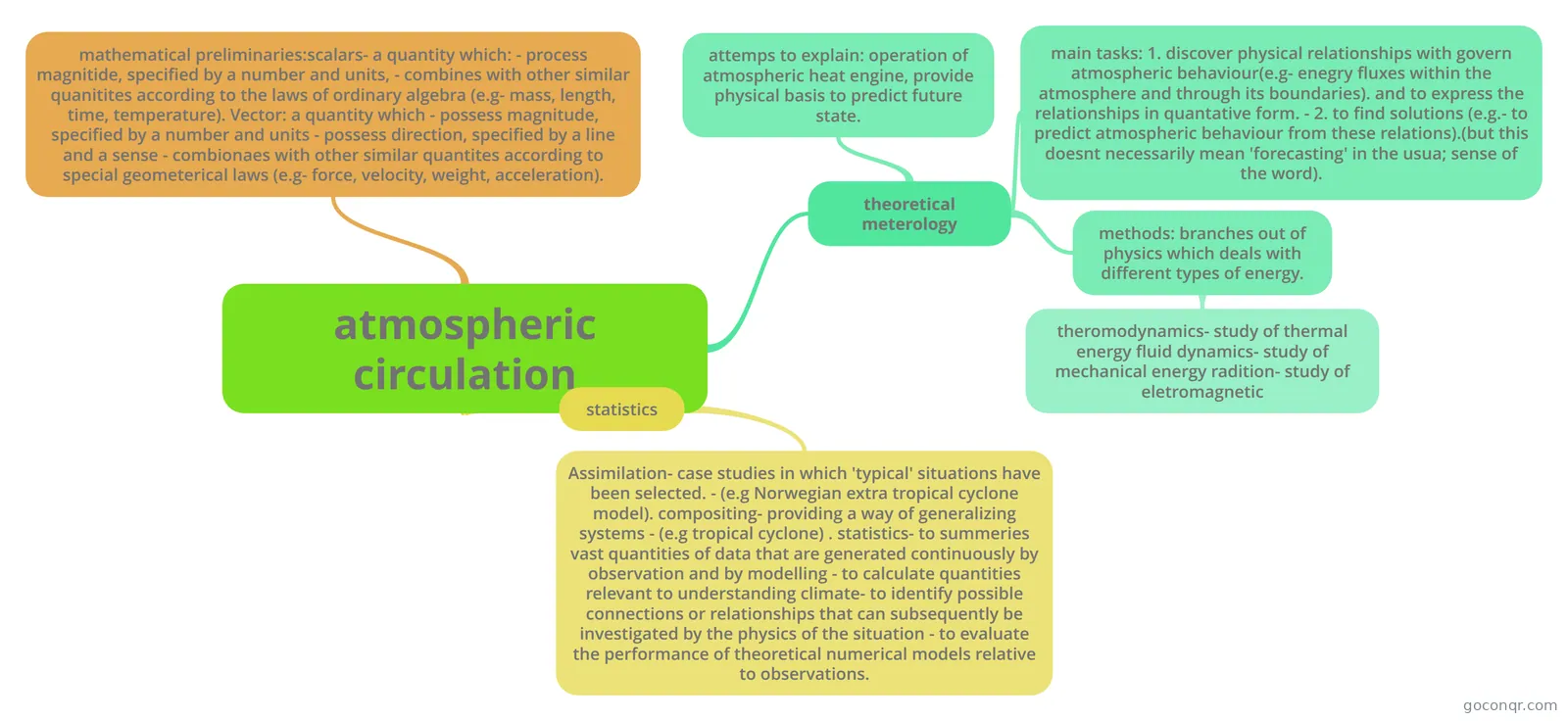
Mind map: atmospheric circulation
Conteúdo do mapa
atmospheric circulation
theoretical meterology
- attemps to explain: operation of atmospheric heat engine, provide physical basis to predict future state.
- main tasks: 1. discover physical relationships with govern atmospheric behaviour(e.g- enegry fluxes within the atmosphere and through its boundaries). and to express the relationships in quantative form. - 2. to find solutions (e.g.- to predict atmospheric behaviour from these relations).(but this doesnt necessarily mean 'forecasting' in the usua; sense of the word).
- methods: branches out of physics which deals with different types of energy.
- theromodynamics- study of thermal energy fluid dynamics- study of mechanical energy radition- study of eletromagnetic
statistics
- Assimilation- case studies in which 'typical' situations have been selected. - (e.g Norwegian extra tropical cyclone model). compositing- providing a way of generalizing systems - (e.g tropical cyclone) . statistics- to summeries vast quantities of data that are generated continuously by observation and by modelling - to calculate quantities relevant to understanding climate- to identify possible connections or relationships that can subsequently be investigated by the physics of the situation - to evaluate the performance of theoretical numerical models relative to observations.
mathematical preliminaries:scalars- a quantity which: - process magnitide, specified by a number and units, - combines with other similar quanitites according to the laws of ordinary algebra (e.g- mass, length, time, temperature). Vector: a quantity which - possess magnitude, specified by a number and units - possess direction, specified by a line and a sense - combionaes with other similar quantites according to special geometerical laws (e.g- force, velocity, weight, acceleration).