
Mapa mental
Claudius
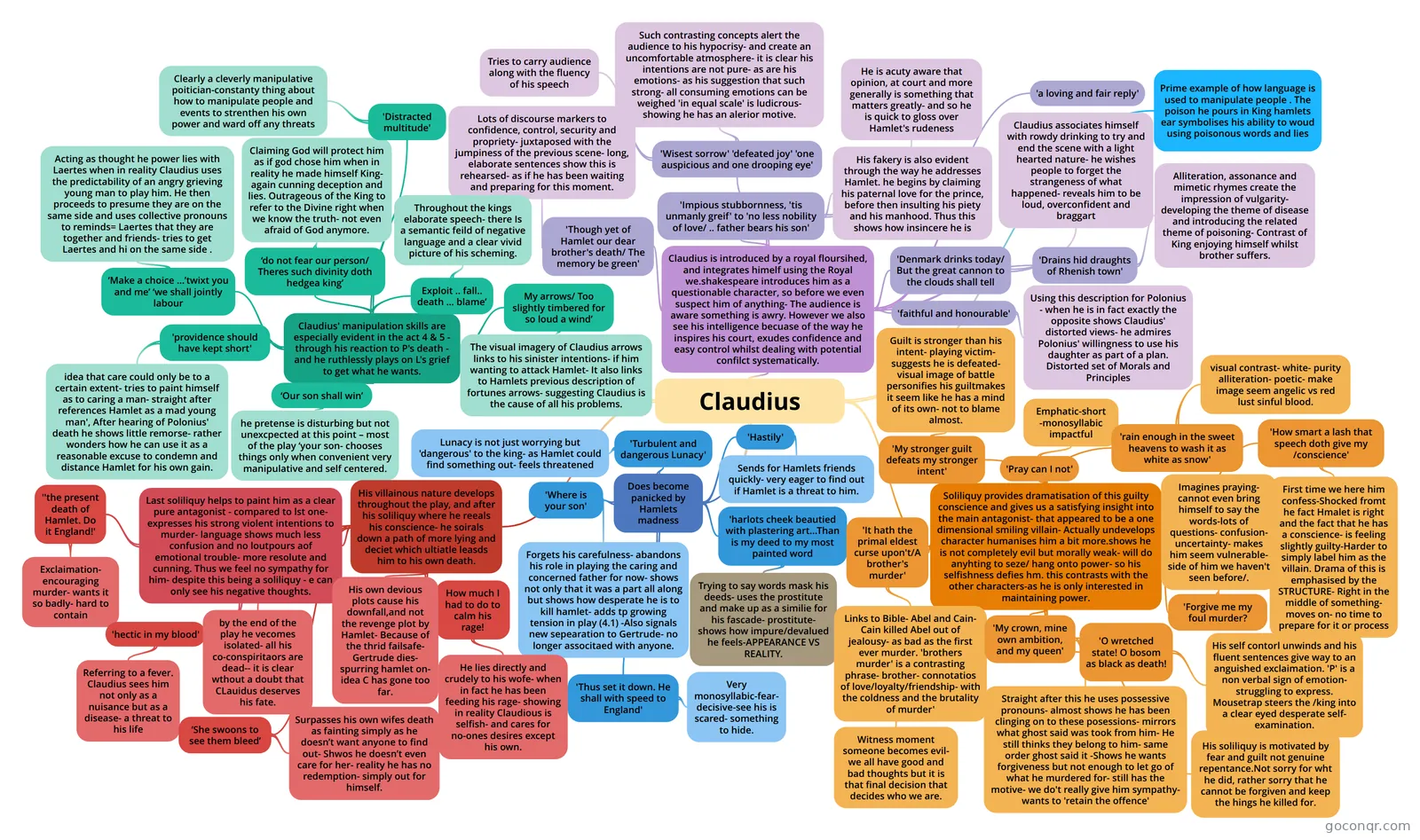
Mind map: Claudius in Hamlet
Conteúdo do mapa
Claudius
Claudius is introduced by a royal floursihed, and integrates himelf using the Royal we.shakespeare introduces him as a questionable character, so before we even suspect him of anything- The audience is aware something is awry. However we also see his intelligence becuase of the way he inspires his court, exudes confidence and easy control whilst dealing with potential confilct systematically.
- 'Though yet of Hamlet our dear brother's death/ The memory be green'
- Lots of discourse markers to confidence, control, security and propriety- juxtaposed with the jumpiness of the previous scene- long, elaborate sentences show this is rehearsed- as if he has been waiting and preparing for this moment.
- 'Wisest sorrow' 'defeated joy' 'one auspicious and one drooping eye'
- Such contrasting concepts alert the audience to his hypocrisy- and create an uncomfortable atmosphere- it is clear his intentions are not pure- as are his emotions- as his suggestion that such strong- all consuming emotions can be weighed 'in equal scale' is ludicrous- showing he has an alerior motive.
- Tries to carry audience along with the fluency of his speech
- 'Impious stubbornness, 'tis unmanly greif' to 'no less nobility of love/ .. father bears his son'
- His fakery is also evident through the way he addresses Hamlet. he begins by claiming his paternal love for the prince, before then insulting his piety and his manhood. Thus this shows how insincere he is
- He is acuty aware that opinion, at court and more generally is something that matters greatly- and so he is quick to gloss over Hamlet's rudeness
- 'Denmark drinks today/ But the great cannon to the clouds shall tell
- Claudius associates himself with rowdy drinking to try and end the scene with a light hearted nature- he wishes people to forget the strangeness of what happened- reveals him to be loud, overconfident and braggart
- 'Drains hid draughts of Rhenish town'
- Alliteration, assonance and mimetic rhymes create the impression of vulgarity- developing the theme of disease and introducing the related theme of poisoning- Contrast of King enjoying himself whilst brother suffers.
- 'faithful and honourable'
- Using this description for Polonius - when he is in fact exactly the opposite shows Claudius' distorted views- he admires Polonius' willingness to use his daughter as part of a plan. Distorted set of Morals and Principles
- 'a loving and fair reply'
- 'Though yet of Hamlet our dear brother's death/ The memory be green'
Does become panicked by Hamlets madness
- 'Hastily'
- Sends for Hamlets friends quickly- very eager to find out if Hamlet is a threat to him.
- 'Turbulent and dangerous Lunacy'
- Lunacy is not just worrying but 'dangerous' to the king- as Hamlet could find something out- feels threatened
- 'harlots cheek beautied with plastering art...Than is my deed to my most painted word
- Trying to say words mask his deeds- uses the prostitute and make up as a similie for his fascade- prostitute- shows how impure/devalued he feels-APPEARANCE VS REALITY.
- 'Thus set it down. He shall with speed to England'
- Very monosyllabic-fear- decisive-see his is scared- something to hide.
- 'Where is your son'
- Forgets his carefulness- abandons his role in playing the caring and concerned father for now- shows not only that it was a part all along but shows how desperate he is to kill hamlet- adds tp growing tension in play (4.1) -Also signals new sepearation to Gertrude- no longer associtaed with anyone.
- 'Hastily'
Soliliquy provides dramatisation of this guilty conscience and gives us a satisfying insight into the main antagonist- that appeared to be a one dimensional smiling villain- Actually undevelops character humanises him a bit more.shows he is not completely evil but morally weak- will do anyhting to seze/ hang onto power- so his selfishness defies hm. this contrasts with the other characters-as he is only interested in maintaining power.
- 'How smart a lash that speech doth give my /conscience'
- First time we here him confess-Shocked fromt he fact Hmalet is right and the fact that he has a conscience- is feeling slightly guilty-Harder to simply label him as the villain. Drama of this is emphasised by the STRUCTURE- Right in the middle of something- moves on- no time to prepare for it or process
- 'It hath the primal eldest curse upon't/A brother's murder'
- Links to Bible- Abel and Cain- Cain killed Abel out of jealousy- as bad as the first ever murder. 'brothers murder' is a contrasting phrase- brother- connotatios of love/loyalty/friendship- with the coldness and the brutality of murder'
- 'Pray can I not'
- Emphatic-short -monosyllabic impactful
- 'My stronger guilt defeats my stronger intent'
- Guilt is stronger than his intent- playing victim- suggests he is defeated- visual image of battle personifies his guiltmakes it seem like he has a mind of its own- not to blame almost.
- 'rain enough in the sweet heavens to wash it as white as snow'
- visual contrast- white- purity alliteration- poetic- make image seem angelic vs red lust sinful blood.
- 'Forgive me my foul murder?
- Imagines praying- cannot even bring himself to say the words-lots of questions- confusion- uncertainty- makes him seem vulnerable- side of him we haven't seen before/.
- 'My crown, mine own ambition, and my queen'
- Straight after this he uses possessive pronouns- almost shows he has been clinging on to these posessions- mirrors what ghost said was took from him- He still thinks they belong to him- same order ghost said it -Shows he wants forgiveness but not enough to let go of what he murdered for- still has the motive- we do't really give him sympathy- wants to 'retain the offence'
- Witness moment someone becomes evil- we all have good and bad thoughts but it is that final decision that decides who we are.
- His soliliquy is motivated by fear and guilt not genuine repentance.Not sorry for wht he did, rather sorry that he cannot be forgiven and keep the hings he killed for.
- 'O wretched state! O bosom as black as death!
- His self contorl unwinds and his fluent sentences give way to an anguished exclaimation. 'P' is a non verbal sign of emotion- struggling to express. Mousetrap steers the /king into a clear eyed desperate self- examination.
- 'How smart a lash that speech doth give my /conscience'
Claudius' manipulation skills are especially evident in the act 4 & 5 - through his reaction to P's death - and he ruthlessly plays on L's grief to get what he wants.
- 'providence should have kept short'
- idea that care could only be to a certain extent- tries to paint himself as to caring a man- straight after references Hamlet as a mad young man', After hearing of Polonius' death he shows little remorse- rather wonders how he can use it as a reasonable excuse to condemn and distance Hamlet for his own gain.
- ‘do not fear our person/ Theres such divinity doth hedgea king’
- Claiming God will protect him as if god chose him when in reality he made himself King- again cunning deception and lies. Outrageous of the King to refer to the Divine right when we know the truth- not even afraid of God anymore.
- ‘Make a choice ...’twixt you and me’ ‘we shall jointly labour
- Acting as thought he power lies with Laertes when in reality Claudius uses the predictability of an angry grieving young man to play him. He then proceeds to presume they are on the same side and uses collective pronouns to reminds= Laertes that they are together and friends- tries to get Laertes and hi on the same side .
- My arrows/ Too slightly timbered for so loud a wind’
- The visual imagery of Claudius arrows links to his sinister intentions- if him wanting to attack Hamlet- It also links to Hamlets previous description of fortunes arrows- suggesting Claudius is the cause of all his problems.
- Exploit .. fall.. death ... blame’
- Throughout the kings elaborate speech- there Is a semantic feild of negative language and a clear vivid picture of his scheming.
- ‘Our son shall win’
- he pretense is disturbing but not unexcpected at this point – most of the play ‘your son- chooses things only when convenient very manipulative and self centered.
- 'Distracted multitude'
- Clearly a cleverly manipulative poitician-constanty thing about how to manipulate people and events to strenthen his own power and ward off any threats
- 'providence should have kept short'
His villainous nature develops throughout the play, and after his soliliquy where he reeals his conscience- he soirals down a path of more lying and deciet which ultiatle leasds him to his own death.
- Last soliliquy helps to paint him as a clear pure antagonist - compared to lst one- expresses his strong violent intentions to murder- language shows much less confusion and no loutpours aof emotional trouble- more resolute and cunning. Thus we feel no sympathy for him- despite this being a soliliquy - e can only see his negative thoughts.
- ''the present death of Hamlet. Do it England!'
- Exclaimation- encouraging murder- wants it so badly- hard to contain
- 'hectic in my blood'
- Referring to a fever. Claudius sees him not only as a nuisance but as a disease- a threat to his life
- ''the present death of Hamlet. Do it England!'
- How much I had to do to calm his rage!
- He lies directly and crudely to his wofe- when in fact he has been feeding his rage- showing in reality Claudious is selfish- and cares for no-ones desires except his own.
- ‘She swoons to see them bleed’
- Surpasses his own wifes death as fainting simply as he doesn’t want anyone to find out- Shwos he doesn’t even care for her- reality he has no redemption- simply out for himself.
- by the end of the play he vecomes isolated- all his co-conspiritaors are dead-- it is clear wthout a doubt that CLauidus deserves his fate.
- His own devious plots cause his downfall,and not the revenge plot by Hamlet- Because of the thrid failsafe- Gertrude dies- spurring hamlet on- idea C has gone too far.
- Last soliliquy helps to paint him as a clear pure antagonist - compared to lst one- expresses his strong violent intentions to murder- language shows much less confusion and no loutpours aof emotional trouble- more resolute and cunning. Thus we feel no sympathy for him- despite this being a soliliquy - e can only see his negative thoughts.
Prime example of how language is used to manipulate people . The poison he pours in King hamlets ear symbolises his ability to woud using poisonous words and lies
Informações
- Descrição
- GCSE English Literature- Texts (Hamlet) Mapa Mental sobre Claudius, criado por Saheefa Ishaq em 01-01-2017.
- Criado por
- Saheefa Ishaq
- Visualizações
- 17
- Avaliação