
Mapa mental
The Working Memory Model
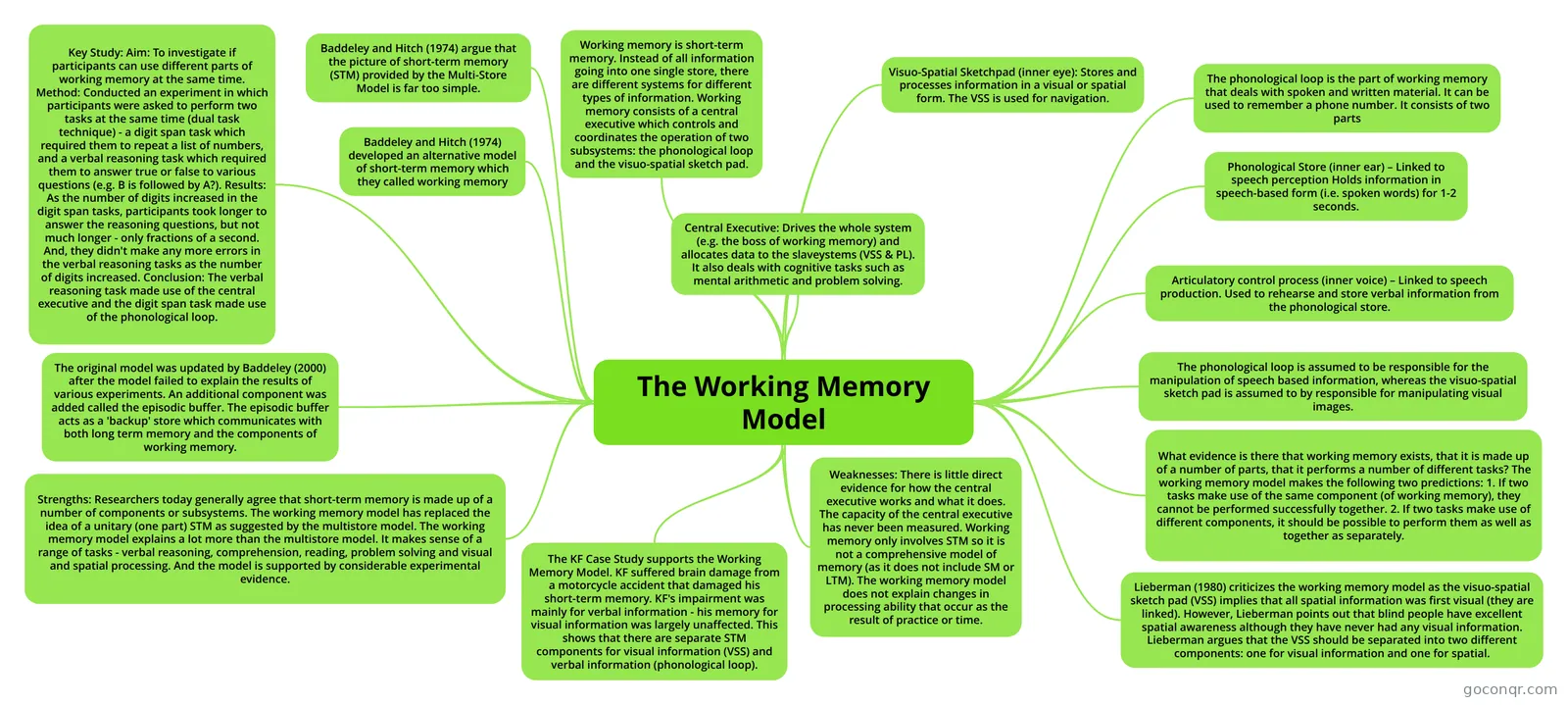
Mind map: The Working Memory Model psychology
Conteúdo do mapa
The Working Memory Model
Baddeley and Hitch (1974) developed an alternative model of short-term memory which they called working memory
Baddeley and Hitch (1974) argue that the picture of short-term memory (STM) provided by the Multi-Store Model is far too simple.
Working memory is short-term memory. Instead of all information going into one single store, there are different systems for different types of information. Working memory consists of a central executive which controls and coordinates the operation of two subsystems: the phonological loop and the visuo-spatial sketch pad.
Central Executive: Drives the whole system (e.g. the boss of working memory) and allocates data to the slaveystems (VSS & PL). It also deals with cognitive tasks such as mental arithmetic and problem solving.
Visuo-Spatial Sketchpad (inner eye): Stores and processes information in a visual or spatial form. The VSS is used for navigation.
The phonological loop is the part of working memory that deals with spoken and written material. It can be used to remember a phone number. It consists of two parts
Phonological Store (inner ear) – Linked to speech perception Holds information in speech-based form (i.e. spoken words) for 1-2 seconds.
Articulatory control process (inner voice) – Linked to speech production. Used to rehearse and store verbal information from the phonological store.
The phonological loop is assumed to be responsible for the manipulation of speech based information, whereas the visuo-spatial sketch pad is assumed to by responsible for manipulating visual images.
What evidence is there that working memory exists, that it is made up of a number of parts, that it performs a number of different tasks? The working memory model makes the following two predictions: 1. If two tasks make use of the same component (of working memory), they cannot be performed successfully together. 2. If two tasks make use of different components, it should be possible to perform them as well as together as separately.
Key Study: Aim: To investigate if participants can use different parts of working memory at the same time. Method: Conducted an experiment in which participants were asked to perform two tasks at the same time (dual task technique) - a digit span task which required them to repeat a list of numbers, and a verbal reasoning task which required them to answer true or false to various questions (e.g. B is followed by A?). Results: As the number of digits increased in the digit span tasks, participants took longer to answer the reasoning questions, but not much longer - only fractions of a second. And, they didn't make any more errors in the verbal reasoning tasks as the number of digits increased. Conclusion: The verbal reasoning task made use of the central executive and the digit span task made use of the phonological loop.
The original model was updated by Baddeley (2000) after the model failed to explain the results of various experiments. An additional component was added called the episodic buffer. The episodic buffer acts as a 'backup' store which communicates with both long term memory and the components of working memory.
Strengths: Researchers today generally agree that short-term memory is made up of a number of components or subsystems. The working memory model has replaced the idea of a unitary (one part) STM as suggested by the multistore model. The working memory model explains a lot more than the multistore model. It makes sense of a range of tasks - verbal reasoning, comprehension, reading, problem solving and visual and spatial processing. And the model is supported by considerable experimental evidence.
The KF Case Study supports the Working Memory Model. KF suffered brain damage from a motorcycle accident that damaged his short-term memory. KF's impairment was mainly for verbal information - his memory for visual information was largely unaffected. This shows that there are separate STM components for visual information (VSS) and verbal information (phonological loop).
Lieberman (1980) criticizes the working memory model as the visuo-spatial sketch pad (VSS) implies that all spatial information was first visual (they are linked). However, Lieberman points out that blind people have excellent spatial awareness although they have never had any visual information. Lieberman argues that the VSS should be separated into two different components: one for visual information and one for spatial.
Weaknesses: There is little direct evidence for how the central executive works and what it does. The capacity of the central executive has never been measured. Working memory only involves STM so it is not a comprehensive model of memory (as it does not include SM or LTM). The working memory model does not explain changes in processing ability that occur as the result of practice or time.
Informações
- Descrição
- Mapa Mental sobre The Working Memory Model, criado por joti Zandu em 10-04-2014.
- Criado por
- joti Zandu
- Visualizações
- 27
- Avaliação