
Mapa mental
As Chemistry Module 3
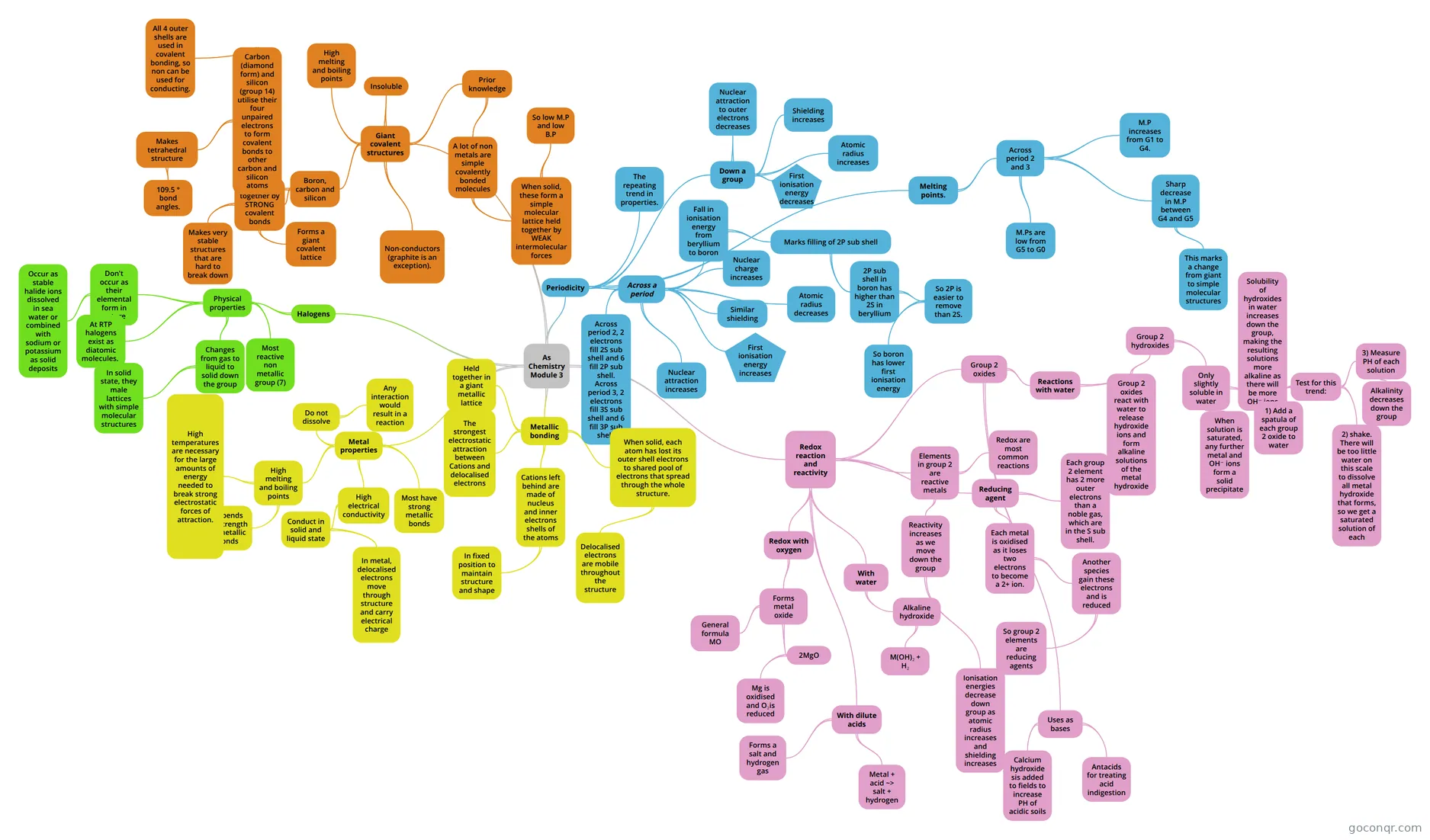
Mind map: AS Chemistry Module 3
Conteúdo do mapa
As Chemistry Module 3
Periodicity
- Across a period
- Across period 2, 2 electrons fill 2S sub shell and 6 fill 2P sub shell. Across period 3, 2 electrons fill 3S sub shell and 6 fill 3P sub shell.
- Nuclear charge increases
- Similar shielding
- Nuclear attraction increases
- Atomic radius decreases
- First ionisation energy increases
- Fall in ionisation energy from beryllium to boron
- Marks filling of 2P sub shell
- 2P sub shell in boron has higher than 2S in beryllium
- So 2P is easier to remove than 2S.
- So boron has lower first ionisation energy
- So 2P is easier to remove than 2S.
- 2P sub shell in boron has higher than 2S in beryllium
- Marks filling of 2P sub shell
- The repeating trend in properties.
- Down a group
- Atomic radius increases
- Shielding increases
- Nuclear attraction to outer electrons decreases
- First ionisation energy decreases
- Melting points.
- Across period 2 and 3
- M.P increases from G1 to G4.
- Sharp decrease in M.P between G4 and G5
- This marks a change from giant to simple molecular structures
- M.Ps are low from G5 to G0
- Across period 2 and 3
- Across a period
Metallic bonding
- When solid, each atom has lost its outer shell electrons to shared pool of electrons that spread through the whole structure.
- Delocalised electrons are mobile throughout the structure
- Cations left behind are made of nucleus and inner electrons shells of the atoms
- In fixed position to maintain structure and shape
- The strongest electrostatic attraction between Cations and delocalised electrons
- Held together in a giant metallic lattice
- When solid, each atom has lost its outer shell electrons to shared pool of electrons that spread through the whole structure.
Metal properties
- Most have strong metallic bonds
- High electrical conductivity
- Conduct in solid and liquid state
- In metal, delocalised electrons move through structure and carry electrical charge
- Conduct in solid and liquid state
- High melting and boiling points
- Depends on strength of metallic bonds
- High temperatures are necessary for the large amounts of energy needed to break strong electrostatic forces of attraction.
- Do not dissolve
- Any interaction would result in a reaction
Giant covalent structures
- Prior knowledge
- A lot of non metals are simple covalently bonded molecules
- When solid, these form a simple molecular lattice held together by WEAK intermolecular forces
- So low M.P and low B.P
- When solid, these form a simple molecular lattice held together by WEAK intermolecular forces
- A lot of non metals are simple covalently bonded molecules
- Boron, carbon and silicon
- Atoms held together by STRONG covalent bonds
- Forms a giant covalent lattice
- Makes very stable structures that are hard to break down
- Carbon (diamond form) and silicon (group 14) utilise their four unpaired electrons to form covalent bonds to other carbon and silicon atoms
- Makes tetrahedral structure
- 109.5 ° bond angles.
- All 4 outer shells are used in covalent bonding, so non can be used for conducting.
- Makes tetrahedral structure
- Atoms held together by STRONG covalent bonds
- High melting and boiling points
- Insoluble
- Non-conductors (graphite is an exception).
- Prior knowledge
Redox reaction and reactivity
- Elements in group 2 are reactive metals
- Redox are most common reactions
- Reactivity increases as we move down the group
- Ionisation energies decrease down group as atomic radius increases and shielding increases
- Reducing agent
- Each group 2 element has 2 more outer electrons than a noble gas, which are in the S sub shell.
- Each metal is oxidised as it loses two electrons to become a 2+ ion.
- Another species gain these electrons and is reduced
- So group 2 elements are reducing agents
- Another species gain these electrons and is reduced
- Redox with oxygen
- Forms metal oxide
- General formula MO
- 2MgO
- Mg is oxidised and O₂is reduced
- Forms metal oxide
- With water
- Alkaline hydroxide
- M(OH)₂ + H₂
- Alkaline hydroxide
- With dilute acids
- Forms a salt and hydrogen gas
- Metal + acid ~> salt + hydrogen
- Group 2 oxides
- Reactions with water
- Group 2 oxides react with water to release hydroxide ions and form alkaline solutions of the metal hydroxide
- Group 2 hydroxides
- Only slightly soluble in water
- When solution is saturated, any further metal and OH⁻ ions form a solid precipitate
- Solubility of hydroxides in water increases down the group, making the resulting solutions more alkaline as there will be more OH⁻ ions
- Test for this trend:
- 1) Add a spatula of each group 2 oxide to water
- 2) shake. There will be too little water on this scale to dissolve all metal hydroxide that forms, so we get a saturated solution of each
- 3) Measure PH of each solution
- Alkalinity decreases down the group
- Test for this trend:
- Only slightly soluble in water
- Group 2 hydroxides
- Group 2 oxides react with water to release hydroxide ions and form alkaline solutions of the metal hydroxide
- Uses as bases
- Calcium hydroxide sis added to fields to increase PH of acidic soils
- Antacids for treating acid indigestion
- Reactions with water
- Elements in group 2 are reactive metals
Halogens
- Physical properties
- Most reactive non metallic group (7)
- Don't occur as their elemental form in nature
- Occur as stable halide ions dissolved in sea water or combined with sodium or potassium as solid deposits
- At RTP halogens exist as diatomic molecules.
- Changes from gas to liquid to solid down the group
- In solid state, they male lattices with simple molecular structures
- Physical properties