
Mapa mental
Responses to Verificationism
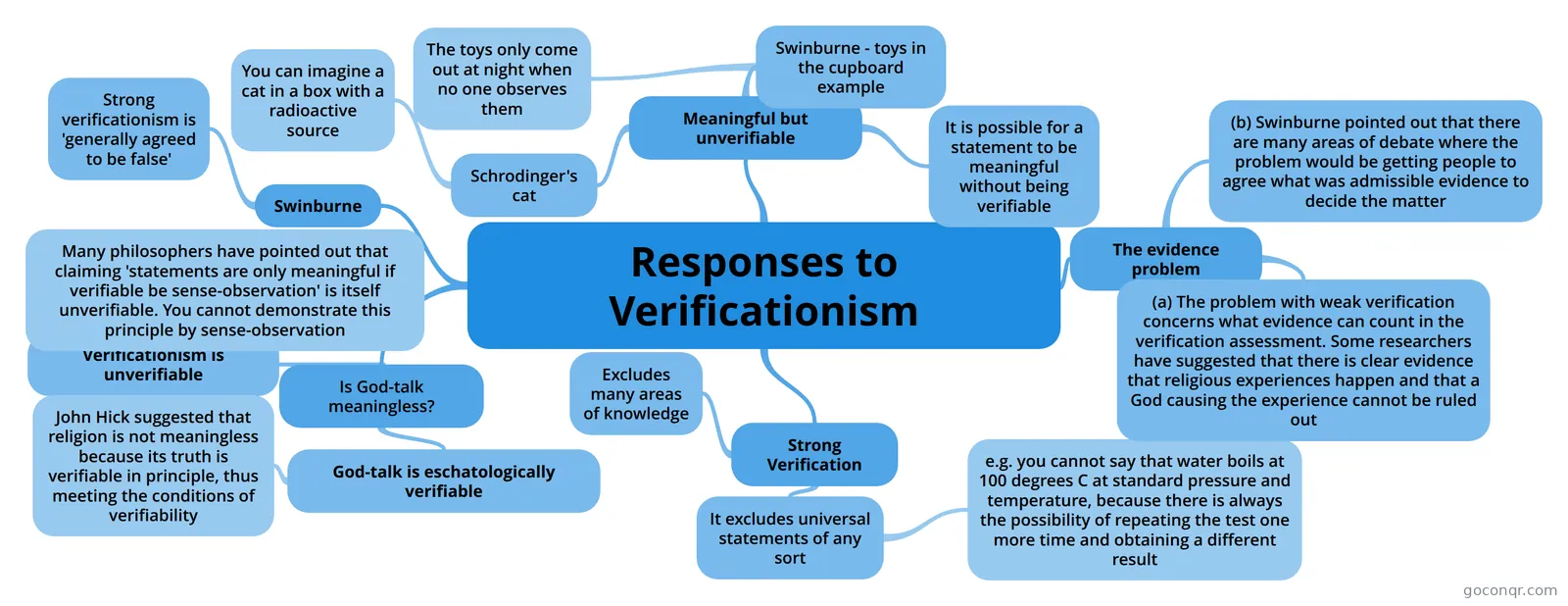
Mind map: Responses to Verificationism
Conteúdo do mapa
Responses to Verificationism
Swinburne
- Strong verificationism is 'generally agreed to be false'
Is God-talk meaningless?
- Verificationism is unverifiable
- Many philosophers have pointed out that claiming 'statements are only meaningful if verifiable be sense-observation' is itself unverifiable. You cannot demonstrate this principle by sense-observation
- God-talk is eschatologically verifiable
- John Hick suggested that religion is not meaningless because its truth is verifiable in principle, thus meeting the conditions of verifiability
- Verificationism is unverifiable
Strong Verification
- Excludes many areas of knowledge
- It excludes universal statements of any sort
- e.g. you cannot say that water boils at 100 degrees C at standard pressure and temperature, because there is always the possibility of repeating the test one more time and obtaining a different result
The evidence problem
- (a) The problem with weak verification concerns what evidence can count in the verification assessment. Some researchers have suggested that there is clear evidence that religious experiences happen and that a God causing the experience cannot be ruled out
- (b) Swinburne pointed out that there are many areas of debate where the problem would be getting people to agree what was admissible evidence to decide the matter
Meaningful but unverifiable
- It is possible for a statement to be meaningful without being verifiable
- Swinburne - toys in the cupboard example
- The toys only come out at night when no one observes them
- Schrodinger's cat
- You can imagine a cat in a box with a radioactive source
Informações
- Descrição
- AS Philosophy (Religious Language) Mapa Mental sobre Responses to Verificationism, criado por Alex T em 20-04-2014.
- Criado por
- Alex T
- Visualizações
- 40
- Avaliação
Mais sobre Verification and Falsification