
Mapa mental
Chronic Kidney Disease
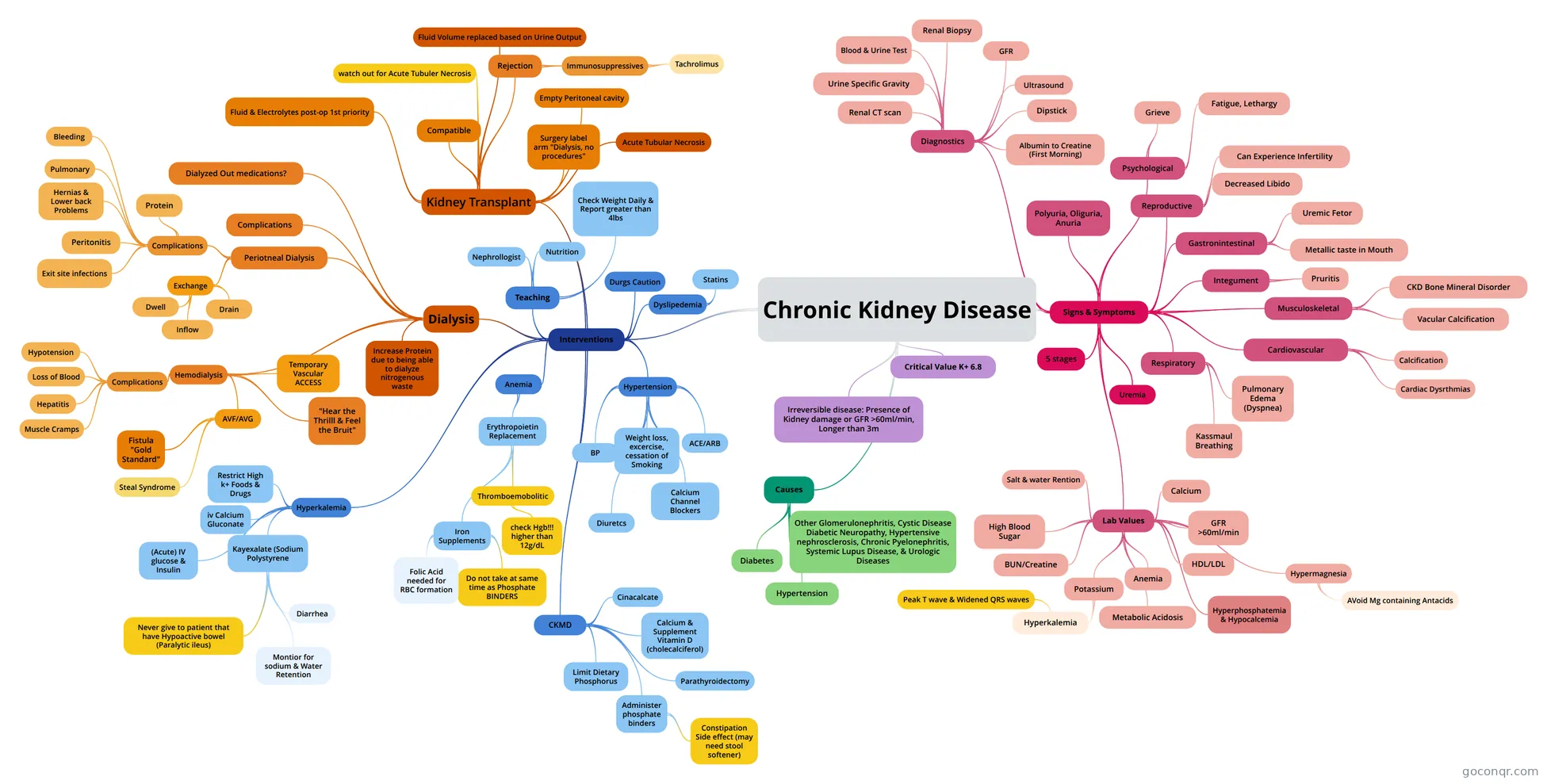
Mind map: Chronic kidney disease
Conteúdo do mapa
Chronic Kidney Disease
Causes
- 50% Diabetes 25% Hypertension Polycystic Kidney Disease, Systemic Lupus erythematosus
- Diabetes
- Hypertension
- Other Glomerulonephritis, Cystic Disease Diabetic Neuropathy, Hypertensive nephrosclerosis, Chronic Pyelonephritis, Systemic Lupus Disease, & Urologic Diseases
Signs & Symptoms
- Retain: Urea, Creatinine, Phenols, Hormones, Electrolytes & Water (Uremia)
- Uremia
- GI: No appeitite
- Diagnostics
- Hx & Physical Dipstick
- Urine Specific Gravity
- 1.01 Specific Gravity or Lower
- Renal Biopsy
- Renal CT scan
- Dipstick
- 1st Test measures the amount of protein or albuminuria in the urine. (1+ protein on standard dipstick 2 or more times over a 3 month period)
- GFR
- MDRD equation (Modification of diet renal disease) or Cockcroft Gualt Formula. Normal GFR is 125ml/min.
- Albumin to Creatine (First Morning)
- 300mg Albumin to 1g of Creatinine signals CKD. Needs to be 1st voided
- Blood & Urine Test
- Ultrasound
- This checks if there is an obstruction and the Size of the Kidneys.
- 5 stages
- Stage 1: >90 Stage 2: 60-90 Stage 3: 30-59 Stage 4: 15-29 Stage 5: <15
- Polyuria, Oliguria, Anuria
- Polyuria initially and as the disease progresses symptoms will appear as oliguria/anuria. Anuria usually when on dialysis 40ml per 24hrs.
- Integument
- Pruritis
- Lab Values
- Potassium
- Muscle Weakness, Parasthesias & ECG changes
- Hyperkalemia
- Peak T wave & Widened QRS waves
- BUN/Creatine
- Increased contributes to N&V, Lethargy, Fatigue, ImpairedThough Processes and headache.
- High Blood Sugar
- Hyperglycemia- The body cannot metabolize Carbohydrates.
- GFR >60ml/min
- The lower the % of the GFR value the more progressive the disease
- HDL/LDL
- Increased LDL & Decreased HDL. Elevated Triglycerides. Most CKD patient die from CV disease.
- Calcium
- Hypocalcemia- Bones fragile
- Metabolic Acidosis
- Impaired ability to excrete acid and defective reabsorption & Regeneration of Bicarbonate.
- Anemia
- This is due to decreased EPO Production
- Hyperphosphatemia & Hypocalcemia
- Hypermagnesia
- AVoid Mg containing Antacids
- Salt & water Rention
- Potassium
- Cardiovascular
- Calcification
- Cardiac Dysrthmias
- Gastronintestinal
- Uremic Fetor
- Metallic taste in Mouth
- Respiratory
- Kassmaul Breathing
- This type of breathing is attempt for the body to compensate for metabolic acidosis by breathing off CO2.
- Pulmonary Edema (Dyspnea)
- This is a result of fluid overload
- Kassmaul Breathing
- Musculoskeletal
- CKD Bone Mineral Disorder
- Disease process prevents body from converting the Vitamin D to the active form. Calcium is therefore not being Absorbed. When calcium is Low in the Blood stream the body Releases PTH! This causes bone demineralization
- Vacular Calcification
- CKD Bone Mineral Disorder
- Reproductive
- Can Experience Infertility
- Decreased Libido
- Psychological
- Grieve
- Fatigue, Lethargy
- Uremia
Interventions
- Teaching
- Teach the Patient to Check daily weights & Report Weight Gain greater than 4 pounds.
- Nephrollogist
- Nutrition
- water, Phosphate, Potassium & Sodium Restricitions
- Check Weight Daily & Report greater than 4lbs
- Dialysis
- Complications
- Hypotension & Muscle Cramps (when taken out to quickly), Loss of Blood, Pt. gets Cold, Infection.
- Dialyzed Out medications?
- Periotneal Dialysis
- Warm (Do NOT want to Cause Hypothermia) . 3-7day training
- Exchange
- Drain
- 15-30min. Massage abdomen or change Position. (Glucose used as osmotic force)
- Inflow
- Inflow of about 10min after done clamp is closed. The amount is 2L and if patient is in Pain it will be decreased.
- Dwell
- 20-30min to 8hrs. This is where osmosis &n DIffusion happen
- Drain
- Complications
- Peritonitis
- Treat with Antibiotics. Usually caused by the exchange making or breaking.
- Protein
- Loss through dialysis
- Exit site infections
- Hernias & Lower back Problems
- Increased Intraadbominal Pressure.
- Pulmonary
- Repeated upward displacement of the diaphragm, decreases lungs exapansion.
- Bleeding
- Peritonitis
- Hemodialysis
- "Hear the Thrilll & Feel the Bruit"
- AVF/AVG
- Least Complication of Thrombosis & Infections. Thrill can be palpated & Bruit can be heared. Maturation takes 6w to a month & should be placed 3m before intiating HD.
- Fistula "Gold Standard"
- Feel a thrill & Hear a Bruit. The Needles 15 or 14 gauge needles.
- Steal Syndrome
- Temporary Vascular ACCESS
- Internal Jugular or Femoral Vein. Soft flexible double lumen tube attach to a Y Hub. Recirculation rate takes about 5%
- Complications
- Loss of Blood
- Hepatitis
- Muscle Cramps
- Rapid removal of water & sodium may cause cramps. NS is the treatment of choice.
- Hypotension
- Increase Protein due to being able to dialyze nitrogenous waste
- Complications
- Kidney Transplant
- Compatible
- Rejection
- Hyperacute (Minutes) Acute (Days to Months) Chronic Rejection (Months-Years)
- Immunosuppressives
- Teach about signs & Symptoms of Infection. Worsen Hypertension & Hyperlispedemia!!!
- Tachrolimus
- Surgery label arm "Dialysis, no procedures"
- Empty Peritoneal cavity
- Fluid & Electrolytes post-op 1st priority
- will have high urine output up to 1L
- watch out for Acute Tubuler Necrosis
- Acute Tubular Necrosis
- Decrease in CVP suggest hypovolemia, which must be rapidly corrected to prevent renal hypoperfusion.
- Fluid Volume replaced based on Urine Output
- CKMD
- Biopsy is the GOLD STANDARD
- Limit Dietary Phosphorus
- NOT restricted usually until the patient requires RRT (limit 1g/day)
- Administer phosphate binders
- Calcium Acetate, Calcium Carbonate, They bind to the phosphate in the bowel and are excreted in the stool. *Administer Non-Calcium Binders Lanthanum Carbonate & Salvelamor Carbonate if Calcification is evident!!! (Most effective with Meals)
- Constipation Side effect (may need stool softener)
- Parathyroidectomy
- If there is excessive release of parathyroid surgery may be an option and a small portion can be implanted into the forearm.
- Calcium & Supplement Vitamin D (cholecalciferol)
- Oral or IV Calcitriol, IV paricalcitol, Oral or IV Doxercalciferol (Active form) Can reduce PTH. If Hypercalcemia occurs reduce Phosphate Binders and d/c Supplementation.
- Cinacalcate
- Mimic Calcium & increase sensitivity of calcium receptors in the parathyroid gland.
- Hyperkalemia
- Restrict High k+ Foods & Drugs
- (Acute) IV glucose & Insulin
- iv Calcium Gluconate
- Kayexalate (Sodium Polystyrene
- Commonly used with patient on stage 4 CDK
- Never give to patient that have Hypoactive bowel (Paralytic ileus)
- Could lead to Necrotic Bowels
- Montior for sodium & Water Retention
- Diarrhea
- Contains sorbitol a sugar alcohol that has an osmotic laxative action
- Anemia
- Erythropoietin Replacement
- Eopoietin Alfa (IV or SC) 2-3w Darbepoetin alfa (longerlasting weekly or biweekly) effects dont kick in until 2-3w
- Thromboemobolitic
- Teach about Risk & Benefits. Start LOW
- check Hgb!!! higher than 12g/dL
- Iron Supplements
- Do not take at same time as Phosphate BINDERS
- Adherence may not be good because of stomach upset & Constipation. Teach that darker stool is Normal. Calcium binds to Iron
- Folic Acid needed for RBC formation
- Removed by dialysis
- Do not take at same time as Phosphate BINDERS
- Erythropoietin Replacement
- Hypertension
- Weight loss, excercise, cessation of Smoking
- ACE/ARB
- Use with diabetics and with nondiabetics w/ proteinuria *Must used Cautiously because can further decrease GFR & Increase K+
- Diuretcs
- Calcium Channel Blockers
- BP
- Monitor Blood Pressure in supine, sitting & standing positions. Evaluate if the medications are working.
- Dyslipedemia
- Statins
- Simvastatin is associated with myopathy if this develops transer to myopathy.
- Statins
- Durgs Caution
- Digoxin, diabetic agents, antibiotics & opioids
- Teaching
Critical Value K+ 6.8
Irreversible disease: Presence of Kidney damage or GFR >60ml/min, Longer than 3m
Informações
- Descrição
- Health Care Concepts 2 (Fluid & Electrolytes) Mapa Mental sobre Chronic Kidney Disease, criado por Ilana Kovach em 23-02-2017.
- Criado por
- Ilana Kovach
- Visualizações
- 9
- Avaliação